
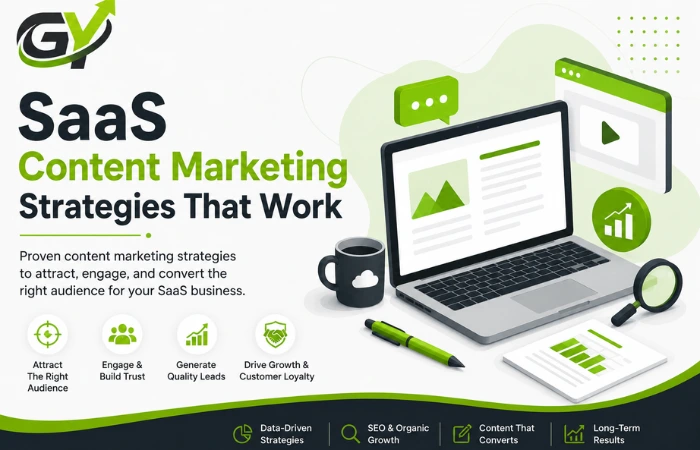
SaaS Content Marketing Strategies That Work
Introduction
The SaaS industry is highly competitive; therefore, providing them with valuable content and information is essential. An effective SaaS content strategy can attract companies, products, and services closer to the right audience, educate potential users, and foster trust. Content is a way for businesses to help customers resolve their issues and demonstrate their knowledge and skills, rather than relying exclusively on advertising. This SaaS content marketing guide teaches you how you can grow your Saas company sustainably through content marketing.
What is SaaS Content Marketing?
SaaS content marketing is the act of generating content and promoting it to capture, engage, and convert customers to software products. It does not sell a product to the public like traditional marketing methods, but rather educates the public.
The intent is to resolve customer queries, address their problems, and showcase their pain points solved using a software solution that increases productivity or business operations. When SaaS offers consistent value-adding information, the company becomes a leader and builds trust with their customers before attempting a sales presentation.
Why Content Marketing Matters for SaaS Companies
Buying a software package typically entails extensive research and comparison, as well as more than one decision maker. Customers typically take several weeks or months to decide on a platform even after considering several options.
All stages of the customer journey are supported by quality content. In order to remove doubts and establish the confidence of products, blog posts, case studies, comparisons, webinars, and tutorials help people get acquainted with the product features. This will result in generating qualified leads who can become customers.
1. Understand Your Target Audience
The very first thing for producing effective content is to understand the target audience. Identify who your perfect customers are along with the problems faced by them.
Creating a buyer persona helps marketers create targeted content for their customers. Knowing what users are looking for will also boost your SEO results as you will be creating content that matches their search intent.
2. Develop a robust content plan
A successful SaaS content marketing campaign always begins with a well-defined strategy. If you are just posting blogs without any clear purpose, then you will not be able to see consistency.
You need to have content goals, audience research, keyword research, a publishing schedule, distribution channels, and performance metrics. A plan guarantees that every piece of content is contributing to the growth of your company.
3. Focusing on Educational Content
In terms of content creation in the SaaS industry, it does miracles, as potential clients are always looking for a solution to buy software.
Create comprehensive guides, tutorials, content for beginners, tips and tricks, and industry insights. Educational content is useful for building trust and positioning your company as an informative resource in your industry.
4. Optimize content for search engines
SEO is one of the best ways of generating traffic for SaaS companies. Optimized content will keep on drawing traffic even after being published.
Find the right keywords, create relevant titles, increase site speed, optimize internal links, and create a compelling meta description. This way, your content will be seen by the customers who are looking for software.
5. Consider the application of different content types
Not everyone is inclined to read longer articles or blog posts. It becomes easier for them to engage in your marketing strategy because of changes in the form of the information.
Consider creating videos, webinars, podcasts, ebooks, infographics, email newsletters, case studies, and other similar interactive content pieces. Several different types of content enable users to consume based upon the content they find convenient.
6. Create High-Quality Product Content
Product-oriented content is focused on the customer and can provide your potential customers with a clear understanding of how your software functions. Rather than just saying what features are, outline what these features offer.
Show screenshots, step-by-step guides, comparison tables, user manuals, faq, and case studies. Optimization of the product content makes customers free of misunderstanding and stimulates purchase.
7. Customer Success Stories for Brand Storytelling
Case studies and customer feedback are powerful tool that builds trust. The prospective customer wants to know what you offer and how they will benefit from using your software.
Focus on how customers solve certain issues with your platform. Use numbers, facts, and direct quotations wherever possible. Regarding success stories, it is always better to see them than to hear them.
8. Promote your content effectively
Production of good content is one part of the deal. Distribution is equally important to guarantee visibility and interaction.
Share articles through email, LinkedIn, industry groups, newsletters, social media, and strategic partnerships. Using blog sites for video content or social media content is also a great way to increase the reach and marketing power of your blog.
Common SaaS content marketing pitfalls
One of the frequent issues many SaaS companies encounter is promoting the product rather than solving customers’ problems. Readers will be interested in learning something from a helpful piece of education, not in sales messages.
Another common mistake is publishing content not on a regular schedule or without adhering to any SEO best practices. Content can be less effective if it doesn’t have good keyword research, contains outdated information, has weak internal linking, or is not analyzed for performance. Updated and consistent existing content is key to successful long term.
How SaaS Content Marketing Prices Vary
The cost of SaaS content marketing can depend on many factors, including the quality of the content you’re creating, the complexity of your industry, the frequency of your content, and the experience of the writer or agency producing it. For a startup business with limited resources, it might suffice even if you optimize a blog a few times per month, and for a SaaS business, you don’t need to spend a fortune on blogs, landing pages, case studies, e-mail marketing, or SEO optimization.
SaaS Content marketing pricing is dependent on the kind of content marketer you hire, ranging from a freelancer to an in-house content marketer or even a content marketing agency. Overall, agencies will be priced higher because they can provide the whole service – keyword research, content planning, editing, design, and performance tracking. There is no fixed cost, but typically good ROI comes in the form of organic traffic, qualified leads, and revenue generated from customer conversions following content investments.
Future Trends in SaaS Content Marketing
AI, customization, and interactive experiences are shaping the future of digital marketing. Nowadays, customers are expecting more customisation in terms of recommendations and content based on their needs.
Although AI may assist in the research and optimization of content and performance analysis, it is necessary for humans to create quality content. Companies that are striving towards gaining a competitive advantage through innovation but still retaining integrity as a company will gain momentum in the coming years.
Conclusion
The key to a successful SaaS content marketing strategy is understanding customer needs, producing educational, helpful content, and continuously providing information on various platforms. Sales are important, but SaaS companies and brands need to also target their audience by solving problems, establishing trust, and building long-term customer relationships.
With the competition growing, it is important to focus on proper paid SaaS content marketing, gaining more visibility, more qualified leads, and better customer retention. By using the right content, targeted marketing strategies, SEO optimization, and ongoing monitoring and measurement, SaaS companies can make a name for themselves in the competitive SaaS landscape and secure their long-term success.
Frequently Asked Questions
1. What exactly is SaaS content marketing?
So, SaaS Content marketing is all about creating content that is useful and informative, builds trust, and resonates with software products, but it is not purely promotional.
2. Why do SaaS companies need to do content marketing?
Content marketing is a great way for SaaS businesses to reap a number of rewards: organic traffic, qualified leads, improved brand visibility, and assisting your customers on their journey to purchase.
3. What are the best types of content for SaaS companies?
Some of the best formats include blog posts, case studies, webinars, videos and tutorials, comparison pages, whitepapers, email newsletters, and customer success stories.
4. How many posts per year should SaaS companies be doing?
In a successful SaaS business, one to four good articles are published monthly that offer information and educate readers.
5. What role can SEO play in the SaaS content marketing strategy?
Content can be optimized through SEO to enhance its ranking and gain more organic traffic, which are actively seeking industry information and software solutions.
6. What is the measure of success for your SaaS content marketing?
There are several metrics that are important, such as organic traffic, keyword ranking, conversions, lead generation, engagement rate, bounce rate, backlinks, and customer acquisition cost.
7. What is the ROI of SaaS content marketing?
After 3-6 months, the SaaS company begins to see some results in SEO and they can continue to grow over time with consistent content production.