
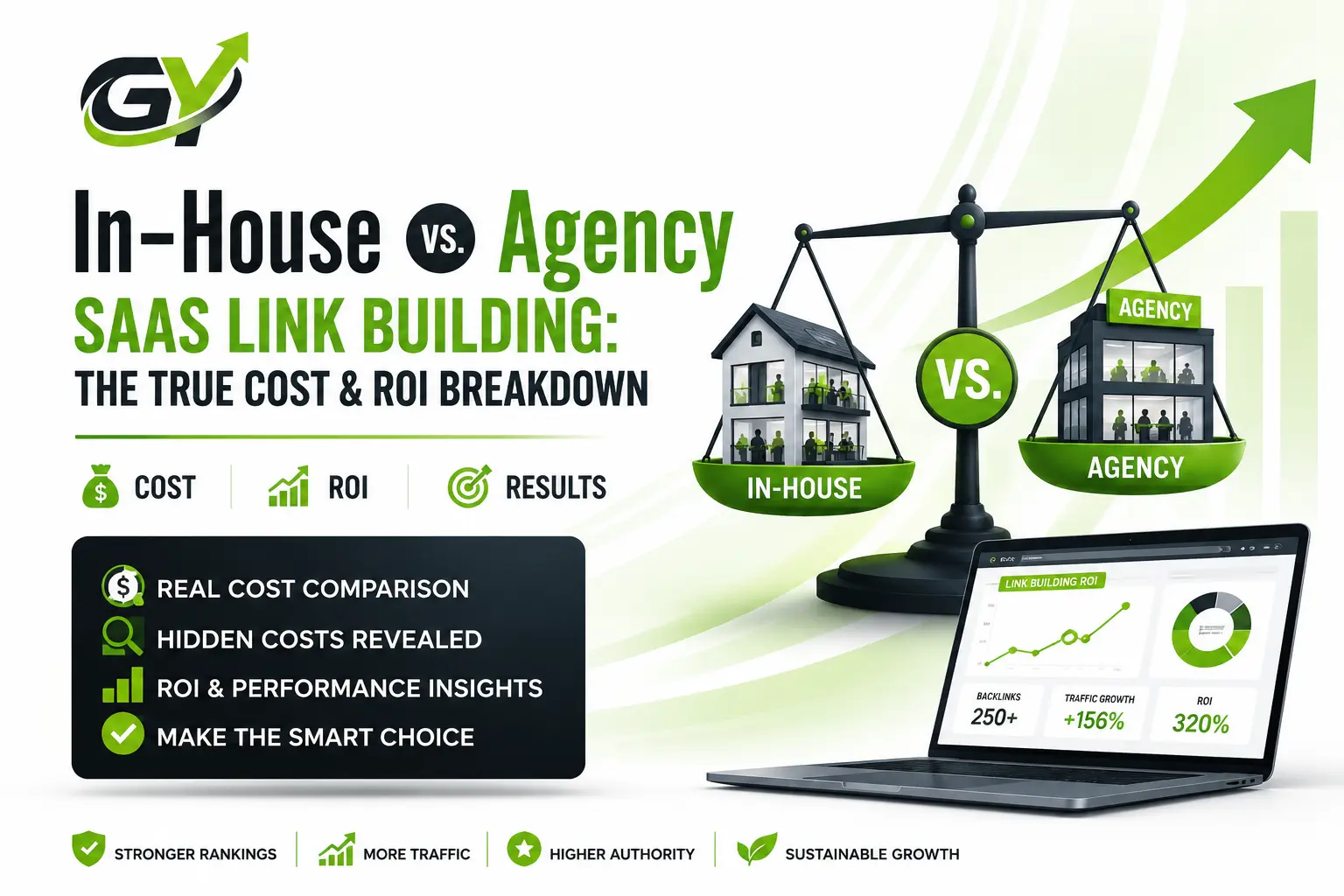
In-House vs. Agency SaaS Link Building: The True Cost and ROI Breakdown
At some point, every SaaS founder and marketing leader has to make an important decision about SaaS link building: should they build backlinks internally with an in-house team, or partner with a specialized agency for faster growth and better ROI?
Prior to adding up the real numbers, the answer seems easy. If you don’t count the cost of salaries, tools, training, and the time your team could be using on something else, building links in-house looks like a good deal. When you think about the people, systems, and relationships they bring to the table from day one, agencies do look pricey.
This guide gets right to the point. We break down every cost, show you the hidden costs that most comparisons miss, and help you figure out which method will give your SaaS business the best return on investment.
What Is SaaS Link Building?
SaaS link building is the process of getting relevant, authoritative domains to link back to your software company’s website. Google uses it as one of the most important ranking signals to decide where your product pages, landing pages, and content show up in search results.
In-House vs. Agency: Key Differences
Before you start comparing numbers, you should know what you’re comparing them to.
- In-house teams know a lot about the product and make sure that their strategies are fully in line with the company’s goals. The person you hired knows the brand voice, the ICP, and the product inside and out.
- SaaS SEO firms offer finished publisher networks, specialized teams, and tried-and-true strategies that have been developed with dozens of clients. As opposed to months, they can start campaigns in just a few weeks.
SaaS Link Building Cost Comparison
Most people don’t tell you this, but here is a side-by-side comparison. We figured out how much it would cost for a mid-sized SaaS company to get 8–12 good backlinks every month.
| Cost Item | In-House (Annual) | Agency (Annual) |
| Base compensation (salary/retainer) | $70,000–$95,000 | $36,000–$72,000 |
| Employer taxes & benefits (~25–30%) | $17,500–$28,500 | ___ |
| SEO & outreach tooling | $4,800–$9,600 | __ |
| Content/copy costs | $12,000–$24,000 | Varies by package |
| Placement / DR fees | $6,000–$18,000 | $6,000–$18,000 |
| Manager/oversight time | $12,000–$20,000 | $3,000–$6,000 |
| Hiring & training (Year 1) | $8,000–$15,000 | __ |
| Turnover risk buffer | $10,000–$20,000 | __ |
| Total Annual | $130,000–$210,000 | $45,000–$96,000 |
In the first year, the fully loaded in-house cost is usually two to three times higher than a comparable agency retainer for getting about ten quality links per month. The cost difference remains significant until the second or third year.
Hidden Costs of In-House Link Building
Most direct costs are shown in the table above, but there is a second layer that doesn’t show up very often in budget spreadsheets. Many times, these hidden costs are what make the real comparison go in favor of agencies.
The ramp-up dead zone
It will take 3–6 months for a new employee to start building links at full speed. During this time, you’re getting paid full-time but not getting many good links. That’s $20,000 to $40,000 that you’ll have to spend before you see real results.
The publisher relationship gap
Building good links depends a lot on having good relationships with website owners, editors, and reporters. Your new worker starts with nothing. An established agency has built hundreds of these kinds of relationships over the years, which means they can put links on trustworthy websites that you just can’t get to on your own.
Scope creep and role dilution
When they work for smaller SaaS companies, in-house SEOs don’t always get to focus on building links. As part of their job, they do keyword research, content strategy, technical audits, and reports. So, getting links turns into a part-time job for someone hired as a full-time expert.
Tool sprawl
A professional link-building workflow needs prospecting tools (Ahrefs and Semrush), outreach platforms (Pitchbox and Hunter.io), content tools, and analytics. Most of the time, these plans cost $500 to $800 a month, even before you build a single link.
Opportunity cost of leadership
Your marketing director could be working on strategy, launching new products, or building partnerships instead of managing an in-house link builder, going over outreach templates, and following up on weekly reports for every hour that goes by. At an hourly rate of $80 to $120, this adds up fast.
Why hiring a SaaS SEO agency is a good idea
The cost point for agencies is easy to see. But the value case is more than just the money you’re not spending.
Pre-built publisher network
Specialist agencies work for years to build relationships with editors at tech blogs, industry newsletters, and publications that are relevant to SaaS. They know which sites get real traffic, which editors respond, and which placements actually change rankings.
A team, not an individual
An outreach specialist who handles hundreds of conversations at once, specialist writers who make content that can be linked to, and an analyst who keeps an eye on performance are all part of the retainer that your agency gets.
Cross-client pattern recognition
When a SaaS-focused agency works with 20–30 clients at the same time, it learns what works across the category in a way that no single company can do on its own.
Speed to market
Within two to four weeks of being hired, most agencies can start outreach campaigns. There will be no job postings, interviews, or 90-day trial period. This time-to-results advantage grows a lot over the course of a year for SaaS companies in categories that change quickly.
Scalability without headcount
An agency changes the scope if you need to double the speed at which you get links before a product launch. If you do the same thing in-house, you’ll need to hire someone else, speed up things, and take a risk if priorities change.
How to Measure SaaS Link-Building ROI?
Most link-building campaigns fail because the companies don’t really track them.
Here is a framework that was made just for SaaS companies.
The main formula is:
ROI = (Organic Revenue Attributed − Link Building Investment) ÷ Link Building Investment × 100
Step 1: Set a baseline for your organic revenue
Write down your current organic traffic volume, trial/demo conversion rate, trial-to-paid conversion rate, and average contract value before you start any campaign.
Step 2: Track keyword ranking progression
Every week, check how the positions of your target keywords change, and mark pages that receive new backlinks. Within 4 to 12 weeks, these pages should show measurable ranking movement on a domain that doesn’t already have authority problems.
Step 3: Attribute organic trials to ranking gains
When you build links to a page, and its ranking goes up, you can credit that work for the extra organic traffic and conversions that follow.
Step 4: Apply your SaaS unit economics.
- Adding more organic visitors times the trial conversion rate equals adding more trials.
- The more trial times, the trial-to-paid rate equals more customers.
- Added customers’ times average selling price = attributed revenue
- Attributed revenue over 12–24 months (taking into account churn) = contribution from link building to revenue
Note: It can take anywhere from 60 to 120 days from getting a link to seeing a change in your ranking. This is normal and the same for both agency and in-house models. Do not look at ROI after 30 days.
Which Gives You a Better ROI: In-House or Agency?
To be honest, the answer depends on your budget and overall strategy.
But it’s easy to see the patterns.
When does it make sense to do it in-house?
- You’re in Series B+, have a marketing team of 10 or more people, and can really use a dedicated specialist.
- Your niche is so small that no agency works with publishers in that area.
- You are making a lot of private data or research that needs a full-time editorial and outreach team.
- You’ve already worked with an agency and proven the channel works. Now you want to take the playbook and use it on a large scale.
When does an agency give a better ROI?
- You need results before Series B, but don’t want to hire 150K+ full-time employees.
- Nine months is too long; you need results in 90 days.
- Your group doesn’t have the right tools or publishers to reach out to people.
- You’ve tried building links in-house before but had trouble with quality or consistency.
- Before hiring someone full-time, you want to give the channel a 6- to 12-month test run.
For most SaaS businesses with less than $10 million in annual revenue, it’s clear that a B2B SaaS SEO agency is the better choice. The fully loaded price is a lot less; you get results faster, and you’re not relying on one person who might leave in 18 months to carry out your link strategy.
A hybrid model often works best for companies with an annual revenue of $20 million or more and strong organic foundations. In this model, an agency builds links while a small in-house SEO team handles strategy, content, and attribution.
Conclusion
When you think about full-time pay, tools, management time, ramp-up lag, and the risk of turnover, building links in-house isn’t always the cheapest option. This is especially true for businesses that haven’t yet tested the channel at scale.
A B2B SaaS SEO agency can get you faster results, lower costs per link, and access to publisher relationships that you can’t get with just one employee. Over the course of 12 to 24 months, the agency model gives most SaaS companies a much better return on investment (ROI).
FAQs
How much should a SaaS company budget for link building?
Most mid-market SaaS companies spend between 20% and 35% of their entire SEO budget on getting links.
What is a realistic cost per link for SaaS?
You can buy generic guest posts for $100 to $200, but they don’t have much of an effect on your rankings. Meaningful links usually cost $400–$900 per link through an agency or $800–$2,000+ when you do it all yourself.
How long does it take for building links to pay off?
It will take between 3 and 6 months for competitive keywords to move up in the rankings and between 6 and 12 months for organic revenue attribution to become statistically significant.
How do I pick a B2B SaaS SEO company? What should I look for?
Make sure they have experience working with SaaS companies in the same situation as you, are open about how they get links, and provide clear reporting that shows how links affect rankings and how that affects organic revenue.
How often does it pay off to have an agency build links to your SaaS business?
When compared to the cost of getting new customers naturally, well-run SaaS link-building programs always give a 200–500% ROI over 24 months.