
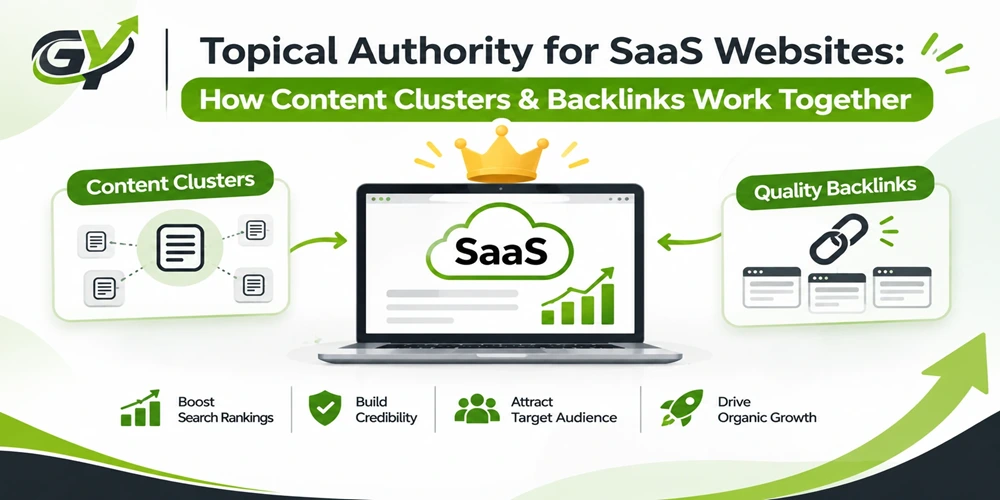
Topical Authority for SaaS Websites: How Content Clusters and Backlinks Work Together
In today’s competitive SaaS market, ranking on Google requires more than publishing blog posts and building random backlinks. Search engines need to understand what your website specializes in, how comprehensively you cover a subject, and whether other relevant websites recognize your content as valuable.
This is where topical authority for SaaS websites becomes important. By combining a well-planned content cluster strategy with high-quality backlinks, SaaS companies can strengthen their online visibility, improve organic rankings, and attract potential customers.
Content clusters help search engines understand the relationship between different pages, while backlinks provide external signals of credibility and authority. When these two SEO strategies work together, they create a strong foundation for sustainable organic growth.
Let’s explore how SaaS businesses can use content clusters and backlinks to build topical authority.
What Is Topical Authority in SEO?
Topical authority refers to the perceived expertise and credibility a website establishes by publishing comprehensive, relevant, and interconnected content around a particular subject.
Instead of targeting individual keywords through unrelated blog posts, businesses build a collection of valuable resources that cover different aspects of a topic.
For example, a SaaS company offering project management software could develop topical authority around project management by publishing content about:
- Project management methodologies
- Team collaboration tools
- Workflow automation
- Resource planning
- Productivity management
- Project tracking software
- Remote team management
Each article addresses a specific search intent while contributing to the broader subject.
For SaaS businesses, this approach helps demonstrate subject-matter expertise, support customer education, and create more opportunities to rank for relevant search queries.
However, topical authority is not a direct Google ranking metric. It is an SEO strategy that helps websites build relevance, useful content, and credibility.
What Are Content Clusters and Why Do SaaS Websites Need Them?
A content cluster is an organized group of related web pages connected through internal links. It generally consists of one central pillar page and several supporting articles.
The pillar page covers a broad topic, while supporting articles explore specific subtopics in greater detail.
This structure helps search engines understand how different pages relate to each other and makes it easier for visitors to discover relevant information.
Understanding the Content Cluster Structure
Consider a SaaS business offering customer relationship management software.
Its content cluster could look like this:
Pillar Topic: CRM Software
Supporting articles:
- What Is CRM Software and How Does It Work?
- Best CRM Software for Small Businesses
- CRM Automation: Benefits and Use Cases
- How to Choose the Right CRM Platform
- CRM Integration with Marketing Automation Tools
- CRM Data Management Best Practices
The pillar page provides an overview of CRM software, while each supporting article answers a more specific question.
All supporting articles link naturally to the pillar page, and the pillar page links to relevant supporting resources.
This creates a logical website structure that benefits both visitors and search engines.
How Backlinks Help Build Topical Authority
Backlinks are links from external websites pointing to your website. They can help search engines discover content and understand its credibility, relevance, and authority.
However, not every backlink delivers the same value. Links from relevant, trustworthy websites are generally more useful than links from unrelated or low-quality sources.
For SaaS companies, acquiring backlinks from industry publications, technology blogs, SaaS directories, and relevant business websites can strengthen their overall SEO strategy.
Here are several ways backlinks support topical authority.
1. Strengthen Industry Relevance
When a SaaS website receives backlinks from relevant websites within its industry, it creates additional contextual signals about the website’s subject matter.
For example, a project management SaaS company receiving editorial backlinks from productivity blogs, software review websites, and technology publications can strengthen its online presence within the project management ecosystem.
Relevant backlinks are more valuable than simply collecting a large number of unrelated links.
2. Improve Content Discovery
Backlinks can help search engines discover new pages, especially when links come from websites that are regularly crawled.
When an industry publication links to a newly published SaaS guide, it can provide another pathway for users and search engines to find that resource.
This is particularly useful for new SaaS websites that are still developing their online presence.
3. Build Website Credibility
Quality backlinks can contribute to a website’s reputation and authority.
For example, earning an editorial mention from a respected SaaS publication can introduce your brand to a relevant audience while providing an SEO benefit.
The goal should be to earn genuine recommendations through valuable resources, original research, expert insights, and useful content.
How Content Clusters and Backlinks Work Together
Content clusters and backlinks serve different purposes, but their combined impact can create a stronger SEO foundation.
Content clusters establish topical relevance through comprehensive coverage and internal linking. Backlinks provide external recognition and can help individual pages attract authority and visibility.
Here is how they complement each other:
Step 1: Build Comprehensive Content Clusters
Start by identifying your primary SaaS topics and creating supporting articles around relevant subtopics. Make sure every page addresses a distinct search intent.
Step 2: Develop Strong Internal Linking
Connect related articles using descriptive and relevant anchor text. Link supporting articles to pillar pages and connect related resources wherever they provide additional value.
Step 3: Identify Link-Building Opportunities
Find relevant websites, industry publications, SaaS blogs, and resource pages that may benefit from referencing your content.
Step 4: Earn Relevant Backlinks
Use digital PR, guest posting, original research, expert contributions, and linkable assets to earn editorial backlinks. For example, SaaS brands can explore GrowthYug’s SaaS link building services to understand how relevant link-building strategies support organic visibility.
Step 5: Monitor and Improve Performance
Track organic traffic, keyword rankings, referring domains, backlink quality, and conversions. Update content regularly based on search performance and changing user needs.
This process creates a connected SEO ecosystem in which useful content attracts links, and strong internal linking helps distribute visitors and authority throughout relevant pages.
5 Effective Strategies to Build Topical Authority for SaaS Websites
Building topical authority requires consistency, planning, and a clear understanding of your audience. The following strategies can help SaaS companies develop a more effective SEO framework.
1. Identify Your Core SaaS Topics
Begin by identifying the primary subjects directly related to your software product and target audience.
For example, an email marketing platform could focus on email automation, campaign optimization, subscriber segmentation, deliverability, and marketing analytics.
Prioritize topics that align with your product capabilities and customer requirements.
2. Perform Keyword and Search Intent Research
Keyword research helps identify what your target audience is searching for.
Look beyond high-volume keywords and explore long-tail queries, informational searches, comparison keywords, and problem-based searches.
Tools such as Ahrefs, Semrush, and Google Keyword Planner can help identify relevant keyword opportunities.
Organize keywords according to search intent to avoid publishing multiple pages targeting the same query.
3. Publish Valuable and Comprehensive Content
Create content that answers real questions and provides practical information.
Include examples, original insights, comparisons, screenshots, use cases, and actionable recommendations wherever relevant.
Avoid publishing multiple articles simply to increase content volume. Every page should offer something useful to readers.
4. Invest in Strategic Link Building
Develop a link-building strategy that supports your most important content clusters.
Some effective approaches include:
- Guest Posting: Contribute informative articles to relevant industry websites. Explore GrowthYug’s guest posting services for more information.
- Editorial Backlinks: Earn natural mentions from authoritative publications.
- Digital PR: Share original research, statistics, and industry insights with journalists.
- Resource Link Building: Create useful guides and resources that other websites may reference.
- Listicle Link Building: Get relevant software products featured in industry comparison articles and resource roundups. Learn more about GrowthYug’s listicle link building services.
A strategic approach to SaaS link building can help improve brand visibility and strengthen your website’s external backlink profile.
5. Track, Update, and Expand Your Content Clusters
SEO is an ongoing process. Monitor your existing content to identify pages that are performing well and those that need improvement.
Review keyword rankings, organic clicks, impressions, internal links, backlinks, and conversion performance.
Update outdated information, add missing sections, improve internal linking, and create new supporting articles when genuine content gaps exist.
For additional insights, read GrowthYug’s guide to AI and link building for SaaS marketers.
Common Mistakes to Avoid When Building Topical Authority
Even a well-planned SEO campaign can underperform when certain mistakes are overlooked.
Here are some common issues SaaS websites should avoid:
- Publishing articles without a clear content strategy.
- Targeting the same keywords across multiple pages.
- Building backlinks from irrelevant websites.
- Ignoring internal linking opportunities.
- Prioritizing Domain Authority over actual link relevance and quality.
- Publishing low-value AI-generated content without meaningful human review.
- Focusing entirely on traffic instead of qualified leads and conversions.
Avoiding these mistakes helps create a more sustainable SEO strategy.
Final Thoughts
Building topical authority for SaaS websites requires more than publishing frequent blog posts or acquiring large numbers of backlinks. It involves creating a well-connected content ecosystem that demonstrates expertise, addresses user search intent, and earns recognition from relevant websites.
Content clusters help organize information and establish subject relevance, while high-quality backlinks strengthen external credibility and improve content discovery.
When both strategies work together, SaaS companies can build a stronger organic search presence, attract qualified audiences, and support long-term business growth.
For SaaS brands looking to improve their search visibility, investing in a combination of strategic content development and relevant link building can be a valuable step toward sustainable SEO success.
Frequently Asked Questions (FAQs)
1. What is topical authority in SaaS SEO?
Topical authority in SaaS SEO refers to establishing expertise and relevance around specific software-related subjects by publishing comprehensive, interconnected, and useful content.
2. How do content clusters improve SEO rankings?
Content clusters organize related articles around a central pillar page. They improve website navigation, strengthen internal linking, help search engines understand content relationships, and provide comprehensive coverage of a subject.
3. Do backlinks help improve topical authority?
Yes, relevant and trustworthy backlinks can strengthen a website’s credibility, support content discovery, and contribute to its overall SEO performance. Links from relevant industry publications can be particularly valuable.
4. How many articles should a SaaS content cluster contain?
There is no fixed number. A content cluster may contain five, ten, or more supporting articles depending on the topic’s complexity, audience needs, and available keyword opportunities.
5. What is more important: content clusters or backlinks?
Both serve different purposes. Content clusters establish comprehensive topic coverage and internal relevance, while backlinks provide external signals of credibility. A balanced SEO strategy should incorporate both.
6. How long does it take to build topical authority?
There is no guaranteed timeline. Results depend on website history, competition, content quality, backlink profile, technical SEO, and publishing consistency. Building meaningful organic visibility generally requires sustained effort over time.