
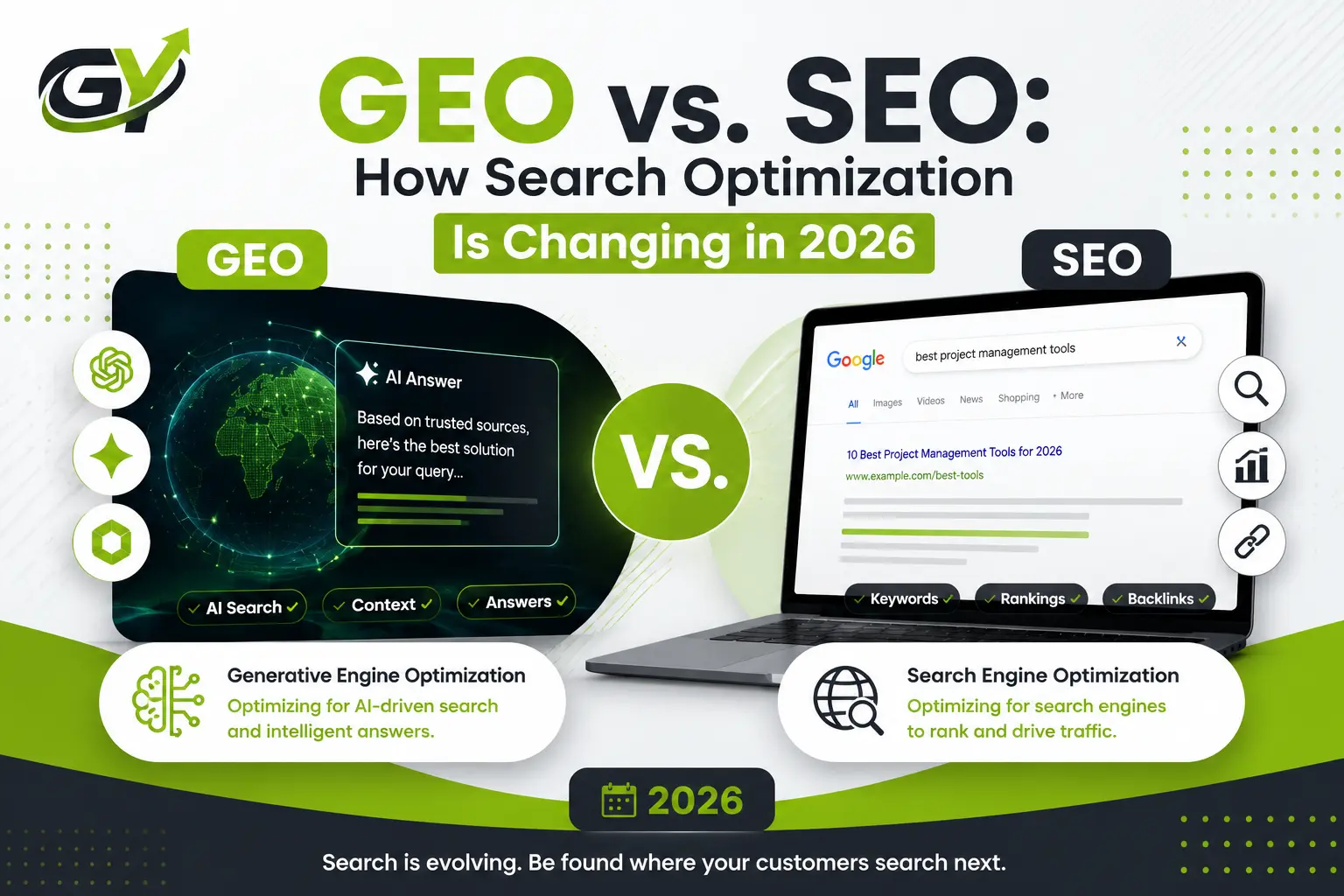
GEO vs. SEO: How Search Optimization Is Changing in 2026
Let’s be honest for a second: when was the last time you actually went to Google, typed in a two-word phrase, and spent twenty minutes clicking through a dozen different websites just to answer a simple question?
If you are anything like me, your search habits have been completely changed in the last year. Now I just ask a huge, very specific question in ChatGPT or Perplexity when I want to know something specific. I don’t want a list of links; I want an answer, right now.
And if you run a business or run a website, you should be paying attention to this shift. The old school method: traditional SEO isn’t the only way anymore. We are now well and truly in the era of Generative Engine Optimisation, GEO.
If you want your brand to survive on the web, you need to understand how the war of GEO vs. SEO is playing out at present and how you can adapt without losing your mind.
The Way We Used to Build Traffic: Traditional SEO
We all know the standard Search Engine Optimization (SEO) playbook. For over a decade, the goal was simple: pick a keyword, optimize your page, build some backlinks, and pray to the Google gods that you land on page one. When you look at traditional SEO, you’re basically looking at this setup:
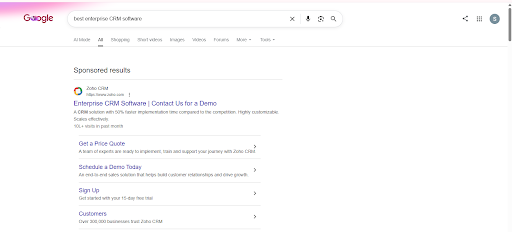
When you go to desktop and search for best enterprise CRM software, you will see exactly what we’re used to: a couple of sponsored ads at the top, followed by a long, static list of blue links from big review sites. To get any actual information, you have to physically click a link and leave Google.
What is GEO?
It aims to make AI search engines recommend your product or service as the answer to a particular question through their chat conversations.
In traditional SEO, you’re fighting for rank. In GEO, you’re fighting for citations.
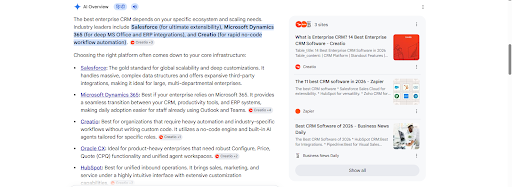
Let us look at how that exact same CRM query looks when someone searches using a modern AI-first workflow:
GEO vs SEO
|
Feature |
Traditional SEO |
GEO |
| The Big Goal | Get your website to rank high so users click your link | Get AI engines to explicitly recommend and cite your brand |
| What the User Sees | List of standalone web links | A synthesized, written answer pulling data from everywhere |
| How People Search | Short, choppy keywords (CRM software features) | Long, natural questions (Which CRM is best for a small team using Slack? |
| How You Win | Keyword optimization, page speed and backlink volume | Plain English clarity, schema code and real data points |
| What You Track | Monthly organic traffic and Click Through Rate (CTR) | Reference Rate (how often AI chooses to name your brand) |
Why You Can No Longer Ignore This
The data is starting to match what we’re seeing in our analytics now. Those fast “how-to” and definition questions are being taken by AI chatbots, which are down in informational search volume on old-school Google.
This has led to a massive increase in zero-click searches. When Google AI Overview perfectly answers a user’s question at the top of the screen, there is no reason to click through to your blog. In fact, CTRs for the number one organic spot can drop by half when a generative summary pops up.
But here’s the silver lining in this: The clicks you do get from an AI citation are very valuable. Consider this: When an AI virtual assistant recommends your product to a user because it matches their specific needs, that user arrives at your site with a strong purchase intent. Quality rather than quantity.
A Few Real Tips to Make Your Content “AI-Readable”
If you want these language models to pull from your website instead of your competitors’, you have to change the way you structure your articles:
- Stop burying the punchline: Put a direct, clear answer to the primary question right at the top of your sections. AI models use real-time retrieval systems; they want to scrape a clean answer instantly, not read through 500 words of introductory fluff.
- Give them hard facts: AI models love data, metrics, and percentages. Instead of saying, “Our software helps teams save time,” say, “Our software reduces project turnaround time by 35%.”
- Fix your backend code: Use clean, explicit Schema markup (like Product or FAQ schema). It provides the AI with a clear, machine-readable map of exactly who you are and what you offer, making it less likely the model will hallucinate or ignore you.
- Bring true human authority: Include unique case studies, original quotes from industry experts, and proprietary data. AI models are getting better at weeding out generic regurgitated content. They are looking for original thoughts.
Conclusion
In the case of GEO vs. SEO, at the end of the day, you shouldn’t be choosing one or the other. They are two sides of the same coin.
AI engines don’t just magically create their knowledge. They crawl and index the web with classic SEO infrastructure. If you have terrible technical SEO and no domain authority, an AI isn’t going to trust you enough to quote you.
Imagine for a moment that SEO is like a famous author penning a volume on the subject of authority while GEO is doing just a small part, yet it is so vital that it helps the AI know where in the book it should look for you. The only secret of their cooperation is to get them both perfectly balanced, and with such a combination, you will get yourself in the right place regardless of the way searchers will want to find.
FAQs
1. Is traditional SEO dead now because of AI?
No, not in the least. Think of GEO as an additional layer on top of your existing SEO foundation. AI engines are still crawling the web to find their info. If your site doesn’t have solid SEO health, crawlability, and baseline authority, AI engines will not even be able to find your content to cite it in the first place.
2. What is the best way to know that my GEO campaign is effective?
Checking standard organic traffic in Google Search Console isn’t the only place to go; besides, if you want to understand a GEO campaign, you have to consider your Reference Rate.
3. How long does it take for AI to cite a website?
If you’re optimising for real-time AI search features (aka, Perplexity or Google AI Overviews searching the live web) you can see your content pulled into answers in 4 to 8 weeks. But it takes closer to a year for an AI model to inherently know your brand as an industry leader in its core training cycle.
4. Do I really need to bother with Schema markup for AI search?
Yes, it is so important. Humans look at nice layouts and images. LLMs read the underlying data. Clean JSON-LD Schema markup provides the AI with a clean, structured summary of your facts, products, or answers, making it easy for the model to extract and credit your site.