
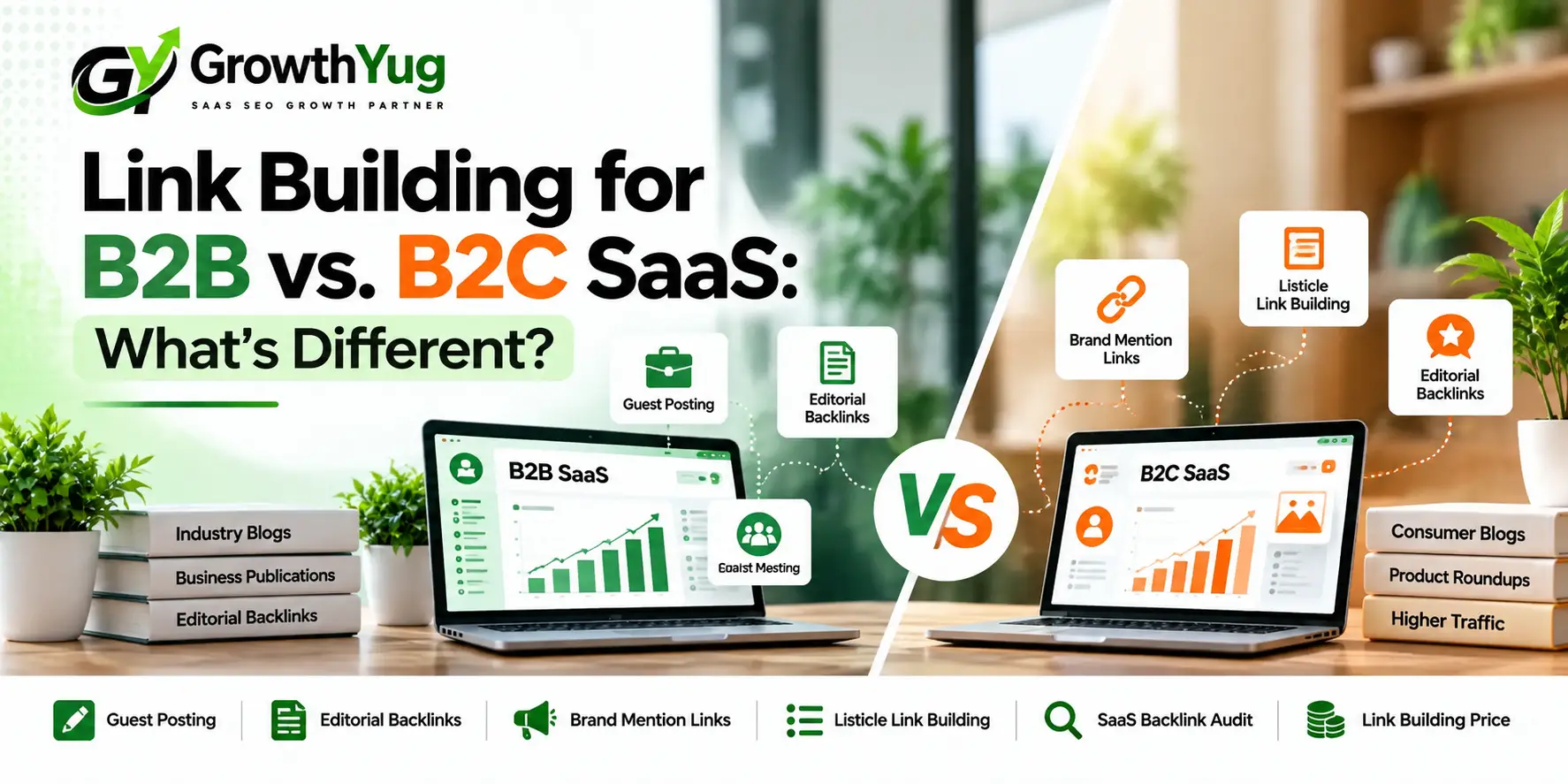
Link Building for B2B vs. B2C SaaS: What’s Different?
Link building is an important part of SEO for SaaS companies, but the right strategy depends on who the software serves. A B2B SaaS company selling software to businesses has different audiences, buying journeys, and content opportunities than a B2C SaaS company targeting individual consumers.
For B2B SaaS brands, link building often focuses on industry publications, expert insights, business resources, software comparisons, and editorial coverage that supports trust and product discovery. B2C SaaS companies may place greater emphasis on consumer publications, product roundups, tutorials, lifestyle content, and resources that attract a broader audience.
Although both business models benefit from relevant, high-quality backlinks, the approach to acquiring those links should reflect the target market.
In this guide, we’ll explore the differences between B2B and B2C SaaS link building, explain the most effective link-building methods, discuss link building price factors, and show you how to choose the right SaaS link building agency.
What Is SaaS Link Building?
SaaS link building is the process of earning backlinks from external websites to improve a software company’s online visibility, support search engine optimization, and help potential customers discover its products and resources.
A backlink occurs when another website links to a page on your website. Relevant editorial links can help people find useful information and provide search engines with additional context about how pages are connected.
However, not every backlink offers the same value. A relevant link from a respected industry publication may provide a more useful audience and referral opportunity than a link from an unrelated website.
An effective SaaS link-building strategy typically includes:
- Identifying important product, service, and educational pages.
- Researching competitors’ backlink profiles.
- Creating resources that publishers may want to reference.
- Building relationships with relevant websites and editors.
- Using guest posting, editorial backlinks, brand mention links, and listicle link building where appropriate.
- Monitoring backlink quality and retention.
- Measuring organic visibility, referral traffic, and relevant business outcomes.
The most effective approach depends on your product, target customers, industry, and marketing goals.
What Is the Difference Between B2B and B2C SaaS?
Before comparing their link-building strategies, it is important to understand the difference between these two business models.
B2B SaaS (Business-to-Business Software as a Service) provides software to businesses, organizations, and professional teams.
Examples include CRM platforms, marketing automation software, project management tools, accounting platforms, and enterprise analytics solutions.
B2C SaaS (Business-to-Consumer Software as a Service) provides subscription-based software directly to individual consumers.
Examples include personal productivity applications, individual budgeting tools, consumer photo-editing platforms, and personal wellness applications.
Some SaaS products serve both audiences. For example, a productivity platform might offer a personal subscription alongside plans for companies. In that case, the link-building strategy may need separate campaigns for each audience.
B2B SaaS vs. B2C SaaS Link Building: Key Differences
Both models aim to earn relevant backlinks, but their target audiences influence which publications, content formats, and pages deserve attention.
| Factor | B2B SaaS Link Building | B2C SaaS Link Building |
|---|---|---|
| Target audience | Businesses, decision-makers, and professional teams | Individual consumers |
| Publisher targets | Industry publications, specialist blogs, business resources | Consumer publications, lifestyle blogs, relevant product sites |
| Content opportunities | Research reports, case studies, technical guides | Tutorials, product guides, templates, consumer-focused resources |
| Common link targets | Product pages, use-case pages, integrations, research | Product pages, feature guides, tutorials, free tools |
| Buying journey | Often involves multiple stakeholders and evaluation stages | Often involves individual research and product comparisons |
| Outreach approach | Expert-led, relationship-driven, industry-focused | Audience-focused, product-focused, and often broader in reach |
| Useful outcomes | Qualified business traffic, product discovery, relevant enquiries | Product discovery, sign-ups, referral traffic, subscriptions |
These are general patterns rather than strict rules. A B2B product can benefit from consumer-oriented publications when their audience is relevant, while a B2C product may earn valuable links from technical or industry publications.
The key is to evaluate each opportunity according to its relevance and potential value.
1. Link Building for B2B SaaS Companies
B2B SaaS companies often sell products that solve specific business problems. Buyers may research different platforms, compare features, evaluate integrations, and seek recommendations before making a purchasing decision.
Their link-building strategy should help potential customers discover the product while supporting important pages across the buying journey.
Focus on Industry-Relevant Publications
Relevant industry websites can introduce your software to people who already understand the problem your product solves.
For example, a marketing automation platform could pursue editorial coverage from marketing technology publications, digital marketing blogs, and business resources that discuss customer acquisition.
A cybersecurity SaaS company might focus on security publications, technical communities, and enterprise technology resources.
Prioritize publications based on their audience, editorial standards, and topical relevance rather than domain metrics alone.
Create Expert-Led Content
B2B audiences often need detailed information before choosing a product. Useful content can help establish expertise and provide publishers with a reason to reference your website.
Consider creating:
- Original industry research and benchmark reports.
- Technical guides and implementation resources.
- Case studies with clearly documented findings.
- Expert commentary on industry developments.
- Comparison guides that help businesses evaluate solutions.
- Integration guides that explain how software products work together.
Make sure your claims are accurate and your content offers information beyond a basic product pitch.
Build Links to Important Commercial Pages
B2B link building should not focus exclusively on the homepage or blog.
Depending on the opportunity, useful destinations may include product pages, industry-specific landing pages, integration pages, and comparison resources.
The link should make sense in the context of the referring article. Avoid forcing a commercial link into content where it does not help the reader.
Develop Long-Term Publisher Relationships
Industry relationships can create opportunities for future expert contributions, research coverage, interviews, and relevant editorial references.
Instead of sending generic outreach messages, identify what each publisher covers and offer a contribution that fits its audience.
2. Link Building for B2C SaaS Companies
B2C SaaS companies typically market directly to individuals. Depending on the product, their audiences may be interested in convenience, affordability, entertainment, productivity, personal organization, or creative features.
Their link-building strategies should reflect the questions and interests of those users.
Target Consumer-Focused Publications
Consumer publications, product review websites, specialist blogs, and relevant online communities may help individual users discover your software.
For example, a photo-editing application might benefit from links within photography tutorials, creative resource pages, and software comparison articles.
A personal finance application may find relevant opportunities on budgeting blogs and consumer financial education websites.
The publication should reach an audience that could reasonably benefit from the product.
Create Useful, Shareable Resources
B2C SaaS companies can create resources that help users solve everyday problems.
Examples include:
- Free templates and downloadable resources.
- Interactive tools and calculators.
- Step-by-step tutorials.
- Product comparison guides.
- Practical educational articles.
- Original studies about consumer behavior or product usage.
These resources can provide natural reasons for other websites to link to your content.
Pursue Relevant Product Roundups
Consumers often compare software before subscribing. Product roundups and comparison articles may help them understand available options.
Identify existing articles that cover your product category and evaluate whether your software genuinely fits the publication’s selection criteria.
Provide accurate product information, explain relevant features, and make it easy for publishers to evaluate your solution.
Do not assume that inclusion is guaranteed or that paying for a placement will produce SEO benefits.
Support Product Discovery and Sign-Ups
For B2C SaaS, referral traffic and sign-ups can be useful measures of a placement’s value.
Use analytics to understand whether visitors from relevant websites explore the product, register for an account, or begin a subscription.
These outcomes should be assessed alongside link quality and organic search performance rather than treated as guaranteed results of acquiring a backlink.
3. Guest Posting for B2B and B2C SaaS
Guest Posting involves contributing an article to another website. When executed thoughtfully, it can introduce your expertise to a relevant audience and provide useful editorial exposure.
For B2B SaaS, suitable topics may include industry analysis, business challenges, technical guidance, or expert insights.
For B2C SaaS, guest contributions may focus on tutorials, practical advice, product-category education, and consumer problems.
How to Make Guest Posting Effective
- Identify publications that reach your target audience.
- Review their editorial standards and previously published articles.
- Propose a specific topic that fits their readers.
- Provide original, accurate, and useful content.
- Reference your website only where the link adds value.
- Follow the publisher’s rules for sponsored content and link attributes.
Guest posting should prioritize editorial value rather than the number of articles published.
If a placement is paid, disclose the commercial relationship as required and qualify the link appropriately. Google recommends using rel="sponsored" for paid placements; nofollow is also acceptable.
4. Editorial Backlinks: Building Relevant Authority
Editorial backlinks are links that publishers include in their content because they consider a resource, source, or contribution relevant to their readers.
These links may come from original research, expert commentary, useful guides, case studies, and other resources worth referencing.
Editorial Backlinks for B2B SaaS
B2B companies can create editorial opportunities by publishing original data, offering specialist expertise, and developing resources that help industry professionals make informed decisions.
For example, a SaaS analytics company might publish a carefully documented industry report that a relevant publication references in an article about data-driven decision-making.
Editorial Backlinks for B2C SaaS
B2C companies can earn editorial attention through practical resources, product-category research, educational tutorials, and useful tools.
For example, a creative software company could publish a detailed guide that a design blog references in a tutorial.
How to Improve Your Editorial Link Opportunities
- Publish original information instead of repeating existing articles.
- Make research methods and limitations clear.
- Provide accurate expert commentary.
- Identify publishers that already cover your subject.
- Pitch a relevant idea rather than requesting an arbitrary link.
- Make the destination page useful and easy to understand.
Publishers retain editorial control over whether they include a link. No agency can guarantee that an independent publisher will link to a particular page.
5. Brand Mention Links: Turning Visibility Into Opportunities
Brand mention links involve identifying relevant online mentions of your company and exploring whether a link would improve the reader’s experience.
A website might mention your brand, product, founder, research, or original report without linking to your website.
These mentions can provide potential outreach opportunities, but not every unlinked mention needs to be converted into a backlink.
How B2B SaaS Companies Can Use Brand Mentions
B2B companies can monitor mentions in industry articles, expert roundups, software reviews, interviews, and research reports.
If an article references your research or product and a link would help readers find the original source, you can politely ask the publisher to consider adding one.
How B2C SaaS Companies Can Use Brand Mentions
B2C companies may find relevant mentions in product reviews, tutorials, consumer publications, and comparison articles.
Prioritize mentions where a link would help readers learn more about the product or access a referenced resource.
A Practical Brand Mention Outreach Process
- Monitor relevant brand and product mentions.
- Review the article to understand its context.
- Check whether a link is missing or broken.
- Identify the most relevant destination URL.
- Contact the publisher with a specific, helpful request.
- Track the response and final link status.
A brand mention can still be valuable without a backlink. The objective is to improve discovery and usefulness, not to treat every mention as a link-building transaction.
6. Listicle Link Building for SaaS Companies
Listicle Link Building focuses on relevant articles that list or compare tools, services, products, and resources.
Examples include articles such as “Best Marketing Automation Tools,” “Top Project Management Software,” or “Best Photo Editing Apps.”
This tactic can support both B2B and B2C SaaS companies, but the target publications and evaluation criteria will differ.
Listicle Link Building for B2B SaaS
B2B companies can identify lists covering enterprise software, business productivity, marketing technology, analytics, security, and other relevant categories.
Focus on articles that genuinely match your product’s use cases and target market.
Provide clear information about features, integrations, pricing where appropriate, and the problems your software solves.
Listicle Link Building for B2C SaaS
B2C companies can explore lists focused on consumer applications, personal productivity, creative software, budgeting tools, and other categories relevant to their audience.
A good prospect should serve people who might reasonably use the product.
How to Evaluate Listicle Opportunities
Before contacting a publisher, review:
- Whether the article covers your product category.
- Whether the publication reaches your target audience.
- Whether its recommendations appear useful and editorially maintained.
- Whether your product meets the article’s selection criteria.
- Whether inclusion involves payment or another commercial relationship.
- Whether the placement’s terms and link attributes are transparent.
Avoid irrelevant directories and low-quality lists created primarily to sell backlinks.
7. SaaS Link Building Agency: How to Choose the Right Partner
A SaaS link building agency can help with prospect research, content planning, publisher outreach, placement review, and backlink reporting.
However, agency quality varies. B2B and B2C SaaS companies should evaluate a provider’s process, transparency, and understanding of their target audience before committing to a campaign.
Check Industry and Audience Experience
Ask whether the agency has worked with businesses similar to yours and whether it understands your target market.
A provider familiar with enterprise software may approach industry publications differently from one focused on consumer applications.
Relevant experience is useful, but it should not replace a clear review of the proposed strategy.
Review Publisher Selection Criteria
Ask how the agency identifies and evaluates websites.
A strong process should consider topical relevance, audience quality, editorial standards, the proposed article, and the value of the destination page.
Do not rely exclusively on Domain Rating, Domain Authority, or other third-party metrics. These scores are not Google ranking factors.
Understand the Outreach and Content Process
Find out who creates the content, who contacts publishers, and who reviews the final placement.
Ask whether the agency uses internal writers, freelancers, subcontractors, or other partners. Understand how content quality, brand accuracy, and publisher selection are managed.
Request Transparent Reporting
Reports should provide enough detail to evaluate what was delivered.
Useful information includes live URLs, referring domains, destination pages, link attributes, placement costs, and the status of acquired links.
Where possible, review referral traffic and the performance of relevant destination pages as well.
Avoid Unrealistic Guarantees
No agency can guarantee specific Google rankings simply by acquiring backlinks. Be cautious of promises involving instant results, large volumes of links from unrelated sites, or guaranteed ranking improvements.
A credible partner should explain its process, acknowledge uncertainty, and set realistic expectations.
8. Link Building Price: How Much Does SaaS Link Building Cost?
Link building price varies depending on the campaign scope, publisher quality, content requirements, outreach effort, and type of placement.
B2B SaaS campaigns may require specialized industry research, expert interviews, or technical content. B2C campaigns may need consumer-focused content, product reviews, or broader publication research.
Neither business model is automatically cheaper. The actual cost depends on the work required and the opportunities available.
What Influences Link Building Price?
Publisher relevance and quality: Researching and securing a placement on a relevant publication may require more work than contacting a general website.
Content production: Original research, expert contributions, technical articles, and detailed guides require different levels of effort.
Outreach complexity: Some industries have established editorial relationships and clear submission processes, while others require more extensive research and relationship building.
Campaign size: A campaign involving multiple markets, products, or website sections may require more resources than a focused project.
Reporting and management: Placement review, link monitoring, project coordination, and reporting can influence the total cost.
Common Pricing Models
| Pricing model | How it works | What to review |
|---|---|---|
| Monthly retainer | Ongoing research, outreach, and campaign management | Included work, reporting, and team capacity |
| Fixed campaign fee | A defined project with specific deliverables | Scope, timelines, and revision limits |
| Per-placement pricing | Payment based on agreed placement criteria | Acceptance rules, quality standards, and replacement terms |
Avoid comparing agencies based only on the price per link. A low-cost placement may have little relevance, while a more expensive campaign may include original content, research, and substantial outreach work.
Ask each provider for a clear breakdown of deliverables, costs, publisher criteria, and any additional fees.
For current package options, visit GrowthYug’s Link Building Packages and Pricing.
9. SaaS Backlink Audit: Evaluate Your Existing Link Profile
Before investing in new backlinks, review the links your website already has.
A SaaS Backlink Audit helps you understand which pages receive links, which referring domains are relevant, where links have been lost, and whether your current profile requires further investigation.
The process is useful for both B2B and B2C SaaS companies.
Step 1: Collect Backlink Data
Use tools such as Ahrefs, Semrush, or Majestic to review known backlinks and referring domains. Google Search Console can provide an additional view of links reported for your website.
Different tools maintain different databases, so no single report should be assumed to contain every backlink.
Step 2: Review Referring Domains
Evaluate the relevance and quality of websites linking to your content.
Consider their subject matter, editorial standards, audience, and the context in which they reference your website.
Step 3: Identify New and Lost Backlinks
Check whether important backlinks have appeared or disappeared.
Investigate lost links that pointed to important pages, especially if the destination URL changed or the linking article was updated.
Step 4: Review Anchor Text and Destination Pages
Look for natural anchor text and relevant destinations.
Investigate unusual patterns in context rather than assuming that every unfamiliar link or repeated phrase indicates a problem.
Step 5: Compare Competitor Backlink Profiles
Identify websites that link to relevant competitors and determine whether they represent realistic opportunities for your brand.
Prioritize publishers where you can offer something useful to their readers.
Step 6: Create an Action Plan
Organize your findings into practical categories:
- Important lost links that may be recoverable.
- Relevant websites to consider for outreach.
- Valuable content that could attract more editorial links.
- Pages that need better content or internal linking.
- Potentially manipulative links that require careful review.
Do not disavow links solely because an SEO tool labels them toxic. Google recommends using its disavow tool cautiously and primarily when there is a substantial pattern of artificial or spammy links and a manual action or likely manual action risk.
A backlink audit should inform decisions, not automatically trigger link removal.
10. How to Measure B2B and B2C SaaS Link-Building Performance
The right performance metrics depend on your business model and campaign objectives.
B2B SaaS companies may have longer sales cycles, while B2C SaaS companies may focus more directly on registrations, subscriptions, or product usage. Both should evaluate link quality alongside business outcomes.
Metrics for B2B SaaS
Consider monitoring:
- New referring domains.
- Backlink retention.
- Organic impressions and clicks for priority pages.
- Relevant referral traffic.
- Qualified enquiries and demo requests.
- Sales opportunities associated with relevant landing pages.
- Campaign cost per accepted placement.
Metrics for B2C SaaS
Consider monitoring:
- New referring domains and link retention.
- Organic traffic to product and educational pages.
- Referral sessions from relevant publications.
- Free-trial registrations or account sign-ups.
- Subscription conversions where measurable.
- Cost per accepted placement.
- Engagement with the content receiving backlinks.
Set a baseline before launching the campaign and review performance over an appropriate period.
A ranking change or increase in traffic does not, by itself, prove that a specific backlink caused the improvement. Consider other SEO activities, content changes, competition, and seasonal patterns when interpreting results.
11. Which Link-Building Strategy Is Best for Your SaaS Business?
There is no universal method that works best for every SaaS company. Your strategy should reflect your product, target customers, existing content, and available resources.
| Business situation | Strategies worth considering |
|---|---|
| B2B SaaS launching a new product | Industry outreach, expert contributions, partner opportunities |
| Established B2B SaaS with original research | Digital PR, editorial backlinks, research-led outreach |
| B2C SaaS targeting a broad consumer audience | Tutorials, product roundups, consumer-focused publications |
| SaaS with existing brand coverage | Brand mention links and link reclamation |
| SaaS with strong educational content | Resource page outreach and editorial contributions |
| SaaS competing in a crowded category | Competitor backlink analysis and relevant listicle opportunities |
Start with a clear objective rather than trying every tactic simultaneously.
For example, a B2B software company may begin by promoting original research to relevant industry publications. A B2C software company may prioritize consumer tutorials and suitable product comparison articles.
Review the results, identify which approaches attract relevant links and visitors, and refine your strategy over time.
How GrowthYug Helps SaaS Businesses Build Relevant Backlinks
Building a strong backlink profile requires more than collecting links. It involves identifying relevant websites, creating useful content, conducting thoughtful outreach, and evaluating placements according to your business goals.
GrowthYug helps SaaS and B2B businesses explore link-building opportunities through services including:
- Guest Posting: Reach relevant audiences through useful, industry-focused contributions.
- Editorial Backlinks: Pursue relevant editorial opportunities that support content discovery.
- Brand Mention Links: Identify relevant brand mentions where a link could help readers.
- Listicle Link Building: Explore suitable product roundups and comparison articles.
Whether your SaaS business targets enterprise buyers or individual consumers, your link-building campaign should reflect your audience, product category, and SEO priorities.
GrowthYug can help you explore a structured approach to relevant placements, transparent campaign planning, and long-term SEO development.
Ready to strengthen your SaaS backlink strategy?
Visit GrowthYug to explore our SaaS link-building services. You can also review our Listicle Link Building service and Link Building Packages and Pricing to find an approach that fits your requirements.
Frequently Asked Questions
1. What is the main difference between B2B and B2C SaaS link building?
B2B SaaS link building often targets industry publications, professional audiences, and business resources. B2C SaaS link building may focus more on consumer publications, tutorials, and product roundups. Both require relevant websites and useful content.
2. Which link-building methods work for both B2B and B2C SaaS?
Guest posting, editorial backlinks, brand mention links, listicle link building, partner opportunities, and useful original content can support both models. The best approach depends on the target audience and publication.
3. How do I choose a SaaS link building agency?
Review its publisher selection criteria, content process, outreach methods, reporting, pricing, and experience with relevant audiences. Avoid providers that rely exclusively on authority metrics or promise guaranteed Google rankings.
4. How much does SaaS link building cost?
Pricing depends on the publisher, content requirements, outreach effort, and campaign scope. Agencies may charge monthly retainers, fixed campaign fees, or per-placement prices. Request a detailed proposal before comparing providers.
5. What are editorial backlinks?
Editorial backlinks are links that publishers include because they consider a resource, source, or contribution relevant to their readers. Original research, expert commentary, and useful educational content can create opportunities for editorial references.
6. What is listicle link building?
Listicle link building involves identifying relevant articles that list or compare products, tools, services, or resources. SaaS companies can explore suitable roundups where their products genuinely fit the topic and audience.
7. What is a SaaS Backlink Audit?
A SaaS Backlink Audit reviews a software website’s known backlinks, referring domains, anchor text, destination pages, and link changes. It helps identify useful opportunities and areas that require further investigation.
8. Are backlinks still important for SaaS SEO?
Backlinks can help people discover useful content and contribute to a website’s overall SEO profile. However, results also depend on content relevance, technical SEO, internal linking, search competition, and user experience.
9. Should B2B SaaS companies focus on homepage backlinks?
Not exclusively. Homepage backlinks can support brand discovery, but product pages, integrations, comparison pages, industry resources, and research reports may also deserve attention. Choose destinations according to the campaign objective.
10. How long does SaaS link building take to show results?
There is no guaranteed timeline. Link acquisition, search engine discovery, ranking changes, and business outcomes may occur at different times. Evaluate campaign delivery early and assess organic and business performance over a suitable observation period.
Related Posts :
Does Guest Posting Still Work for SEO? (The Truth About Link Building Today)
How to Evaluate Backlinks That Drive SaaS SEO Growth: GrowthYug Guide
Google Search Console vs. Dedicated Backlink Monitoring Tools: Which Is Better?
SaaS SEO Guide 2026: Complete Strategy for SaaS Growth
Guest Posting for SEO: Does It Still Work in 2026
SaaS Outreach Email Templates That Get Replies
Zero-Budget SaaS Link Building: How to Get Your First 100 Backlinks
AI in SaaS Link Building: What Works and What’s Hype
SaaS SEO Audit Checklist: Boost Rankings Fast