
White Label Link Building: Services, Pricing & Providers
Scaling an SEO agency requires more than acquiring new clients. You also need reliable processes, skilled specialists, and enough capacity to deliver consistent results without increasing operational complexity. Link building can become a major challenge when your team must handle prospect research, outreach, content coordination, publisher negotiations, and quality checks for multiple campaigns.
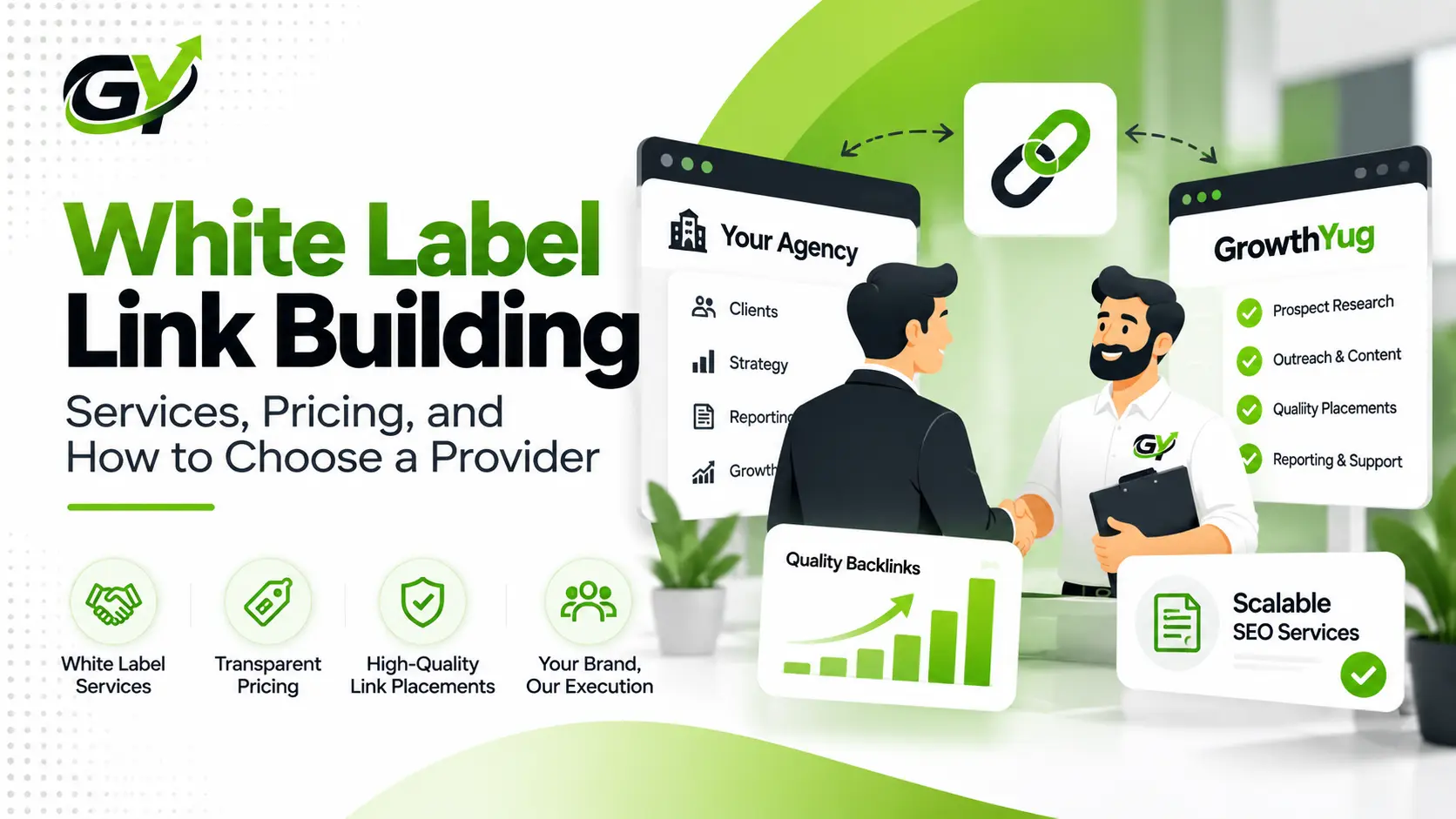
White label link building offers a way to expand your service capacity without building a dedicated in-house link-building department. An agency partners with an external provider that performs agreed-upon work behind the scenes, while the agency manages the client relationship and presents the service under its own brand.
The right arrangement can help agencies serve more clients, manage campaign workloads, and offer specialized link-building services without hiring a large team. However, the results depend on the provider’s editorial standards, transparency, processes, and approach to link quality. Understanding these factors is essential before outsourcing any part of your SEO delivery.
What Is White Label Link Building?
White label link building is a service arrangement in which one company performs backlink acquisition activities for another company, which then delivers those services to its own clients under its brand.
For example, an SEO agency may have five SaaS clients that need ongoing authority-building campaigns. Instead of hiring outreach specialists, content writers, and campaign managers, the agency can work with a white-label provider to handle selected execution tasks.
The agency remains responsible for client communication, strategy, expectations, and reporting. The provider performs the agreed work according to the agency’s requirements.
Typical responsibilities may include:
- Identifying relevant websites and publishers.
- Researching prospects and evaluating their editorial suitability.
- Conducting personalized outreach to website owners and editors.
- Coordinating content creation and editorial placement.
- Monitoring published links and reporting campaign progress.
- Checking live URLs, contextual relevance, and link attributes.
White label link building is different from simply purchasing a list of backlinks. A professional arrangement should establish how websites are selected, how placements are earned or arranged, what quality checks are performed, and how the agency receives evidence of completed work.
Agencies developing their overall approach can also explore this SaaS link building strategy guide for a broader view of building links around business and search objectives.
How Does White Label Link Building Work?
Although workflows vary between providers, a well-managed campaign usually follows a series of defined steps.
1. Define the client’s goals
The agency begins by understanding the client’s business, target audience, website, and organic search priorities. These details help determine which pages should receive attention and which publishers are relevant.
For a SaaS company, the priorities might include a product landing page, a comparison page, an integration page, or an educational resource. The campaign should support the broader SEO strategy rather than acquire links without a clear purpose.
2. Establish publisher selection criteria
The agency and provider agree on the types of websites that qualify for outreach. Criteria can include topical relevance, editorial standards, audience quality, organic visibility, and the suitability of the proposed content.
Domain Rating and Domain Authority can help with initial comparisons, but neither metric independently establishes whether a website is trustworthy or whether a backlink will be valuable.
A relevant publication with a genuine audience may be a better prospect than a website with impressive third-party metrics but little connection to the client’s industry.
3. Research prospects and conduct outreach
The provider identifies suitable publishers and contacts them with relevant pitches. Effective outreach explains why a proposed article, resource, or contribution would be useful to the publication’s audience.
Generic mass emails, irrelevant pitches, and automated follow-ups without meaningful personalization can damage publisher relationships. Agencies should understand how their provider sources prospects and maintains outreach quality.
For practical examples of outreach workflows, see GrowthYug’s guest posting outreach strategies.
4. Coordinate content and publication
When a publisher accepts a contribution, the provider may coordinate the content, editorial revisions, and publication process. The article should meet the publisher’s standards and provide useful information to readers.
Content should not exist solely to insert a backlink. It should have a clear purpose, accurate information, and a logical connection between the subject matter and the linked destination.
Agencies should also agree on whether the provider handles writing, editing, publisher communication, or only prospecting and outreach.
5. Verify placements and report results
After publication, the provider should supply the live URL and the agreed campaign details. The agency can verify that the page loads, the link points to the intended destination, and the surrounding content is relevant.
Reporting should distinguish between outreach activity, accepted opportunities, published placements, and verified live links. These are different stages, and treating them as interchangeable can create misleading expectations.
What Services Should a White Label Link Building Provider Offer?
Not every agency needs the same level of outsourcing. Some want a provider to manage the entire execution process, while others need support with specific tasks.
Common service options include:
Guest posting and editorial outreach
This service involves identifying publications, pitching relevant topics, and coordinating contributions. The quality of the result depends on the publication’s audience, editorial standards, and the usefulness of the content.
Link prospecting
Prospecting focuses on identifying websites that may be appropriate for outreach. A good prospecting process considers subject relevance, audience fit, editorial activity, and whether the website is a sensible match for the client’s goals.
Digital PR and resource-based outreach
Digital PR aims to earn attention and links through original research, useful resources, expert commentary, and newsworthy stories. Resource-based outreach may promote tools, studies, or reference materials that help publishers serve their readers.
These approaches often require more strategic input than routine prospecting, but they can help agencies build campaigns around genuine editorial value.
Content creation and placement coordination
Some providers create articles and manage the publication workflow. Agencies should establish who is responsible for research, factual accuracy, originality, editing, and final approval before work begins.
Backlink verification and reporting
Post-publication checks help agencies confirm delivery and identify issues. Reporting can include the source URL, destination URL, publication date, topical relevance, link attributes, and current status.
GrowthYug’s guide to evaluating backlinks that drive SaaS SEO growth provides additional context for assessing link quality.
White Label Link Building Pricing: What Affects the Cost?
There is no single standard price for white label link building. Providers use different pricing models, and the cost depends on the work included, publisher requirements, content needs, and campaign complexity.
Common pricing structures include the following.
Per-placement pricing: The agency pays for each completed placement under agreed criteria. The contract should explain what qualifies as a completed placement and how problems such as incorrect URLs or removed links are handled.
Monthly retainers: The agency pays a recurring fee for an agreed scope of work. This can suit ongoing campaigns that require prospecting, outreach, content coordination, and reporting throughout the month.
Custom campaign pricing: A provider develops a scope around particular industries, target pages, editorial opportunities, or digital PR projects. This can be useful when standard packages do not match the client’s needs.
When comparing quotes, agencies should look beyond the headline price. Consider the time required for quality assurance, the cost of content, account management, publisher communication, and any additional fees.
A lower quote may exclude important services or rely on websites that do not meet the client’s requirements. A higher quote is not automatically better either. The goal is to understand exactly what the agency receives and whether the service fits its delivery standards and commercial model.
Before agreeing to a contract, request a sample report, a clear scope of work, and an explanation of what happens if a placement fails to meet the agreed criteria.
How to Choose the Right White Label Link Building Agency
Choosing a provider is not simply a matter of comparing the number of links offered each month. The agency needs a partner whose processes protect client relationships and support long-term SEO objectives.
1. Evaluate website relevance
Ask how the provider selects publishers and determines whether a website is appropriate for a particular client. Look for a clear process that considers subject matter, editorial quality, audience fit, and the context in which a link would appear.
A provider should be able to explain why a placement makes sense rather than relying exclusively on authority scores.
2. Review sample placements and reports
Request examples of completed work where disclosure is permitted. Examine the published pages, article quality, contextual links, and reporting details.
If the provider cannot explain how it evaluates websites or verify the work it delivers, investigate further before committing to a large campaign.
3. Understand its link acquisition methods
Ask whether the provider uses personalized outreach, editorial contributions, digital PR, paid placements, private networks, or other methods.
These approaches are not equivalent. Google’s policies address manipulative link schemes, including certain paid links that pass ranking credit and link exchanges intended to manipulate search rankings. Paid placements should use appropriate link qualification, such as rel="sponsored" where applicable.
A provider should be transparent about its methods and should not promise guaranteed rankings or claim that every backlink will improve organic performance.
4. Check communication and quality control
Determine who manages campaign updates, approves content, handles publisher responses, and resolves delivery issues.
An effective white-label relationship should make it easy for the agency to review progress without having to chase multiple people for basic information.
5. Compare the provider with in-house delivery
Outsourcing is not always the best choice. Agencies with predictable workloads, specialized requirements, and sufficient internal resources may prefer to retain more control over their campaigns.
For a detailed decision framework, read in-house vs. agency SaaS link building. The right model depends on internal expertise, costs, capacity, and the amount of operational control the agency needs.
How to Maintain Link Quality When Outsourcing
Outsourcing execution does not remove the agency’s responsibility to evaluate the work delivered to its clients.
Start with documented acceptance criteria. Define what makes a publisher relevant, which content standards apply, which destination pages are appropriate, and what information must appear in the final report.
Next, review placements regularly rather than assuming that every delivered link meets expectations. Look for unrelated topics, thin content, suspicious publishing patterns, misleading metrics, or pages created primarily to host commercial links.
It is also important to understand that a live backlink is not a guarantee of ranking improvements. Search engines evaluate many signals, and the effect of an individual link cannot reliably be predicted in isolation.
A consistent review process helps agencies identify delivery problems early and avoid confusing link volume with campaign success. GrowthYug’s backlink audit guide can help readers understand how to assess an existing backlink profile and investigate potential issues.
Common Mistakes Agencies Should Avoid
Even a capable provider cannot compensate for an unclear campaign strategy. Several common mistakes can undermine an otherwise useful outsourcing arrangement.
- Choosing providers based only on price: This can encourage compromises in research, content quality, and publisher selection.
- Setting link quotas without quality criteria: A fixed quantity alone does not establish whether the links are relevant or useful.
- Ignoring the client’s target audience: Publishers should make sense for the business and its subject matter, not just its SEO metrics.
- Failing to review published work: Verification helps catch errors, unsuitable placements, and reporting discrepancies.
- Promising guaranteed rankings: No provider can guarantee specific search positions through link building alone.
- Treating every link as permanent: Publisher pages and links can change. Contracts should define verification periods and reasonable procedures for addressing delivery issues.
- Neglecting broader SEO work: Backlinks cannot replace useful content, sound technical foundations, clear information architecture, and a good user experience.
Agencies should also avoid assuming that every low-quality backlink requires a disavowal. Link issues need to be assessed in context rather than treated as an automatic reason for corrective action.
Is White Label Link Building Right for Your Agency?
White label link building can be a practical option for agencies that have established client demand but lack the internal capacity to manage every part of link acquisition. It can also help smaller teams access specialized outreach and content coordination without immediately expanding their permanent headcount.
The arrangement works best when both parties understand their responsibilities. The agency should define campaign goals, maintain client communication, and review quality. The provider should follow the agreed process, communicate limitations, document completed work, and deliver transparent reporting.
Before selecting a partner, compare the full scope of service, acquisition methods, quality standards, communication process, and total cost. Start with a manageable scope, review the work carefully, and expand only when the arrangement meets your expectations.
Ultimately, white label link building should help an agency deliver better-organized, relevant, and accountable SEO services. The objective is not simply to acquire more backlinks, but to build a sustainable delivery process that supports client goals without sacrificing editorial quality or transparency.