
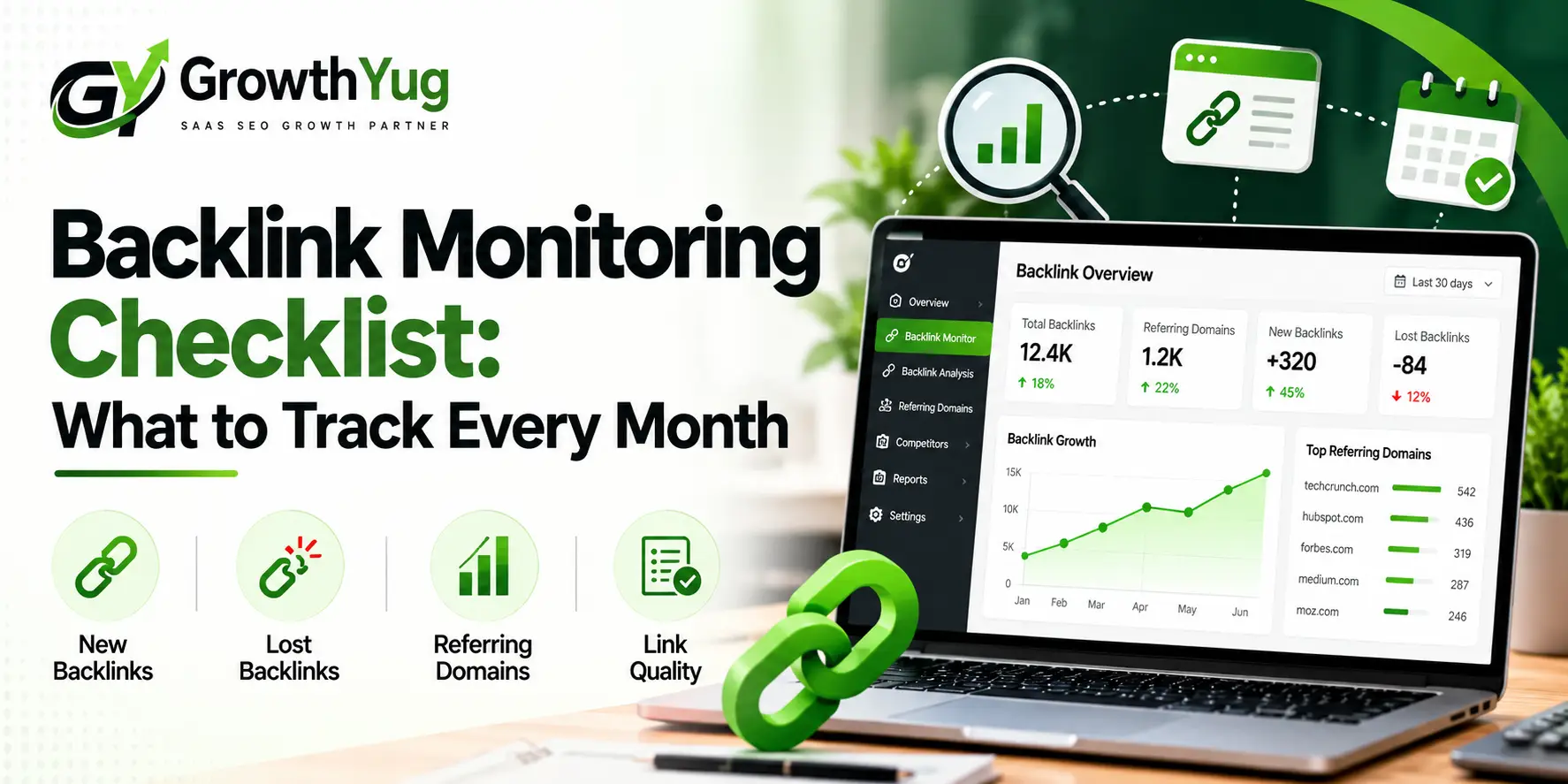
Backlink Monitoring Checklist: What to Track Every Month
Backlinks remain an important part of a strong SEO strategy. However, building links is only one part of the process. To understand whether your link-building efforts are delivering value, you need to monitor your backlinks regularly, evaluate their quality, and identify changes that could affect your website’s organic search performance.
A consistent backlink monitoring process helps you discover new links, detect lost backlinks, review referring domains, evaluate anchor text, and identify potential link-building opportunities. For SaaS companies, tracking these metrics is particularly valuable because search visibility, brand authority, and organic traffic can contribute to long-term business growth.
This guide covers a practical backlink monitoring checklist, the metrics you should track every month, the best backlink monitoring tools, and how to use backlink data to improve your SEO strategy.
What Is Backlink Monitoring?
Backlink monitoring is the ongoing process of tracking links pointing to your website and evaluating their quality, relevance, and performance.
A backlink monitoring tool helps SEO professionals review their backlink profile, identify newly acquired and lost links, analyze referring domains, and investigate changes in link quality. Some tools also provide alerts, historical data, competitor comparisons, and scheduled reports.
Regular monitoring helps answer important questions:
- Are we earning backlinks from relevant, authoritative websites?
- Which backlinks have been lost or removed?
- Are our link-building campaigns generating valuable referring domains?
- Are our important landing pages receiving enough backlinks?
- Are competitors earning links from websites we should approach?
- Are our backlinks contributing to stronger organic search performance?
Instead of checking backlinks only when rankings decline, make monitoring a routine part of your monthly SEO workflow.
Why Is Backlink Monitoring Important for SaaS Companies?
SaaS companies often compete in crowded search results where earning relevant, trustworthy backlinks can support their broader SEO and brand-building efforts. Monitoring allows marketing teams to measure link acquisition and spot opportunities to improve their campaigns.
1. Identify New Backlinks
Track newly discovered backlinks to understand which campaigns, partnerships, guest posts, and editorial mentions are generating links. Review the source website, linked page, anchor text, and relevance.
2. Detect Lost Backlinks
A backlink may disappear because a page was updated, a publisher removed the link, a page was deleted, or a website changed its URL. Identifying lost links gives you an opportunity to investigate and recover valuable placements.
3. Evaluate Backlink Quality
Not all backlinks provide the same value. Assess topical relevance, editorial context, source-page quality, link placement, and whether the link is naturally earned.
4. Measure Link-Building Campaign Performance
Monitoring helps you evaluate which campaigns attract relevant referring domains and which approaches deserve further investment. Combine backlink data with organic traffic, referral visits, and conversions for a more complete picture.
5. Discover Competitor Opportunities
Competitor backlink analysis can reveal industry publications, resource pages, comparison articles, and websites that may be suitable prospects for your next link-building campaign.
The Monthly Backlink Monitoring Checklist
Use the following checklist at the beginning or end of every month. Compare your latest data with the previous month and investigate significant changes before making decisions.
1. Review New Backlinks
Start by identifying backlinks discovered during the reporting period.
Check:
- The number of newly discovered backlinks.
- The number of new referring domains.
- The relevance of each linking website.
- The quality and context of the source page.
- The target URL receiving the backlink.
- Whether the link is editorial, sponsored, or user-generated.
- Whether the link uses a follow or nofollow-related attribute.
What to do: Record valuable new links, identify which campaigns earned them, and use those insights to improve future outreach.
2. Check Lost and Broken Backlinks
Lost backlinks can indicate a removed placement, deleted source page, redirect issue, or temporary crawling problem.
Check:
- Which backlinks disappeared during the month.
- Whether the source page still exists.
- Whether the linking page returns an error.
- Whether your destination URL has changed.
- Whether a redirect is working correctly.
- Whether a valuable editorial link can be recovered.
What to do: Prioritize relevant, valuable links that were unintentionally removed. Contact the publisher when appropriate, correct broken destination URLs, and avoid treating every lost link as an emergency.
3. Analyze Referring Domains
A referring domain is a unique website linking to your site. Ten backlinks from one domain are not equivalent to ten independent referring domains.
Check:
- Total referring domains.
- Newly acquired referring domains.
- Lost referring domains.
- Topical relevance of linking websites.
- Changes in the quality of referring domains.
- The distribution of links across important pages.
What to do: Focus on earning links from relevant websites with genuine editorial standards. Avoid judging backlink quality by domain authority or another third-party score alone.
4. Evaluate Anchor Text Distribution
Anchor text is the clickable text used in a hyperlink. It helps describe the linked page, but an unnatural pattern of repetitive, keyword-heavy anchors may indicate manipulative link-building practices.
Check:
- Branded anchors.
- Naked URL anchors.
- Natural, descriptive anchors.
- Generic anchors such as “learn more.”
- Commercial or exact-match keyword anchors.
- Unusual concentrations of repetitive anchor text.
What to do: Aim for natural variation based on editorial context. Do not build backlinks using a predetermined exact-match anchor-text percentage.
5. Review Your Most Important Linked Pages
Not every backlink should point to your homepage. Important product pages, solution pages, research reports, and high-value educational resources may also benefit from relevant backlinks.
Check:
- Which URLs attract the most backlinks.
- Whether important SaaS landing pages receive relevant links.
- Whether backlinks point to outdated or redirected pages.
- Whether valuable content assets attract links naturally.
- Whether internal links help visitors navigate from linked pages to relevant conversion pages.
What to do: Identify pages that attract links and improve their internal linking, content quality, and conversion paths where appropriate.
6. Inspect Link Attributes and Placement
Review how links appear on source pages and whether their attributes match the publisher’s relationship with your website.
Check:
- Whether links are editorially placed.
- Whether the link is relevant to the surrounding content.
- Whether sponsored links are appropriately qualified.
- Whether user-generated links use suitable attributes.
- Whether the link is visible and functional.
What to do: Prioritize relevant, useful placements over raw link volume. A properly qualified sponsored link can still provide referral traffic and brand exposure even when it does not function like a standard editorial backlink.
7. Monitor Competitor Backlinks
Competitor backlink monitoring helps identify websites already linking to businesses in your category.
Check:
- New backlinks earned by key competitors.
- Publications that frequently cover your industry.
- Competitor listicles and comparison pages.
- Relevant resource pages and industry directories.
- Guest contribution opportunities.
- Brand mentions that may offer editorial opportunities.
What to do: Evaluate each prospect individually. Develop a useful resource, expert contribution, original study, or relevant pitch instead of copying competitor link placements without considering their context.
8. Review Toxic or Suspicious Backlinks
A backlink report may contain links from low-quality, irrelevant, scraped, or suspicious websites. However, an unusual link or a low third-party authority score does not automatically mean the link is harmful.
Check:
- Unusual spikes in backlinks from unrelated domains.
- Repeated, manipulative-looking anchor text.
- Obvious link schemes or paid-link patterns.
- Large numbers of duplicate or automatically generated links.
- Any relevant Google Search Console manual-action notifications.
What to do: Investigate the source and context before taking action. Google’s systems ignore many spammy links automatically. Consider Google’s disavow tool only in appropriate circumstances, such as a substantial number of artificial links accompanied by a manual action or a credible risk of one. Do not disavow links solely because an SEO tool labels them toxic.
9. Compare Backlink Growth With SEO Performance
Backlink growth alone does not prove that an SEO campaign is successful. Review link data alongside other performance indicators.
Check:
- Organic clicks and impressions.
- Organic traffic to linked pages.
- Search visibility for relevant keywords.
- Referral traffic from linking websites.
- Leads, sign-ups, or conversions where measurable.
- Changes in the performance of priority landing pages.
What to do: Use Google Search Console and your analytics platform alongside backlink tools. Consider seasonality, content changes, technical SEO, and competitor activity before attributing ranking changes to backlinks.
10. Document Findings and Assign Next Steps
End each month with a clear report that turns backlink data into action.
Record:
- New and lost backlinks.
- New and lost referring domains.
- The most valuable link placements.
- Significant anchor-text or link-quality changes.
- Competitor opportunities discovered.
- Links requiring investigation or recovery.
- Actions, owners, and deadlines for the next month.
What to do: Maintain a consistent reporting format so your team can compare performance over time and make decisions based on evidence rather than isolated metrics.
Monthly Backlink Monitoring Checklist Template
Use this checklist for your monthly SEO review.
- Export the latest backlink and referring-domain data.
- Compare new backlinks with the previous month.
- Identify lost backlinks and investigate valuable losses.
- Review referring-domain relevance and quality.
- Check anchor-text distribution for unusual patterns.
- Review backlinks to priority SaaS pages.
- Inspect link attributes and placement context.
- Analyze competitor backlink opportunities.
- Investigate suspicious backlink patterns.
- Compare backlink data with organic and referral performance.
- Record findings, owners, and next steps.
The goal is not to achieve a particular number of backlinks every month. It is to build a relevant, sustainable backlink profile that supports your wider SEO objectives.
What Are the Best Tools Available for Monitoring Backlinks and Analyzing Their Performance?
The best backlink monitoring tool depends on your budget, reporting requirements, website size, and link-building workflow. Some platforms focus on backlink discovery and competitive research, while others are useful for recurring monitoring and technical SEO reporting.
Here are several established options to evaluate.
1. Ahrefs
Ahrefs is widely used for backlink research, competitor analysis, referring-domain discovery, and reviewing newly discovered or lost backlinks.
Best for: SEO teams and link-building professionals who need detailed backlink research and competitor insights.
2. Semrush
Semrush provides backlink analytics, referring-domain reports, competitor comparisons, and backlink audit functionality.
Best for: Marketing teams that want backlink research alongside broader SEO and competitive-analysis workflows.
3. SE Ranking
SE Ranking offers backlink analysis and monitoring features that can help teams review backlink changes, evaluate referring domains, and prepare reports.
Best for: Agencies and businesses looking for an integrated SEO platform.
4. Majestic
Majestic specializes in link intelligence and provides proprietary metrics such as Trust Flow and Citation Flow to support backlink evaluation.
Best for: SEO professionals who want additional link-graph and referring-domain analysis.
5. Google Search Console
Google Search Console provides a Links report showing examples of external links, top linked pages, top linking sites, and top linking text.
Best for: Website owners who want a free, first-party source of link information for their verified properties.
Search Console is not a complete real-time backlink monitor, and its link reports may differ from commercial backlink databases.
Which Backlink Monitoring Tools Offer the Most Comprehensive Reports?
For comprehensive backlink reports, compare tools based on the information they provide rather than choosing solely by brand or price.
| Reporting requirement | Tools to consider |
|---|---|
| New and lost backlinks | Ahrefs, Semrush, SE Ranking |
| Competitor backlink research | Ahrefs, Semrush, Majestic |
| Backlink audit and risk investigation | Semrush, Ahrefs |
| Link intelligence metrics | Majestic |
| Free external-link reporting | Google Search Console |
| Integrated agency SEO reporting | SE Ranking, Semrush |
Feature availability, historical data, reporting limits, update frequency, and pricing depend on the selected plan and can change over time. Confirm the current capabilities directly with each provider before purchasing.
What Should an SEO Backlink Monitor Report Include?
A useful monthly report should include:
- Total backlinks and referring domains.
- Newly discovered and lost links.
- Referring-domain relevance and quality.
- Anchor-text distribution.
- Backlinks to priority landing pages.
- Link attributes and source-page context.
- Competitor link acquisition.
- Referral traffic and relevant organic performance.
- Issues requiring investigation.
- Recommended actions for the next reporting period.
A good report should explain what changed, why it matters, and what your team should do next.
How SaaS Companies Can Use Backlink Monitoring to Improve Link Building
For SaaS businesses, backlink monitoring is most effective when it connects link acquisition with a clear content and outreach strategy.
Backlink Database
Maintain a structured backlink database containing the linking URL, referring domain, target page, anchor text, link attribute, acquisition date, status, campaign, and follow-up notes.
A clean database makes it easier to identify successful campaigns, investigate lost links, and prevent duplicate outreach.
Editorial Backlinks
Editorial backlinks are links included by publishers because they consider a resource, insight, or source useful to their audience.
Monitor editorial placements for relevance, link status, referral traffic, and the quality of the source page. Original research, expert commentary, and useful industry resources can help attract these links.
Listicle Backlinks
Listicle backlinks come from articles such as “best SaaS tools,” product roundups, and industry resource lists.
Track which relevant listicles mention competitors but not your brand. Look for opportunities to provide accurate product information, demonstrate a distinctive feature, or offer a useful resource to the publisher.
Brand Mention Links
Brand mentions can create opportunities to earn relevant backlinks when publishers refer to your company without linking to your website.
Monitor brand mentions, investigate the context, and contact the publisher when adding a link would genuinely help readers. A mention does not guarantee that a publisher will add a link, so keep outreach personalized and useful.
Guest Posting Backlinks
Guest posting can help SaaS brands reach relevant audiences when contributions provide genuine editorial value.
Track the publication, topic, target page, live URL, link attributes, referral visits, and any agreed follow-up. Prioritize relevant publications and original content rather than large-scale placements created primarily to manipulate rankings.
Backlink Monitoring vs. Backlink Audit: What Is the Difference?
Backlink monitoring and backlink audits are related but serve different purposes.
Backlink monitoring is an ongoing process that tracks changes in your link profile, including new links, lost links, and changes in referring domains.
A backlink audit is a more structured evaluation of your backlink profile to identify patterns, assess quality, investigate risks, and discover opportunities for improvement.
Both processes are useful. Monitoring helps you notice changes throughout the year, while periodic audits provide a deeper review of your overall link profile.
How Often Should You Monitor Backlinks?
For most small and medium-sized websites, a detailed monthly review is a practical starting point. Larger websites, active SaaS link-building campaigns, and businesses in competitive search markets may benefit from more frequent checks or automated alerts.
A simple schedule is:
- Weekly: Check important new or lost links and active campaign placements.
- Monthly: Review the full backlink checklist, compare trends, and prepare a report.
- Quarterly: Conduct a deeper backlink audit, assess competitor changes, and update your link-building priorities.
Adjust the schedule to match your campaign volume and business needs. Monitoring tools may discover links at different times, so avoid treating every delayed discovery as a problem.
Build a Stronger Backlink Strategy With GrowthYug
Monitoring backlinks is only one part of a successful link-building strategy. The next step is using that information to identify relevant publishers, strengthen your backlink profile, and earn placements that support your business objectives.
GrowthYug helps SaaS businesses approach link building with a focus on relevant websites, strategic outreach, editorial opportunities, and long-term SEO growth.
Whether you want to discover new link opportunities, improve your existing backlink profile, or develop a repeatable link-building process, a structured strategy can help your team make better decisions.
Ready to strengthen your SaaS backlink strategy?
Explore GrowthYug to learn more about our SaaS link-building services and how we can help you build a stronger foundation for organic growth.
Frequently Asked Questions
1. What is the best backlink monitoring tool?
Ahrefs, Semrush, and SE Ranking are worth comparing for backlink monitoring and analysis. Majestic is another option for link intelligence, while Google Search Console provides free external-link reporting for verified websites. The best choice depends on your reporting needs, budget, and workflow.
2. What are the best tools for backlink analysis and monitoring?
Ahrefs, Semrush, SE Ranking, and Majestic are established options. Compare their backlink databases, discovery frequency, competitor research, historical reports, and pricing before selecting a tool.
3. What are the best tools for backlink tracking and monitoring?
Choose a tool that can help you identify new and lost backlinks, review referring domains, monitor anchor text, and export reports. Ahrefs, Semrush, and SE Ranking are useful starting points for comparison.
4. Can I monitor backlinks for free?
Yes. Google Search Console offers a free Links report for verified websites. It provides useful link information but does not replace a dedicated backlink monitoring platform with broader discovery, competitor analysis, and alerting features.
5. How do I know if a backlink is valuable?
Consider the relevance of the linking website, the quality of its content, the context of the link, the usefulness of the linked page, and potential referral traffic. Third-party authority scores can provide context, but no single score guarantees SEO value.
6. How often should I check my backlinks?
A monthly review is a practical baseline for many websites. Businesses running active campaigns or managing large backlink profiles may benefit from weekly checks and automated alerts.
7. Should I remove every toxic backlink?
No. Third-party tools can flag suspicious links, but those labels do not automatically mean a link is harmful. Investigate the context and follow Google’s guidance before considering removal or disavowal.
8. Why is backlink monitoring important for a SaaS link-building agency?
It helps an agency track campaign placements, verify live links, identify lost backlinks, evaluate referring-domain relevance, and find new outreach opportunities. These insights support more transparent reporting and better-informed link-building decisions.
Final Thoughts
A consistent backlink monitoring checklist helps you move beyond counting links and focus on the quality, relevance, and outcomes of your link-building efforts.
By reviewing new and lost backlinks, analyzing referring domains, monitoring anchor text, investigating suspicious patterns, and tracking competitor opportunities, your team can develop a more informed SEO strategy.
Choose a backlink monitoring tool that fits your needs, maintain a reliable backlink database, and review performance every month. For SaaS businesses, combining ongoing monitoring with strategic editorial link building can support a stronger long-term organic search presence.
You May Like to know :
Backlink Monitoring vs. Backlink Analysis: What’s the Difference?
Guest Posting, Editorial Link, Brand Mentions & Listicles: Which Link-Building Strategy Wins?
How to Build Brand Authority for Google & AI Search in 2026
AI and Link Building: What SaaS Marketers Need to Know in 2026
Does Guest Posting Still Work for SEO? (The Truth About Link Building Today)
How to Monitor New and Lost Backlinks: A Practical SEO Guide