
Backlink Monitoring vs. Backlink Analysis: What’s the Difference?
Backlinks remain an important part of SEO because they help search engines understand how websites are connected and can contribute to a website’s authority and search visibility. However, building backlinks is only one part of a successful SEO strategy. You also need to understand the quality of your existing links, track changes over time, and identify opportunities to improve your backlink profile.
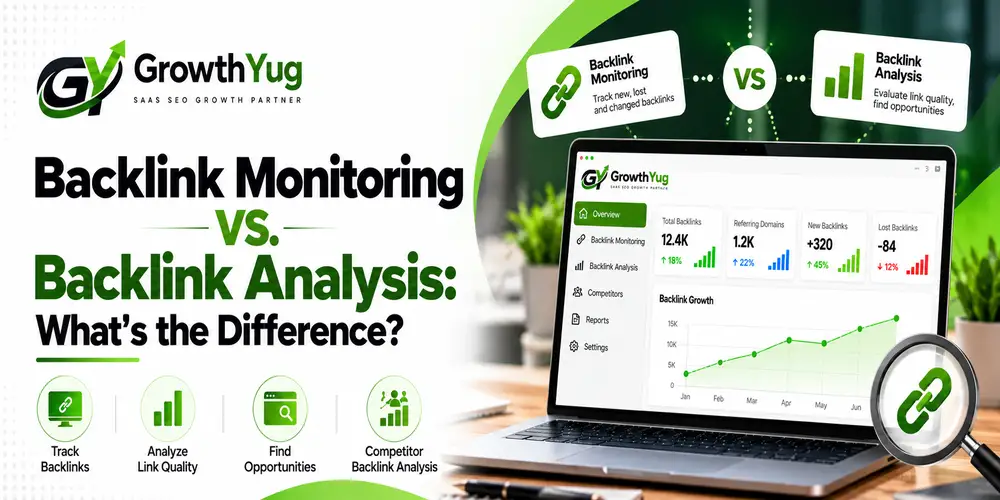
This is where backlink monitoring and Backlink Analysis come in. Although these terms are often used interchangeably, they serve different purposes. Backlink monitoring helps you track changes in your backlinks over time, while backlink analysis helps you evaluate the quality, relevance, and overall performance of those links.
Understanding the difference can help SaaS companies, digital marketers, and SEO professionals make better decisions about link building, competitor research, and long-term organic growth.
In this guide, we’ll explain backlink monitoring vs. backlink analysis, explore the best tools available, and show you how to use both approaches to improve your SEO strategy.
What Is Backlink Monitoring?
Backlink monitoring is the process of tracking your website’s backlinks over time. It helps you identify newly acquired links, lost backlinks, changes to existing links, and potential issues that could affect your backlink profile.
For example, suppose your SaaS website earns a backlink from a relevant industry blog. Backlink monitoring helps you check whether that link remains live, whether the linking page is still accessible, and whether the link attributes have changed.
Without consistent monitoring, you might not notice when valuable backlinks disappear or when unexpected links appear in your backlink profile.
Why Is Backlink Monitoring Important?
Backlink monitoring helps you:
- Track new backlinks: Discover when other websites link to your content.
- Identify lost backlinks: Find links that have disappeared or stopped pointing to your website.
- Protect valuable links: Investigate changes affecting important editorial placements.
- Monitor link attributes: Check whether links are marked as follow, nofollow, sponsored, or UGC.
- Measure link-building progress: Understand whether your campaigns are earning and retaining links.
- Spot unusual patterns: Investigate sudden backlink spikes or other unexpected changes.
Using reliable backlink monitoring tools makes it easier to track these changes without manually checking individual websites.
What Is Backlink Analysis?
Backlink Analysis is the process of evaluating the backlinks pointing to a website to understand their quality, relevance, diversity, and potential SEO value.
Rather than simply tracking whether a backlink exists, backlink analysis examines what that link tells you about your website’s backlink profile.
For example, you might have 500 backlinks, but the total number alone does not explain whether those links come from relevant websites, whether they point to useful pages, or whether they are helping you reach your SEO goals.
Backlink analysis helps answer those questions.
Why Is Backlink Analysis Important?
Backlink analysis helps SEO professionals:
- Evaluate link quality: Review the relevance and credibility of referring websites.
- Understand referring domains: Determine how many unique websites link to your content.
- Identify link-building opportunities: Find relevant websites that could be potential outreach targets.
- Conduct Competitor Backlink Analysis: Study where competitors earn links and identify gaps in your strategy.
- Review anchor text: Understand the words used in links pointing to your website.
- Support a Backlink Audit: Identify potentially problematic links, lost opportunities, and areas that need further investigation.
- Improve content strategy: Discover which pages and topics attract links from other websites.
Backlink analysis is particularly useful when planning a new SEO campaign, investigating a decline in organic visibility, or comparing your backlink profile with competitors.
Backlink Monitoring vs. Backlink Analysis: Key Differences
Both activities help you understand your backlink profile, but their main objectives differ.
| Comparison | Backlink Monitoring | Backlink Analysis |
|---|---|---|
| Primary purpose | Track backlink changes over time | Evaluate backlink quality and patterns |
| Main focus | New, lost, and changed backlinks | Relevance, referring domains, anchors, and link profile |
| Typical frequency | Ongoing or scheduled checks | Periodically and whenever needed |
| Main benefit | Helps you spot changes quickly | Helps you make informed SEO decisions |
| Common use case | Finding a lost editorial backlink | Comparing your links with a competitor’s |
| Useful metrics | New links, lost links, link status | Referring domains, anchor text, link relevance |
| Best suited for | Ongoing link management | Strategy, research, and audits |
Which One Should You Prioritize?
You should not treat backlink monitoring and backlink analysis as competing activities. They work best together.
Use backlink monitoring to keep track of what is happening to your backlink profile. Use backlink analysis to understand why those changes matter and what actions you should take next.
For example, monitoring might reveal that several backlinks have disappeared. Analysis can help you determine whether those links came from relevant websites, pointed to important pages, and deserve recovery outreach.
Similarly, analysis might reveal that competitors earn links from industry publications you have not targeted. Monitoring can then help you track the results of your outreach campaign.
What Are the Best Tools Available for Monitoring Backlinks and Analyzing Their Performance?
The best tool depends on your website size, budget, SEO experience, and whether you need ongoing monitoring, competitor research, or comprehensive backlink audits.
Here are some widely used options to consider.
1. Ahrefs
Ahrefs is a popular SEO platform for backlink research, competitor analysis, and link-profile tracking.
Best for: SEO agencies, SaaS businesses, and experienced marketers.
Key capabilities include:
- Discovering referring domains and backlinks
- Reviewing new and lost backlinks
- Conducting Competitor Backlink Analysis
- Examining anchor text and linking pages
- Identifying link-building opportunities
Ahrefs is useful when you want to combine backlink research with broader SEO analysis. Its available features and data depend on your subscription.
2. Semrush
Semrush offers backlink research and monitoring features alongside keyword research, site audits, and competitive SEO analysis.
Best for: Businesses that want several SEO capabilities in one platform.
Key capabilities include:
- Reviewing backlink profiles
- Tracking new and lost links
- Comparing competitors’ backlink profiles
- Evaluating referring domains and anchor text
- Investigating potentially toxic backlinks
Semrush can be a practical choice for marketing teams that want backlink monitoring and broader campaign reporting in the same workflow.
3. SE Ranking
SE Ranking provides backlink checking and monitoring capabilities as part of its broader SEO platform.
Best for: Small businesses, freelancers, and agencies looking for an integrated SEO toolkit.
Depending on the plan, useful capabilities can include:
- Tracking backlink status
- Reviewing referring domains
- Monitoring new and lost backlinks
- Analyzing competitor backlinks
- Supporting ongoing SEO reporting
Review the current plan limits before choosing it for a large website or multiple client campaigns.
4. Majestic
Majestic focuses heavily on backlink intelligence and link-profile analysis.
Best for: SEO professionals who want to investigate link relationships and backlink quality signals.
Its well-known metrics include Trust Flow and Citation Flow, which provide different perspectives on a website’s backlink profile. These are third-party metrics, not Google ranking factors.
Majestic can help you compare backlink profiles, evaluate referring domains, and investigate potential link opportunities.
5. Google Search Console
Google Search Console is a free tool that provides website owners with information about how Google Search interacts with their websites.
Its Links report shows examples of external links, internally linked pages, and commonly used linking text.
Best for: Website owners who want a free starting point for understanding their backlink profile.
Important limitations:
- It is not a complete real-time backlink monitoring platform.
- Its links report may not include every known backlink.
- It does not replace a dedicated competitor backlink research tool.
- It does not provide the same ongoing new-link and lost-link alerts as specialized monitoring platforms.
Despite these limitations, Google Search Console is a valuable addition to almost any SEO workflow.
6. Monitor Backlinks
Monitor Backlinks is a backlink-focused tool designed around tracking links and reviewing backlink profile changes.
Best for: Users whose primary requirement is dedicated backlink tracking.
Before selecting it, verify current product availability, supported features, pricing, and integration options. These details can change over time.
Backlink Monitoring Tools: Quick Comparison
| Tool | Main Strength | Best Use |
|---|---|---|
| Ahrefs | Backlink research and competitor discovery | Detailed SEO research |
| Semrush | Backlinks plus broader SEO features | Integrated SEO campaigns |
| SE Ranking | Backlink tracking and SEO reporting | Small businesses and agencies |
| Majestic | Backlink intelligence and link metrics | Link-profile investigation |
| Google Search Console | First-party search reporting at no cost | Basic backlink review |
| Monitor Backlinks | Backlink-focused tracking | Dedicated link monitoring |
No single tool is perfect for every business. Compare backlink database coverage, update frequency, alert options, export limits, reporting features, and pricing before making your decision.
How to Choose the Right Backlink Monitoring Tool
Choosing the right backlink monitoring tool requires more than comparing subscription prices. You need to consider how well it fits your SEO workflow.
1. Check New and Lost Backlink Tracking
Your chosen tool should make it easy to identify newly discovered and lost backlinks. This is particularly useful when managing editorial placements, guest posts, and ongoing link-building campaigns.
2. Review the Backlink Database
Different tools discover and report different backlinks. Compare their referring-domain coverage and the freshness of their data rather than assuming that one tool will show every link.
3. Look for Competitor Research
If you want to find new link-building opportunities, choose a platform that supports Competitor Backlink Analysis. It should help you review competitors’ referring domains, linking pages, and relevant content.
4. Evaluate Alerts and Reporting
Automated alerts and scheduled reports can save time. They are particularly valuable for agencies managing multiple websites or businesses running several campaigns simultaneously.
5. Consider Your Budget and Team Size
A solo marketer may need only a basic backlink tracker, while an SEO agency may require multiple projects, detailed exports, and client-ready reports.
Choose a plan based on the features you will actually use rather than paying for an extensive toolkit you do not need.
How to Conduct a Backlink Audit Using Monitoring and Analysis
A Backlink Audit brings monitoring and analysis together to help you understand the current state of your backlink profile.
Follow these steps to create a practical audit process.
Step 1: Collect Your Backlink Data
Use one or more backlink analysis tools to gather known backlinks, referring domains, anchor text, and linking-page information. Google Search Console can provide an additional perspective on links Google reports for your website.
Step 2: Identify New and Lost Links
Review recent backlink changes. Check whether important links have disappeared, whether new links have been acquired, and whether the changes require further investigation.
Step 3: Evaluate Link Relevance and Quality
Examine the linking website, the specific page, its relevance to your content, and the context in which your link appears. Do not rely on a single third-party authority score to determine whether a backlink is valuable.
Step 4: Review Anchor Text and Linking Patterns
Look for natural, relevant anchor text and investigate unusual patterns. A large number of links using identical commercial anchor text may deserve closer examination, but patterns should be evaluated in context rather than treated as automatic evidence of a problem.
Step 5: Conduct Competitor Backlink Analysis
Identify relevant competitors and study the websites linking to them. Look for industry publications, resource pages, expert roundups, listicles, and editorial content that could represent legitimate opportunities for your brand.
A competitor backlink is a research lead, not a guarantee that the same website will link to you.
Step 6: Prioritize Actionable Findings
Organize your findings into practical categories:
- Valuable lost links that may be recoverable
- Relevant new websites for outreach
- Important pages that attract backlinks
- Potentially manipulative links requiring closer review
- Content that could be improved to attract more editorial links
Step 7: Monitor the Results
After making changes or launching a link-building campaign, continue monitoring your backlink profile. Review whether links remain live, whether new referring domains appear, and whether the campaign supports your broader SEO objectives.
Important: Do not disavow backlinks solely because a third-party tool labels them toxic. Google recommends using the disavow tool cautiously, mainly when there is a substantial pattern of spammy or artificial links and a manual action or likely manual action risk. Review the evidence before taking action.
Common Backlink Monitoring and Analysis Mistakes
Even with the right tools, backlink reports can be misunderstood. Avoid these common mistakes.
Focusing Only on the Number of Backlinks
A large backlink count does not automatically indicate a strong backlink profile. Evaluate referring domains, relevance, context, and the quality of the linking pages.
Ignoring Lost Backlinks
Losing a valuable editorial link can reduce the strength of your backlink profile. Review lost-link reports to determine whether a link was intentionally removed, the page disappeared, or the linking website changed its content.
Treating Every Unfamiliar Link as Toxic
Some low-quality or irrelevant links occur naturally. Do not assume that every unfamiliar domain is harmful or that every link needs to be removed.
Copying Competitors Without Evaluating Relevance
Competitor research should help you discover opportunities, not encourage you to pursue every backlink your competitors have. Prioritize links that make sense for your audience and business.
Checking Metrics Without Taking Action
Reports are useful only when they inform decisions. Use your findings to improve content, recover valuable links, refine outreach, and develop a sustainable link-building strategy.
How GrowthYug Can Help You Build a Stronger Backlink Profile
Backlink monitoring tools help you understand your link profile, but effective SEO also requires a clear strategy for earning relevant, credible backlinks.
GrowthYug helps SaaS and B2B brands strengthen their SEO through strategic link-building services, including guest posting, editorial backlinks, brand mention links, and listicle link building.
Whether you are planning a new campaign or looking for ways to improve an existing backlink profile, a structured approach can help you identify relevant opportunities and build links that support your long-term SEO goals.
With GrowthYug, you can explore link-building opportunities aligned with your niche, target audience, and SEO objectives rather than focusing on backlink quantity alone.
Ready to strengthen your backlink strategy?
Visit GrowthYug to explore our SaaS link-building services and check our Link Building Packages and Pricing to find the right solution for your SEO goals and organic growth.
Frequently Asked Questions
1. What is the difference between backlink monitoring and backlink analysis?
Backlink monitoring tracks changes in your backlinks over time, including newly discovered and lost links. Backlink analysis evaluates the quality, relevance, and patterns of those links to support SEO decisions.
2. What are the best backlink monitoring tools?
Ahrefs, Semrush, SE Ranking, and backlink-focused platforms such as Majestic can help with different aspects of backlink tracking and research. Google Search Console is a useful free starting point. The best choice depends on your budget, required features, and website size.
3. Are free tools available to monitor backlinks?
Yes. Google Search Console provides a free Links report that helps website owners review examples of external links and internally linked pages. However, it does not provide all the automated monitoring, competitor research, or reporting features available in paid SEO tools.
4. How often should I monitor my backlinks?
For an actively managed website, ongoing or weekly monitoring is a practical approach. High-priority campaigns may benefit from more frequent checks, while smaller websites may review changes less often. The right frequency depends on campaign activity and business needs.
5. What is a Backlink Audit?
A Backlink Audit is a structured review of a website’s backlink profile. It examines referring domains, link relevance, anchor text, new and lost backlinks, and potential issues that may require further investigation.
6. How does Competitor Backlink Analysis help SEO?
Competitor Backlink Analysis identifies websites linking to competing brands and reveals potential opportunities for outreach, content promotion, and editorial coverage. It helps you understand how competitors attract links and where your own strategy may have gaps.
7. Can backlink monitoring improve Google rankings?
Backlink monitoring does not directly improve rankings on its own. It helps you track and manage links, identify lost opportunities, and assess link-building campaigns. SEO results depend on many factors, including content quality, relevance, technical performance, and the overall strength of your website.
8. Should I use a separate tool for monitoring and analysis?
Not necessarily. Many SEO platforms offer both monitoring and analysis features. A single platform may be sufficient for smaller websites, while agencies and larger SaaS businesses may benefit from combining tools to compare backlink data and improve reporting accuracy.