
Domain Authority vs. Domain Rating vs. Authority Score: Key Differences!
When evaluating a website’s SEO strength or researching backlink opportunities, you will often come across three important metrics: Domain Authority (DA), Domain Rating (DR), and Authority Score (AS).
These metrics are commonly used by SEO professionals, digital marketing agencies, and link-building specialists to evaluate websites, compare competitors, and assess potential backlink sources.
However, there is a common misunderstanding: many people assume that DA, DR, and Authority Score measure exactly the same thing. Others believe that a website with a higher score will automatically rank better on Google.
Neither assumption is correct.
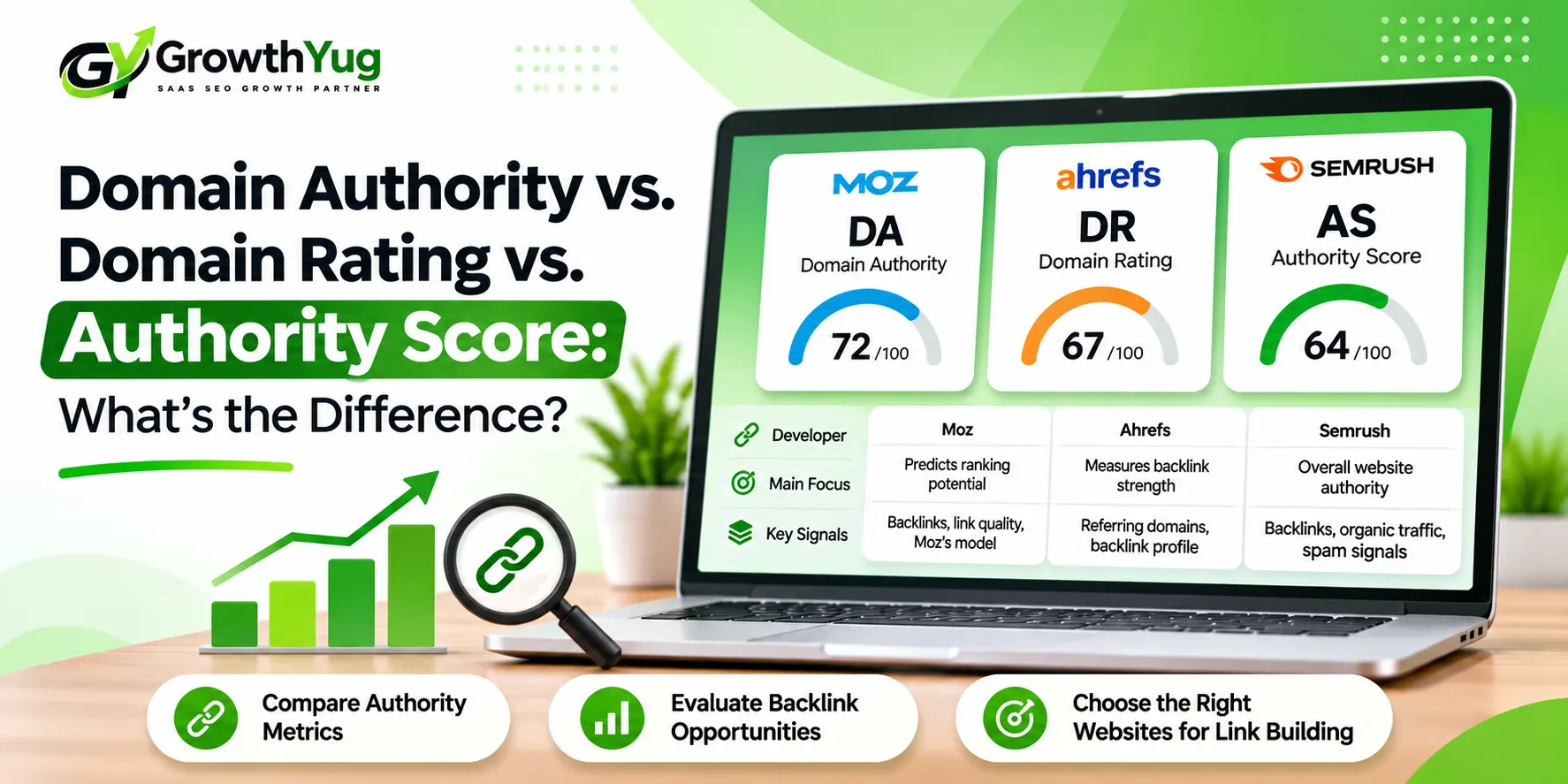
Domain Authority is developed by Moz, Domain Rating is developed by Ahrefs, and Authority Score is developed by Semrush. Each platform uses its own data, methodology, and calculation process to estimate website strength.
Understanding these differences is essential when planning an SEO campaign, evaluating guest posting websites, conducting competitor backlink analysis, or building a high-quality backlink profile.
In this guide, we explain how DA, DR, and Authority Score work, how they differ, what makes a score good, and how to use them effectively in your link-building strategy.
Quick Comparison: DA vs. DR vs. Authority Score
Before exploring each metric in detail, here is a quick comparison.
| Comparison Factor | Domain Authority (DA) | Domain Rating (DR) | Authority Score (AS) |
|---|---|---|---|
| Developed by | Moz | Ahrefs | Semrush |
| Main purpose | Predicts relative ranking potential | Measures backlink profile strength | Evaluates overall website authority and quality |
| Score range | 1–100 | 0–100 | 0–100 |
| Primary data | Link index and predictive model | Backlink profile | Backlinks, organic traffic, spam signals |
| Backlink analysis | Yes | Yes | Yes |
| Traffic considered | Not a direct core input in the same way as AS | No | Yes |
| Spam-related signals | Separate Spam Score metric | Not directly included in DR calculation | Included in Natural Profile assessment |
| Best use | Comparing domain ranking potential | Comparing backlink strength | Evaluating broader website authority |
| Official tool | Moz Link Explorer | Ahrefs Site Explorer | Semrush Domain Overview |
Important: These metrics are proprietary estimates. Their scores are not interchangeable, and Google does not use Moz DA, Ahrefs DR, or Semrush Authority Score as direct ranking factors.
1. What Is Domain Authority (DA)?
Domain Authority (DA) is a website authority metric developed by Moz. It predicts how likely a website is to rank in search engine results compared with other websites.
The score ranges from 1 to 100. Generally, a higher score indicates stronger estimated ranking potential relative to other domains in Moz’s index.
For example:
- Website A: DA 18
- Website B: DA 42
- Website C: DA 68
Based on Moz’s metric, Website C has a stronger estimated ranking potential than Website A or Website B. However, this does not guarantee that Website C will rank higher for every keyword.
How Is Domain Authority Calculated?
Moz calculates Domain Authority using its own link index and a machine-learning model designed to predict a website’s ranking potential.
Its methodology considers information about the website’s backlink profile and the relationships between linking domains.
Factors associated with evaluating DA include:
- Linking root domains.
- Quality and quantity of inbound links.
- The strength of the website’s link profile.
- Patterns identified through Moz’s link data.
- A predictive model that estimates ranking potential.
Moz does not publish every detail of its calculation formula. Therefore, DA should be treated as a comparative metric rather than a precise measurement of Google’s assessment of a website.
What Is a Good Domain Authority Score?
There is no universal DA score that makes a website good or bad. The right benchmark depends on the website’s industry, competition, age, and SEO objectives.
The following ranges can be used as broad reference points, not official Moz classifications.
| DA Score | General Interpretation |
|---|---|
| 1–10 | Very low authority |
| 11–20 | Developing authority |
| 21–30 | Moderate authority |
| 31–40 | Established authority |
| 41–50 | Strong comparative authority |
| 51–60 | High comparative authority |
| 61–70 | Very high comparative authority |
| 71–80 | Excellent comparative authority |
| 81–100 | Extremely high comparative authority |
A DA 25 website with relevant content and genuine traffic may be a better backlink opportunity than a DA 70 website with unrelated content and an unnatural backlink profile.
How to Check Domain Authority
You can check a website’s DA using Moz’s tools.
Steps:
- Visit the official Moz website.
- Open Moz Link Explorer.
- Enter the domain you want to analyze.
- Review the Domain Authority score.
- Examine linking domains and backlink information.
- Review Spam Score and other available link metrics.
Official tool: https://moz.com/link-explorer
Advantages of Domain Authority
- Helps compare websites within the same industry.
- Useful for evaluating potential backlink prospects.
- Provides a simple metric for SEO reporting.
- Helps track changes in a domain’s estimated authority over time.
- Commonly used by SEO professionals and link-building agencies.
Limitations of Domain Authority
- It is not a Google ranking factor.
- It does not guarantee keyword rankings.
- It cannot independently determine whether a backlink is valuable.
- Scores may change as Moz updates its index and methodology.
- A high DA does not automatically mean a website has relevant content or genuine organic traffic.
2. What Is Domain Rating (DR)?
Domain Rating (DR) is a website authority metric developed by Ahrefs. It measures the relative strength of a website’s backlink profile compared with other websites in Ahrefs’ database.
DR ranges from 0 to 100. A higher DR generally indicates a stronger backlink profile according to Ahrefs’ calculation methodology.
Unlike metrics that combine several website-quality signals, DR focuses specifically on backlink-related data.
For example:
- Website A: DR 15
- Website B: DR 38
- Website C: DR 72
According to Ahrefs, Website C has a stronger backlink profile than Website A and Website B.
However, this does not necessarily mean Website C is the best website from which to acquire a backlink.
How Is Domain Rating Calculated?
Ahrefs calculates DR by evaluating the backlink profiles of websites in its database.
Its methodology considers:
- The number of unique domains linking to a website.
- The DR of referring domains.
- The number of unique websites each referring domain links to.
- The distribution of backlink strength across linked domains.
One important concept is that a referring domain’s influence is distributed among the unique domains it links to.
For example, consider two websites:
- Website A has a DR of 70 and links to 1,000 unique domains.
- Website B has a DR of 35 and links to only 10 unique domains.
The number of unique domains linked by each source can influence how much DR value is passed through Ahrefs’ calculation.
This is why simply acquiring a backlink from the website with the highest DR does not guarantee the strongest impact on your own DR.
What Is a Good Domain Rating?
There is no fixed DR benchmark that applies to every website. Ahrefs describes DR as a relative metric, so comparing your website with similar competitors is more meaningful than targeting an arbitrary number.
Here is a general reference guide:
| DR Score | General Interpretation |
|---|---|
| 0–10 | Very low backlink strength |
| 11–20 | Developing backlink profile |
| 21–30 | Moderate backlink strength |
| 31–40 | Established backlink profile |
| 41–50 | Strong comparative profile |
| 51–60 | High backlink strength |
| 61–70 | Very high backlink strength |
| 71–80 | Excellent backlink strength |
| 81–100 | Extremely strong backlink profile |
These are informal descriptions, not official Ahrefs score categories.
How to Check Domain Rating
You can check DR through Ahrefs.
Steps:
- Visit the Ahrefs website.
- Open Site Explorer or the free Website Authority Checker.
- Enter the website domain.
- Review its Domain Rating.
- Examine referring domains and backlinks.
- Investigate the quality and relevance of linking websites.
Official tools:
Advantages of Domain Rating
- Provides a clear view of relative backlink profile strength.
- Useful for competitor backlink analysis.
- Helps identify websites with established link profiles.
- Supports backlink prospect research.
- Useful for tracking backlink-related progress.
Limitations of Domain Rating
- It does not directly measure organic search traffic.
- It is not a Google ranking factor.
- It does not independently evaluate content quality.
- It does not directly include spam signals in the DR calculation.
- A high DR website may still be irrelevant to your business or audience.
3. What Is Authority Score (AS)?
Authority Score (AS) is a proprietary website authority metric developed by Semrush.
It evaluates the overall quality and SEO strength of a domain or webpage using three main groups of signals:
- Link Power
- Organic Traffic
- Natural Profile and spam-related signals
Authority Score ranges from 1 to 100. A higher score generally indicates a stronger website according to Semrush’s methodology.
The main difference between Authority Score and DR is that Semrush incorporates estimated organic traffic and spam-related signals alongside backlink information.
How Is Authority Score Calculated?
Semrush calculates Authority Score using eight weighted factors grouped into three main categories.
A. Link Power
Link Power evaluates the strength of a website’s backlink profile.
It considers signals such as:
- The number of referring domains.
- The quality of backlinks.
- The strength of linking domains.
- The overall backlink profile.
A website with relevant and trustworthy referring domains may have a stronger Link Power profile than one with many low-quality links.
B. Organic Traffic
Organic Traffic represents the estimated monthly search traffic a website receives from unpaid search results.
This signal helps Semrush understand whether a website has an established presence in organic search.
For example:
- Website A has thousands of backlinks but very little estimated organic traffic.
- Website B has fewer backlinks but receives consistent organic search traffic.
The organic traffic component can help distinguish these websites within Semrush’s Authority Score methodology.
C. Natural Profile
The Natural Profile component evaluates signals that may indicate unnatural or manipulated backlink patterns.
Semrush documents checks including:
- An unusually high percentage of dofollow referring domains.
- A mismatch between backlink profile size and estimated organic traffic.
- Too many referring domains sharing the same IP address.
- Too many referring domains sharing the same IP network.
- Very limited keyword rankings.
- Similarity with another domain’s backlink profile.
These checks are intended to help identify suspicious patterns. They should not be treated as proof that a website is using spam tactics.
What Is a Good Authority Score?
Like DA and DR, there is no universal Authority Score that guarantees a good backlink opportunity.
The following ranges are general reference points rather than official Semrush classifications.
| Authority Score | General Interpretation |
|---|---|
| 1–10 | Low authority |
| 11–20 | Developing authority |
| 21–30 | Moderate authority |
| 31–40 | Established authority |
| 41–50 | Strong comparative authority |
| 51–60 | High authority |
| 61–70 | Very high authority |
| 71–80 | Excellent authority |
| 81–100 | Extremely high authority |
Semrush also provides contextual labels for some scores, including niche relevance. A lower-scoring website can still be valuable if it has strong relevance to your industry.
How to Check Authority Score
You can check Authority Score using Semrush.
Steps:
- Visit Semrush.
- Open the Domain Overview tool.
- Enter the website domain.
- Find the Authority Score metric.
- Review estimated organic traffic.
- Examine referring domains and backlink information.
- Investigate the website’s overall SEO performance.
Official tool: https://www.semrush.com/analytics/overview/
Advantages of Authority Score
- Combines backlink information with organic traffic estimates.
- Includes spam-related signals in its calculation.
- Useful for evaluating potential link-building websites.
- Helps compare domains during competitor research.
- Offers a broader perspective than a backlink-only metric.
Limitations of Authority Score
- It is not a Google ranking factor.
- Organic traffic is estimated, not a direct measurement of actual analytics data.
- It is based on Semrush’s own database and methodology.
- A high score does not guarantee that a website is relevant to your niche.
- A lower score does not automatically make a website unsuitable for link building.
4. DA vs. DR vs. Authority Score: Key Differences Explained
Although all three metrics use a 0–100 scale, they do not measure website strength in exactly the same way.
Let’s understand their major differences.
Difference 1: Different SEO Platforms
Each metric belongs to a different SEO platform.
| Metric | SEO Platform |
|---|---|
| Domain Authority | Moz |
| Domain Rating | Ahrefs |
| Authority Score | Semrush |
Each platform maintains its own backlink index, data collection systems, and scoring methodology.
Therefore, the scores for the same website can vary significantly.
Difference 2: Different Calculation Methods
This is one of the most important differences.
- DA: Uses Moz’s link data and a machine-learning model to predict relative ranking potential.
- DR: Focuses on backlink profile strength, including referring domains and their link relationships.
- Authority Score: Combines backlink strength, estimated organic traffic, and spam-related signals.
A website can have a high DR but a comparatively lower Authority Score if its backlink profile is strong while its estimated organic traffic is limited.
Similarly, a website may have a different DA because Moz uses its own index and predictive model.
Difference 3: Different Backlink Databases
Moz, Ahrefs, and Semrush do not maintain identical backlink databases.
Each platform discovers and processes links differently.
As a result:
- Moz may discover certain referring domains that another platform has not recorded.
- Ahrefs may report a different number of backlinks because of its own crawling and indexing process.
- Semrush may calculate authority differently because it combines multiple types of signals.
This explains why the same website can have three different authority scores.
Difference 4: Organic Traffic Consideration
Organic traffic is an important distinction between these metrics.
Semrush includes estimated organic traffic in its Authority Score calculation.
Ahrefs DR is based on backlink-related factors and does not directly include organic traffic.
Moz DA is a predictive metric based on its own link index and machine-learning methodology, not a direct traffic measurement.
Difference 5: Spam-Related Signals
Semrush includes spam-related checks in its Authority Score calculation.
Moz provides a separate Spam Score metric that can be considered alongside DA.
Ahrefs DR itself is not a spam score and does not directly incorporate spam signals into its calculation.
This distinction matters when evaluating backlink opportunities because a high authority score alone cannot establish that a website is safe or suitable.
5. Why Do DA, DR, and Authority Score Differ for the Same Website?
It is normal for the same domain to have different scores across SEO platforms.
For example, a website might show:
| SEO Metric | Example Score |
|---|---|
| Moz Domain Authority | 45 |
| Ahrefs Domain Rating | 58 |
| Semrush Authority Score | 37 |
These are illustrative numbers, not actual measurements of a specific website.
Why does this happen?
1. Different Backlink Indexes
Each SEO platform discovers, crawls, and stores backlink information independently.
One platform may identify more referring domains than another.
2. Different Calculation Formulas
Each provider uses its own proprietary methodology.
Even if two platforms identify the same backlinks, their scores may still differ because they assign different weights to the data.
3. Different Update Cycles
Backlink databases and authority scores are updated according to each provider’s processes.
A recently acquired backlink may appear in one platform before it appears in another.
4. Different Signal Weighting
DA, DR, and Authority Score do not assign the same importance to every signal.
For example, Semrush includes estimated organic traffic in its Authority Score methodology, whereas Ahrefs DR focuses on backlink strength.
5. Different Treatment of Linking Domains
A website’s number of referring domains is not the only consideration.
The strength of linking domains, their outgoing links, and the quality of the overall link profile can affect the final score differently across platforms.
The takeaway: Never assume that a 50 DA website is equivalent to a 50 DR or a 50 Authority Score website.
6. Which Metric Is Best for Backlink Analysis?
The best metric depends on what you want to evaluate.
| Your SEO Requirement | Metric to Consider | Why |
|---|---|---|
| Compare ranking potential | Domain Authority | Moz’s predictive authority metric |
| Evaluate backlink profile strength | Domain Rating | Focuses on backlink relationships |
| Evaluate broader website authority | Authority Score | Combines links, traffic, and spam signals |
| Review potential spam indicators | Spam Score and other link checks | Helps investigate suspicious patterns |
| Compare competitors | All three | Provides different perspectives |
| Evaluate guest posting websites | All three plus manual checks | Helps avoid relying on one score |
Should You Use One Metric or All Three?
For serious link-building campaigns, it is better to use more than one metric.
For example, when evaluating a potential guest posting website, you could:
- Check DA using Moz.
- Review DR using Ahrefs.
- Check Authority Score using Semrush.
- Examine estimated organic traffic.
- Review referring domains.
- Check whether the website publishes relevant content.
- Investigate the quality of its outbound links.
- Review whether its audience matches your target market.
This approach provides a more complete picture than relying on a single number.
7. How to Evaluate a Website Before Building a Backlink
A website’s authority score is only one part of backlink evaluation.
Before investing time or money in a backlink opportunity, examine these important factors.
1. Topical Relevance
Check whether the website publishes content related to your industry.
For example, if you operate a SaaS business, relevant websites may include:
- SaaS publications.
- Technology blogs.
- Software review websites.
- Business and startup publications.
- Marketing and productivity websites.
A relevant website with a moderate authority score may be more useful than an unrelated website with a much higher score.
2. Organic Search Traffic
Check whether the website receives meaningful organic search traffic.
Look at:
- Estimated monthly organic traffic.
- Ranking keywords.
- Traffic trends.
- Top-performing pages.
- Country-level traffic distribution.
Be careful with sudden traffic increases or declines. Investigate the reasons rather than making decisions based on one snapshot.
3. Referring Domains
Review how many unique websites link to the domain.
Check:
- Quality of referring domains.
- Relevant industry websites.
- Natural backlink growth.
- Repeated or suspicious linking patterns.
- Diversity of referring sources.
More backlinks do not automatically mean a stronger website.
4. Content Quality
Review the actual content published on the website.
Ask:
- Is the content original and useful?
- Does it provide information for a real audience?
- Are articles regularly maintained?
- Does the website have clear editorial standards?
- Are topics relevant to its industry?
5. Outbound Link Quality
A website that links to every unrelated industry may require additional investigation.
Check whether it publishes excessive sponsored articles, irrelevant guest posts, or links to suspicious websites.
6. Audience and Geographic Relevance
Evaluate whether the website reaches the audience you want to attract.
For a business targeting the United States, a website with a relevant US audience may be more suitable than a website whose audience is concentrated in unrelated markets.
7. Placement and Context
The location and context of a backlink matter.
A relevant editorial link within a useful article is generally a stronger prospect than an unrelated link placed in a low-quality directory or an isolated page.
8. Example: How to Compare Three Backlink Opportunities
Imagine you are managing SEO for a SaaS company and have shortlisted three websites for potential link-building opportunities.
Here is an illustrative comparison:
| Evaluation Factor | Website A | Website B | Website C |
|---|---|---|---|
| Domain Authority | 55 | 35 | 48 |
| Domain Rating | 62 | 42 | 51 |
| Authority Score | 31 | 45 | 52 |
| Estimated Monthly Traffic | 2,000 | 18,000 | 12,000 |
| Industry Relevance | Low | High | High |
| Content Quality | Moderate | High | High |
| Backlink Opportunity | Review carefully | Strong candidate | Strong candidate |
Which website would you choose?
Website A has the highest DA and DR, but its relevance is low and its estimated traffic is limited.
Website B has lower DA and DR, but it has stronger industry relevance and useful organic visibility.
Website C also has strong relevance, content quality, and traffic.
Based on this information, Websites B and C may deserve further investigation before Website A.
This example demonstrates an important principle:
The best backlink opportunity is not necessarily the website with the highest authority score.
Always evaluate the complete website rather than making decisions based on DA, DR, or Authority Score alone.
9. How to Improve Your Website’s DA, DR, and Authority Score
You cannot directly increase these scores by changing a setting on your website.
Instead, focus on improving the signals that these tools evaluate.
Here are practical strategies for building a stronger website and backlink profile.
1. Earn Relevant, High-Quality Backlinks
Focus on acquiring backlinks from websites that publish useful content in your industry.
Prioritize:
- Relevant editorial backlinks.
- Genuine guest post placements.
- Industry publications.
- Resource-page links.
- Relevant business and partner mentions.
- Natural references from authoritative content.
Avoid buying large quantities of low-quality links simply to increase DA or DR.
2. Publish Link-Worthy Content
Create useful resources that other websites have a reason to reference.
Examples include:
- Original research and industry reports.
- SaaS comparison guides.
- Detailed tutorials.
- Case studies.
- Free tools and templates.
- Expert insights and practical data.
Useful content gives publishers a genuine reason to link to your website.
3. Analyze Competitor Backlinks
Study the backlink profiles of competitors that perform well in your target market.
Identify:
- Websites linking to multiple competitors.
- Industry publications.
- Guest posting opportunities.
- Relevant resource pages.
- Unlinked brand mentions.
- Content attracting natural backlinks.
Use competitor analysis to discover opportunities, not to copy every backlink.
4. Recover Lost Backlinks
Monitor your backlink profile for links that have disappeared.
If a valuable link is lost, investigate whether:
- The linking page was removed.
- The destination URL changed.
- The website updated its content.
- The backlink was removed accidentally.
- The original page returned an error.
When appropriate, contact the website owner and request restoration or an updated link.
5. Improve Internal Linking
Create a clear internal linking structure that helps search engines and users discover important pages.
Link relevant supporting articles to key product, service, and resource pages using descriptive anchor text.
Internal links do not directly increase DA or DR, but they can improve navigation and help distribute link equity across your website.
6. Maintain a Natural Backlink Profile
Avoid manipulative link-building patterns.
Build backlinks gradually through relevant content, genuine outreach, and useful editorial contributions.
Do not focus on achieving a particular DA, DR, or Authority Score at any cost.
7. Monitor Your SEO Performance
Track more than authority metrics.
Monitor:
- Organic traffic.
- Keyword rankings.
- Referring domains.
- New and lost backlinks.
- Indexed pages.
- Conversions and qualified leads.
These indicators help you understand whether your SEO strategy is contributing to business growth.
10. Common Mistakes to Avoid When Using DA, DR, and Authority Score
Many businesses and SEO professionals make decisions based on authority scores without understanding their limitations.
Avoid these common mistakes.
Mistake 1: Treating All Three Scores as Equal
A DA of 40, DR of 40, and Authority Score of 40 are not equivalent.
Each metric uses a different calculation methodology.
Mistake 2: Assuming Higher Scores Guarantee Better Rankings
Google does not use these third-party scores as direct ranking factors.
A website with a lower score can rank above a website with a higher score for a particular keyword.
Mistake 3: Buying Backlinks Only Based on DA or DR
A high-score website may have irrelevant content, low-quality traffic, or excessive outbound links.
Evaluate the website’s overall quality before considering a placement.
Mistake 4: Ignoring Organic Traffic
A website’s authority score does not tell the complete story.
Review organic visibility, ranking keywords, and traffic trends alongside backlink metrics.
Mistake 5: Chasing Score Increases Instead of SEO Results
Increasing DA or DR should not be the primary goal of a link-building campaign.
Focus on relevant backlinks, improved organic visibility, qualified traffic, and business outcomes.
Mistake 6: Ignoring Topical Relevance
A backlink from a relevant industry website can be more strategically valuable than a link from an unrelated high-authority website.
11. How GrowthYug Helps You Build a Stronger Backlink Profile
Understanding DA, DR, and Authority Score is useful, but selecting the right backlink opportunities and executing a consistent link-building strategy is what matters next.
At GrowthYug, we help SaaS businesses and growing brands strengthen their online presence through strategic link-building solutions.
Our approach focuses on relevant websites, quality placements, and backlink opportunities aligned with your industry and SEO goals.
Our Link-Building Services
Build relevant backlinks for SaaS businesses to strengthen their online authority and support organic search growth.
Earn relevant placements through useful, industry-focused guest content.
Build contextual backlinks through relevant editorial opportunities and publisher relationships.
Listicle Link Building
Get your brand featured in relevant industry listicles, produ
Brand Mention Links
ct roundups, and curated recommendation articles. Improve brand visibility, reach potential customers, and earn valuable contextual backlinks.
Turn existing unlinked brand mentions into valuable backlink opportunities. Identify websites already mentioning your brand and reach out to publishers to request relevant links to your website.
Build Backlinks That Support Long-Term SEO Growth
Don’t focus only on increasing DA, DR, or Authority Score. Focus on acquiring relevant backlinks that strengthen your website’s visibility, credibility, and organic growth potential.
Partner with GrowthYug for strategic SaaS link building, white label link building, guest posting, and editorial backlink acquisition.
Ready to strengthen your backlink profile?
Explore GrowthYug’s Link Building Services, Link Building Packages and Pricing, and find the right strategy for your SEO goals.
Partner with GrowthYug for strategic SaaS link building, white-label link building, guest posting, and editorial backlink acquisition.
Explore our Link Building Packages and Pricing and discuss your SEO requirements with our team.
Final Thoughts
Domain Authority vs. Domain Rating vs. Authority Score is not about finding one perfect SEO metric. It is about understanding what each platform measures and using that information to make better decisions.
Moz DA helps estimate relative ranking potential, Ahrefs DR measures backlink profile strength, and Semrush Authority Score combines backlink data, organic traffic, and spam-related signals.
All three can support competitor research and backlink evaluation, but none should be treated as a direct measure of Google’s ranking decisions.
For a stronger SEO strategy, evaluate the complete website: backlink quality, organic traffic, topical relevance, content quality, and editorial standards.
Ultimately, the goal should not be to achieve the highest authority score. It should be to build a trustworthy backlink profile that supports sustainable organic visibility and business growth.
Frequently Asked Questions (FAQs)
1. What is the difference between Domain Authority, Domain Rating, and Authority Score?
Domain Authority is developed by Moz, Domain Rating is developed by Ahrefs, and Authority Score is developed by Semrush. DA uses Moz’s predictive link-based model, DR measures backlink profile strength, and Authority Score combines backlink data, estimated organic traffic, and spam-related signals.
2. Is DA the same as DR?
No. Domain Authority and Domain Rating are different metrics developed by different SEO platforms. Both use a 0–100 scale, but their databases and calculation methods are different.
3. Is Domain Authority a Google ranking factor?
No. Domain Authority is a third-party metric developed by Moz. Google does not use Moz’s DA score as a direct ranking factor.
4. Is Domain Rating a Google ranking factor?
No. Domain Rating is an Ahrefs metric used to estimate the relative strength of a website’s backlink profile. It is not a direct Google ranking factor.
5. Is Semrush Authority Score a ranking factor?
No. Authority Score is Semrush’s proprietary metric. It helps SEO professionals evaluate websites, but Google does not use the score directly to rank websites.
6. Which is better: DA, DR, or Authority Score?
None is universally better. DA is useful for comparing estimated ranking potential, DR focuses on backlink profile strength, and Authority Score provides a broader assessment using backlinks, estimated organic traffic, and spam-related signals.
7. Why is my DA higher than my DR?
Moz and Ahrefs use different backlink databases and scoring methodologies. Your website may have a higher DA than DR because the platforms discover different referring domains and assign different weights to link-related signals.
8. What is a good DA score for a website?
There is no universal good DA score. Compare your website with competitors in the same industry and consider relevance, organic traffic, backlink quality, and business goals.
9. What is a good DR score for backlinks?
A good DR depends on the website’s niche and competition. A relevant website with a moderate DR and genuine traffic may be a better backlink prospect than an unrelated website with a very high DR.
10. What is a good Authority Score in Semrush?
There is no fixed score that guarantees a valuable website. Review the Authority Score alongside organic traffic, backlink quality, topical relevance, and Semrush’s Natural Profile signals.
11. Can a website have high DA but low DR?
Yes. Since Moz and Ahrefs use different databases and calculation methods, a website can have a high DA and a comparatively low DR.
12. Does increasing backlinks improve DA and DR?
Acquiring relevant, quality backlinks may improve the signals used in these metrics. However, changes are not guaranteed, and the scores depend on each platform’s methodology and database updates.
13. Can a low-authority website rank on Google?
Yes. Websites with lower DA, DR, or Authority Score can rank well when their pages satisfy search intent, offer useful content, and compete effectively for specific search queries.
14. Which metric should I use for guest posting?
Use DA, DR, and Authority Score as supporting indicators rather than selection rules. Also examine organic traffic, topical relevance, editorial quality, outbound links, and the website’s audience.
15. How often should I check DA, DR, and Authority Score?
A monthly review is a reasonable starting point for most businesses. For active link-building campaigns, monitor backlink changes and SEO performance more frequently.
Related Posts :
How to Measure SEO ROI for SaaS: From Organic Traffic to Pipeline and Revenue
How to Build a Monthly Backlink Monitoring Report: A Complete SEO Guide
Backlink Monitoring Tools Compared: Ahrefs vs. Semrush vs. Moz vs. Free Tools
Link Building for B2B vs. B2C SaaS: What’s Different?
How to Choose a B2B Link Building Agency in 2026
Google Search Console vs. Dedicated Backlink Monitoring Tools: Which Is Better?
Why Are Your Backlinks Not Getting Indexed? Causes, Checks, and Fixes
Backlink Monitoring vs. Backlink Analysis: What’s the Difference?
How to Track Competitor Backlinks and Find Link Opportunities!
AI and Link Building: What SaaS Marketers Need to Know in 2026