
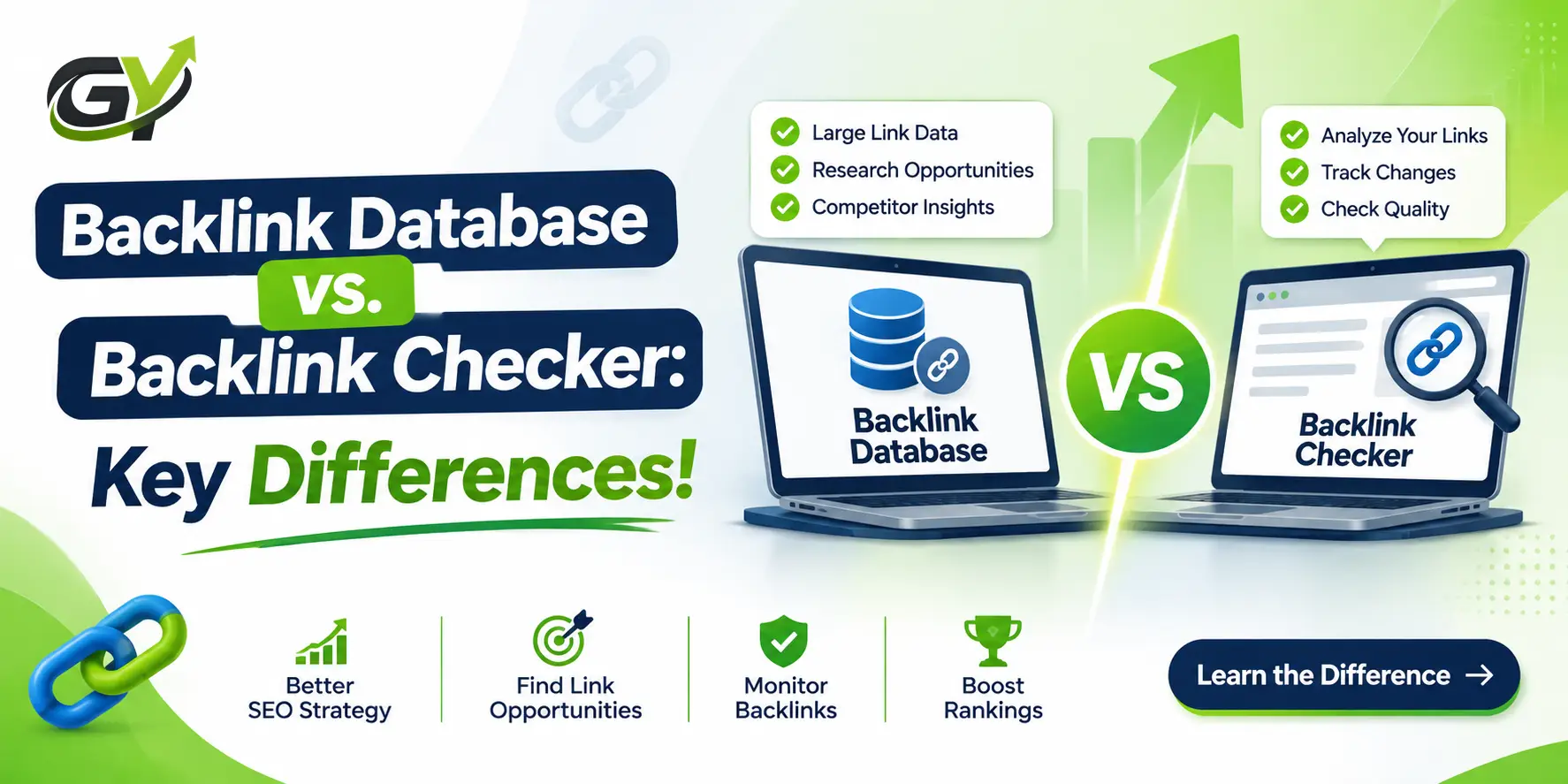
Backlink Database vs. Backlink Checker:Key Differences!
Backlinks play an important role in search engine optimization (SEO). They help search engines discover webpages, understand relationships between websites, and evaluate signals of authority and relevance. For businesses looking to improve their organic visibility, understanding and managing backlinks is an essential part of a successful SEO strategy.
However, finding, analyzing, and managing backlinks requires access to reliable data. This is where a Backlink Database and backlink checker become valuable.
Although these two SEO resources are closely connected, they serve different purposes. A backlink database provides a broader collection of backlink information from websites across the internet, while a backlink checker helps users analyze the backlinks associated with a particular domain or URL.
Whether you are an SEO professional, digital marketing agency, SaaS business, or website owner, understanding these differences can help you make better link-building decisions.
In this guide, we will explore everything about backlink databases and backlink checkers, including how they work, their features, benefits, differences, practical applications, limitations, and frequently asked questions.
What Is a Backlink Database?
A Backlink Database is a structured collection of information about links pointing from one website to another. It contains backlink records gathered through web crawling and other data collection processes.
SEO platforms use these databases to help users research backlink profiles, identify referring domains, analyze competitors, and discover potential link-building opportunities.
For example, imagine you own a SaaS website and want to discover which websites are linking to other businesses in your industry. Instead of manually checking hundreds of websites, you can use a backlink database to explore existing link relationships and identify relevant prospects.
A typical backlink database may contain:
- Source page URLs
- Target page URLs
- Referring domain information
- Anchor text
- Follow and nofollow attributes
- First-seen and last-seen dates
- Historical backlink information
- Domain and page-level SEO metrics
- Linking page status
The available information depends on the SEO platform and its crawling coverage.
A well-maintained backlink database makes large-scale backlink research easier and helps SEO professionals identify opportunities that may otherwise be difficult to discover. For a focused introduction, read our guide on what a backlink database is.
What Is a Backlink Checker?
A backlink checker is an SEO tool that analyzes the backlinks pointing to a specific website, domain, or webpage.
Its primary purpose is to help users understand their existing backlink profile and evaluate the characteristics of incoming links.
For example, if you enter your website URL into a backlink checker, you may see the number of backlinks, referring domains, anchor text distribution, link attributes, and other available metrics.
Common backlink checker features include:
- Total backlinks
- Referring domains
- Anchor text analysis
- Follow and nofollow links
- New and lost backlinks
- Linking page information
- Competitor backlink comparisons
- Backlink quality indicators
Backlink checkers are particularly useful for website owners who want to monitor their link profiles and investigate changes in backlink performance.
Backlink Database vs. Backlink Checker: What Is the Difference?
A backlink database and a backlink checker both provide backlink-related information, but they are designed for different research activities.
A backlink database focuses on collecting, organizing, and making backlink records searchable. A backlink checker focuses on examining backlinks associated with a specific website or webpage.
| Comparison Factor | Backlink Database | Backlink Checker |
|---|---|---|
| Main purpose | Stores and organizes backlink information | Analyzes a website’s backlink profile |
| Data coverage | Broad collection of backlink records | Specific domains or URLs |
| Research capabilities | Supports large-scale backlink research | Supports focused backlink analysis |
| Competitor analysis | Helps discover link opportunities across competitors | Examines competitor backlink profiles |
| Link prospecting | Useful for identifying potential websites | Helps evaluate existing link relationships |
| Historical information | May provide historical backlink records | Depends on platform features |
| Data exploration | Supports broader research and filtering | Focuses on selected websites |
| Main users | SEO agencies, researchers, and link builders | Website owners and SEO professionals |
The two resources are complementary rather than competing solutions. Using them together can make backlink research more organized and effective.
How Does a Backlink Database Work?
A backlink database is generally built through a combination of web crawling, link extraction, data processing, and indexing.
Although the exact process differs between SEO platforms, the basic workflow follows several steps.
1. Website Crawling
SEO crawlers visit webpages across the internet to discover links and collect information about website content and structure.
During this process, crawlers identify links pointing from one webpage to another.
2. Link Extraction
After discovering webpages, the crawler extracts relevant hyperlink information.
This may include source URLs, destination URLs, anchor text, link attributes, page information, and HTTP response status.
3. Data Processing
Collected information is processed, organized, and checked for duplicates or inconsistencies.
SEO platforms may also calculate additional metrics to help users understand the characteristics of linking domains and pages.
4. Database Indexing
The processed backlink records are stored in an organized database.
Indexing makes it possible for users to search and filter backlink information based on domains, URLs, anchor text, and other available fields.
5. Regular Updates
Websites frequently publish new pages, remove content, update links, or change website structures.
SEO crawlers revisit webpages to discover new backlinks and identify links that are no longer available.
However, no backlink database contains every link on the internet. Coverage depends on crawler capacity, discovery methods, update frequency, and platform infrastructure.
Important Data Available in a Backlink Database
Understanding backlink data is essential before using it for SEO research. Different metrics provide different insights into the quality, relevance, and structure of a website’s backlink profile.
1. Referring Domains
A referring domain is a unique website that links to your website.
For example, if five different pages on one website link to your domain, they generally count as five backlinks but only one referring domain.
Referring domain information helps SEO professionals understand the diversity of websites linking to a particular domain.
2. Anchor Text
Anchor text is the clickable text used in a hyperlink.
For example, if another website links to GrowthYug using the phrase “SaaS link building agency,” that phrase is the anchor text.
Analyzing anchor text helps identify how websites reference your content and whether the backlink profile contains natural or potentially manipulative patterns.
3. Dofollow and Nofollow Links
Backlinks can have different link attributes.
- Dofollow: A commonly used term for standard links without a qualifying link attribute such as nofollow.
- Nofollow: Links containing the rel=”nofollow” attribute.
- Sponsored: Links marked with rel=”sponsored”, commonly used for paid placements or advertisements.
- UGC: Links marked with rel=”ugc”, generally associated with user-generated content.
These attributes help search engines understand the nature of links. They do not guarantee whether a link will influence rankings.
4. Domain Authority Metrics
Some SEO platforms provide proprietary domain and page-level metrics to estimate the strength of a website’s backlink profile.
Examples include:
- Domain Rating (DR)
- Domain Authority (DA)
- Trust Flow
- Citation Flow
- Page Authority (PA)
These are third-party SEO metrics, not direct Google ranking factors. They should be used as research indicators rather than absolute measures of backlink quality.
5. New and Lost Backlinks
New backlinks are links discovered recently by an SEO platform.
Lost backlinks are links that were previously recorded but are no longer detected.
Monitoring these changes helps website owners understand backlink growth and investigate important link losses. If a valuable link disappears, our guide on recovering lost backlinks explains how to reclaim it.
6. Historical Backlink Data
Historical backlink data shows how a website’s backlink profile has changed over time.
It can help SEO professionals understand backlink growth patterns, changes in referring domains, competitor link acquisition, lost backlink trends, and historical link-building activity.
Historical data is especially useful when evaluating long-term SEO campaigns.
Why Is a Backlink Database Important for SEO?
A backlink database provides valuable information that supports different SEO activities.
1. Discover New Link-Building Opportunities
One of the biggest advantages of a backlink database is the ability to discover websites that may be relevant to your link-building campaign.
Instead of searching for opportunities manually, you can research existing links across competitors and industry websites.
This helps you build a more focused outreach list.
2. Understand Competitor Backlinks
Competitor backlink research helps you understand which websites are linking to businesses operating in your industry.
By reviewing competitor backlinks, you can identify relevant publications, blogs, resource pages, and other websites that may offer potential link opportunities.
Read our detailed guide on Competitor Backlinks to learn how competitor backlink analysis can help uncover new link-building opportunities.
3. Improve Link Prospecting
Finding websites that are relevant to your business is an important part of successful link building.
A backlink database can help you filter potential websites based on industry, referring domains, anchor text, linking pages, and other available information.
This makes prospect discovery more efficient.
4. Analyze Backlink Growth
Backlink data can help you understand how your website’s referring domains and backlinks change over time.
By reviewing this information regularly, you can evaluate the progress of your link-building campaigns.
5. Support Better SEO Decisions
Instead of relying on assumptions, SEO professionals can use backlink data to understand competitor strategies, identify opportunities, and prioritize research activities.
This makes backlink research more organized and data-driven.
Benefits of a Backlink Checker
A backlink checker earns its place for a different reason: it turns database records into answers about one website. These are its main benefits.
- Instant profile overview: Enter a domain and see the full picture in seconds — total backlinks, referring domains, and authority metrics — without touching raw data.
- Competitor comparison: Check a competitor’s profile side by side with yours and see exactly where their links come from. Those linking sites become your outreach list.
- Toxic link detection: Checkers flag links from spammy or irrelevant sites, so you can remove or disavow them before they hurt rankings.
- New and lost link monitoring: Track links gained and lost over time, so you catch a valuable lost link in days instead of discovering it in a traffic drop.
- Anchor text and quality analysis: See your anchor text distribution and the share of followed vs nofollowed links, and judge whether your profile looks natural or over-optimised.
Monitoring and one-time analysis are different jobs — see our guide on backlink monitoring vs backlink analysis.
How to Use a Backlink Database for Competitor Research
Competitor backlink analysis is one of the most practical applications of backlink database information.
Follow these steps to conduct effective research.
Step 1: Identify Your Main Competitors
Start by identifying websites that compete with your business in organic search results.
Focus on websites targeting similar keywords, audiences, and services.
You do not necessarily need to analyze only direct business competitors. Websites ranking for your target keywords can also provide useful backlink insights.
Step 2: Analyze Competitor Backlink Profiles
Enter competitor domains into an SEO platform that provides backlink research capabilities.
Review the available information, including referring domains, backlink counts, anchor text, linking pages, link attributes, and new and lost links.
Step 3: Find Common Referring Domains
Look for websites linking to multiple competitors.
These websites may already be interested in your industry and could represent relevant link-building prospects.
Step 4: Evaluate Website Relevance
Do not target websites based only on domain authority or backlink metrics.
Review their content, audience, industry relevance, editorial standards, and overall quality.
Step 5: Build an Outreach List
Organize suitable prospects into a spreadsheet or outreach management system.
Include website URL, contact information, industry category, linking opportunity, relevant content, and outreach status.
Step 6: Start Relevant Outreach
Develop personalized outreach messages based on the website’s content and audience.
Focus on providing useful resources, expert insights, original research, or valuable content rather than requesting links without offering value.
How to Use a Backlink Checker
Use a backlink checker when you need answers about one site: your own, or a competitor’s. Follow these five steps.
Step 1: Run Your Own Domain First
Enter your domain and record the baseline: total backlinks, referring domains, authority score, and the followed vs nofollowed split. Save the report so you can compare later.
Step 2: Check New and Lost Links
Open the new and lost links report. Investigate every valuable link lost in the last 30 days: was the page deleted, the link removed, or the site down? Reclaim what you can.
Step 3: Run Your Top Three Competitors
Enter each competitor’s domain and export their referring domains. Highlight the sites that link to two or more competitors but not to you. Those are your highest-priority prospects.
Step 4: Review Anchor Text and Toxic Links
Check your anchor text distribution for over-optimisation, and review the lowest-quality linking domains. Confirm suspicious links before you disavow anything.
Step 5: Repeat Monthly
Run the same checks every month and track the trend: referring domains growing, toxic links falling, competitor gaps closing. Monthly tracking beats a yearly panic audit.
Which One Do You Need?
Most SaaS teams need both, but at different times. Use this guide:
- You need a backlink checker if you audit your own site, watch competitors, find toxic links, or report on link growth. The checker is the daily tool.
- You need backlink database access if you build prospect lists at scale, research a whole niche, or run link building for many clients. The database is the research engine.
- Start with the checker if you are a startup or a small team. One good checker subscription covers audits, competitor research, and monitoring.
- Add database-level access when your prospecting outgrows single-domain checks — usually when you run outreach every week and need fresh lists, not one-off reports.
Best Backlink Checker Tools in 2026
The checker you choose matters less than the database behind it. These are the five options SaaS teams use most.
Ahrefs Site Explorer. The most widely used backlink checker for SaaS. Its large index, fast crawling, and clear interface make it the default choice for competitor research and lost-link tracking. Its free backlink checker shows the top 100 backlinks for any domain.
Semrush Backlink Analytics. Strong for teams that also need keyword, content, and PPC data in one place. Its backlink database is large, and its toxic link scoring helps with audits.
Moz Link Explorer. Known for Domain Authority and its spam score. Useful for quick authority checks, though its index is smaller than Ahrefs or Semrush.
Majestic. The specialist choice for deep link analysis. Its Trust Flow and Citation Flow metrics, plus separate fresh and historic indexes, suit analysts who want history as well as current data.
Google Search Console. Free, and the only source that shows exactly which links Google reports for your own site. Limited to your own property, delayed, and capped in what it exports — but every SaaS site should check it alongside a paid tool.
Compare the main options in our guides to the best backlink monitoring tools and Ahrefs vs Semrush vs Moz vs free tools.
Backlink Database vs. Backlink Audit: Understanding the Difference
A backlink database and a backlink audit serve different purposes in an SEO workflow.
A backlink database helps collect and research backlink information. A backlink audit evaluates a website’s existing backlink profile to identify potentially harmful, irrelevant, or suspicious links and opportunities for improvement.
For example, an SEO professional may use a backlink database to research competitor links and discover new prospects. They may then perform a backlink audit to review their own website’s existing backlinks.
A backlink audit generally examines:
- Referring domain quality
- Anchor text distribution
- Suspicious linking patterns
- Irrelevant backlinks
- Lost and broken backlinks
- Unusual backlink growth
- Potentially manipulative link patterns
It is important to remember that not every low-quality-looking backlink requires disavowing. Google’s systems can often evaluate and ignore many spammy links automatically. If the audit flags suspicious links, confirm them with our guide on how to find toxic backlinks before you disavow anything.
Learn more through our detailed guide on Backlink Audit.
How to Choose the Right Backlink Database for Your SEO Strategy
Choosing a backlink database depends on your research requirements, business goals, and campaign size.
Before selecting a platform, consider the following factors.
1. Database Coverage
Look for a platform that provides broad backlink coverage across different industries, regions, and website categories.
A larger database can offer more discovery opportunities, although size alone does not guarantee quality or completeness.
2. Data Accuracy
Backlink information should be reliable and clearly presented.
Check whether the platform provides useful information about referring domains, source URLs, anchor text, and link attributes.
3. Data Freshness
Backlinks can appear or disappear as websites change.
Choose a platform that regularly updates its backlink information and clearly communicates its data refresh capabilities.
4. Search and Filtering Options
Advanced filters can help you find relevant prospects more efficiently.
Useful filtering options may include domain metrics, industry relevance, anchor text, link attributes, country, new and lost backlinks, and referring domain categories.
5. Historical Information
Historical backlink data helps you evaluate changes in backlink profiles and understand long-term link acquisition patterns.
6. Reporting Capabilities
If you manage multiple clients, reporting features can make backlink research easier to organize and communicate.
7. Pricing and Scalability
Compare subscription costs, data limits, export allowances, user access, and API availability.
The right platform should support your current research requirements without making future growth unnecessarily expensive.
Common Challenges and Limitations of Backlink Databases
Although backlink databases are useful for SEO research, they also have certain limitations.
1. Incomplete Backlink Coverage
No SEO platform can crawl and index every webpage on the internet.
Some backlinks may not appear because pages have not been discovered, crawled, or indexed by the platform.
2. Delayed Data Updates
A backlink database may not reflect newly published links immediately.
The time required to discover and process backlinks depends on crawler activity and update frequency.
3. Differences Between SEO Platforms
Different platforms may report different backlink counts for the same domain.
This happens because they use different crawlers, databases, indexing processes, and data refresh schedules.
4. Third-Party Metrics Are Estimates
Metrics such as Domain Authority and Domain Rating are proprietary indicators.
They can help with research, but they should not be treated as official Google ranking signals.
5. Incorrect Interpretation of Link Quality
A high domain metric does not automatically make a backlink valuable.
Relevance, editorial context, placement, content quality, and the naturalness of the link also matter.
Best Practices for Effective Backlink Database Management
To get better results from backlink research, follow these practices:
- Prioritize relevance: Focus on websites that are related to your business and audience.
- Review competitors regularly: Monitor competitor backlink profiles to discover new opportunities.
- Track referring domains: Evaluate the diversity of websites linking to your domain.
- Analyze anchor text: Look for natural and relevant anchor text patterns.
- Monitor lost links: Investigate important backlinks that disappear.
- Maintain prospect records: Organize outreach opportunities to avoid duplicate research.
- Evaluate website quality: Review actual content and editorial standards instead of relying only on SEO metrics.
- Use multiple data sources: Compare backlink information when accuracy and coverage are important.
- Conduct regular audits: Review your backlink profile to identify unusual patterns.
- Focus on sustainable link building: Prioritize useful content, genuine relationships, and editorially relevant backlinks.
How Backlink Databases Support SaaS Link Building
SaaS businesses often operate in competitive markets where building relevant backlinks can support organic visibility and content discovery.
A backlink database can help SaaS marketing teams research websites, identify industry publications, and discover competitors’ link acquisition patterns.
For example, a SaaS company selling project management software may research backlinks pointing to competing software companies.
The research could reveal opportunities such as:
- SaaS review websites
- Technology blogs
- Industry publications
- Software comparison websites
- Business resource pages
- Relevant guest contribution opportunities
Once suitable prospects are identified, the next step is to evaluate their relevance and develop a personalized outreach strategy.
For businesses that need additional support with backlink prospecting, outreach, and campaign execution, working with an experienced link-building partner can help organize the process.
Frequently Asked Questions (FAQs)
1. What is a backlink database?
A backlink database is a collection of backlink information gathered from websites across the internet. It contains details such as referring domains, source URLs, target URLs, anchor text, link attributes, and historical backlink records.
2. What is the difference between a backlink database and a backlink checker?
A backlink database stores and organizes large collections of backlink information, while a backlink checker analyzes the backlinks pointing to a specific website or webpage. Both help SEO professionals research and manage backlinks.
3. Why is a backlink database important for SEO?
A backlink database helps SEO professionals research competitors, discover relevant link-building opportunities, analyze referring domains, review anchor text, and understand backlink growth patterns.
4. How does a backlink database collect information?
Most SEO backlink databases collect information through web crawlers that discover webpages and extract hyperlinks. The collected data is processed, organized, indexed, and periodically updated.
5. Can I use a backlink database to analyze competitors?
Yes. You can use backlink database information to research competitor domains, identify referring websites, examine anchor text, and discover potential link-building opportunities.
6. What information should a backlink database provide?
A useful backlink database should provide source URLs, target URLs, referring domains, anchor text, link attributes, historical information, and relevant SEO metrics.
7. How often should backlink database information be updated?
There is no universal update schedule. It depends on the SEO platform’s crawling infrastructure and data refresh process. Frequently updated information is useful for discovering new backlinks and identifying lost links.
8. Are backlink databases completely accurate?
No. Every backlink database has limitations in terms of crawling coverage, data freshness, and indexing. Different SEO platforms may report different backlink counts for the same website.
9. Can a backlink database help find link-building opportunities?
Yes. It can help identify websites linking to competitors, industry publications, relevant blogs, and potential referring domains that may be suitable for outreach.
10. What is a referring domain in backlink analysis?
A referring domain is a unique website that contains at least one backlink pointing to another website. Multiple backlinks from the same domain generally count as one referring domain.
11. What are new and lost backlinks?
New backlinks are links recently discovered by an SEO platform, while lost backlinks are previously recorded links that are no longer detected. Monitoring these changes helps track backlink profile development.
12. Does a high Domain Authority guarantee a quality backlink?
No. Domain Authority and similar metrics are third-party estimates. Backlink quality also depends on website relevance, editorial standards, content quality, link placement, and other factors.
13. What is the relationship between a backlink database and a backlink audit?
A backlink database provides information for researching backlinks, while a backlink audit evaluates an existing backlink profile to identify potential issues, suspicious patterns, and opportunities for improvement.
14. Are nofollow backlinks useful for SEO?
Nofollow links do not generally pass ranking credit in the same way as standard links, but they can still provide referral traffic, brand exposure, and discovery opportunities.
15. Can small businesses benefit from backlink databases?
Yes. Small businesses can use backlink databases to research local competitors, discover relevant industry websites, identify outreach opportunities, and plan their link-building activities.
16. What should I look for when choosing a backlink database?
Consider database coverage, data accuracy, update frequency, filtering options, historical information, reporting capabilities, pricing, and scalability.
17. Can backlink databases help SaaS companies?
Yes. SaaS companies can use backlink databases to research competitors, identify technology publications, discover software review websites, and find relevant link-building prospects.
18. Is a larger backlink database always better?
Not necessarily. A larger database may offer broader coverage, but data quality, freshness, relevance, and accuracy are equally important when evaluating a backlink research platform.
Final Thoughts
A backlink database and a backlink checker are both valuable resources for modern SEO, but they serve different purposes.
A backlink database provides access to broader backlink information, making it useful for competitor research, link prospecting, and industry analysis. A backlink checker helps examine the backlinks associated with a specific domain or webpage.
Using both together can help SEO professionals build a more effective backlink research process.
However, successful link building is not just about collecting backlink data or increasing the total number of referring domains. The real objective is to identify relevant websites, understand linking opportunities, and build meaningful connections through valuable content.
By combining reliable backlink data, regular audits, competitor research, and a quality-focused strategy, businesses can create a more sustainable approach to SEO growth.
At GrowthYug, we believe that effective link building starts with the right research, relevant opportunities, and a long-term focus on quality.