
TopHillSport.com SEO Analysis: Backlinks & Rankings
A website can have thousands of backlinks and hundreds of referring domains without achieving strong organic search visibility. Understanding why requires looking beyond backlink counts and examining how links, content, technical SEO, and search intent work together.
In this article, we analyze the available third-party SEO metrics for TopHillSport.com using Semrush and Ahrefs. The goal is to understand what these figures reveal, what they cannot tell us, and what SEO professionals and SaaS marketers can learn from evaluating a website’s backlink profile.
The analysis is based on the tool data available in the supplied screenshots. It is not an official audit of the website, and we do not have access to its private Google Search Console or analytics data.
TopHillSport.com SEO Metrics at a Glance
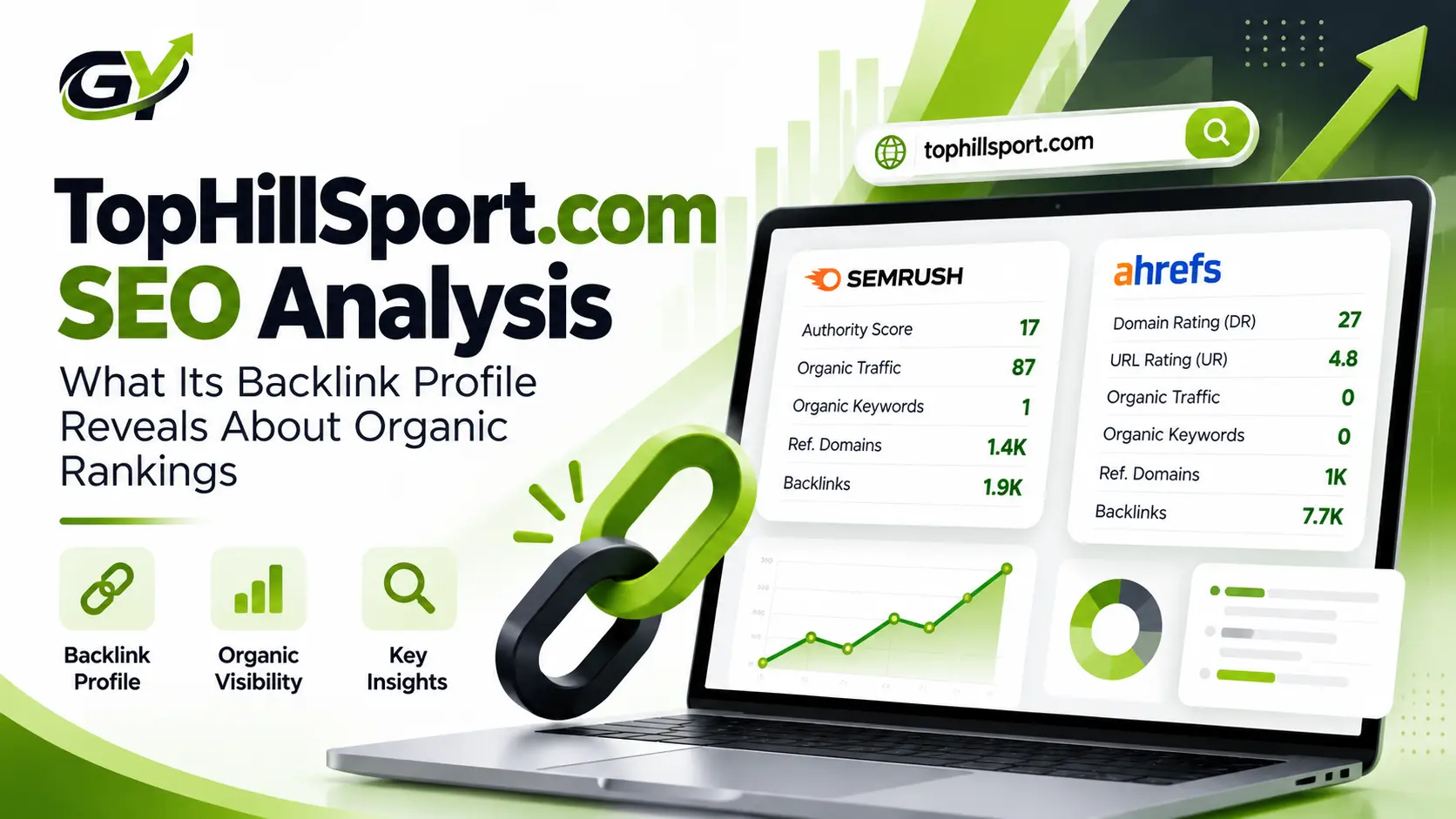
The supplied Semrush and Ahrefs screenshots show different estimates for the website’s backlink profile and organic search performance.
| SEO Metric | Semrush | Ahrefs |
|---|---|---|
| Authority metric | Authority Score: 17 | Domain Rating (DR): 27 |
| URL Rating (Ahrefs) | Not shown | 4.8 |
| Estimated organic traffic | 87 | 0 |
| Organic keywords | 1 | 0 |
| Referring domains | Approximately 1.4K | Approximately 1K |
| Backlinks | Approximately 1.9K | Approximately 7.7K |
| Paid traffic | 0 | 0 |
Source: Supplied Semrush and Ahrefs screenshots. The Semrush screenshot displays October 20, 2026, while the Ahrefs screenshot shows a three-month change view. Figures are tool-reported estimates, not verified Google data.
What Do These Numbers Mean?
The first observation is the difference between the backlink figures and the estimated organic visibility.
Semrush reports approximately 1,400 referring domains and 1,900 backlinks, while Ahrefs reports around 1,000 referring domains and 7,700 backlinks. At the same time, both tools show very limited estimated organic keyword visibility.
However, these figures should be interpreted carefully.
Semrush and Ahrefs maintain separate databases and use different methods to discover backlinks, estimate organic traffic, and calculate authority metrics. Their results are not directly interchangeable. A zero in one tool also does not prove that a website receives no organic traffic from Google.
The data therefore raises a useful SEO question: How should a website’s backlink profile be evaluated when its estimated organic visibility appears limited?
Answering that question requires examining more than the headline metrics.
What Does the TopHillSport.com Backlink Profile Tell Us?
Backlinks can help search engines discover pages and understand relationships between websites. However, their potential value depends on several factors, including relevance, placement, context, and the page receiving the link.
1. Backlink Quantity Is Only One Metric
The Ahrefs screenshot reports approximately 7,700 backlinks, while Semrush reports approximately 1,900. These totals provide a snapshot of what each tool has discovered, but they do not establish how useful those links are.
For example, a website may receive many links from a relatively small group of sites, links from pages with little topical relevance, or links that point to pages that do not target valuable search queries.
These are possibilities to investigate, not confirmed characteristics of TopHillSport.com.
A more meaningful assessment requires reviewing the actual linking pages, their context, and the URLs receiving those links.
2. Referring Domains Provide Additional Context
Referring domains represent the distinct websites linking to a domain. This metric can help distinguish a backlink profile supported by many websites from one dominated by repeated links from fewer sources.
The supplied tools report approximately 1,000–1,400 referring domains, depending on the platform.
That is a substantial number of reported referring domains, but the count alone does not establish that the links are relevant, editorially earned, or capable of supporting organic visibility.
An effective backlink audit should investigate:
- Whether referring websites are relevant to the linked page.
- Whether links appear naturally within useful content.
- Whether the referring pages are accessible and indexed.
- Whether links point to important landing pages or less useful URLs.
- Whether the profile contains unusual patterns that warrant further investigation.
The aim is to understand the profile, not to judge it by a single metric.
For a more detailed evaluation process, see GrowthYug’s guide to evaluating backlinks that drive SaaS SEO growth.
3. Authority Scores Are Not Google Rankings
Semrush Authority Score and Ahrefs Domain Rating measure different aspects of a website’s perceived authority or backlink strength according to each platform’s methodology.
Semrush reports an Authority Score of 17, while Ahrefs reports a Domain Rating of 27 and a URL Rating of 4.8.
These numbers should not be compared as if they were scores on the same scale. Neither is a direct Google ranking score, and neither guarantees that a website will rank for competitive keywords.
They are useful diagnostic indicators when combined with other evidence, such as organic visibility, referring-page quality, content relevance, and technical performance.
Why Can a Website Have Backlinks but Little Organic Visibility?
The available data does not establish why TopHillSport.com has limited estimated organic visibility. Several possible explanations can be investigated during a full SEO audit.
Content May Not Match Search Intent
A page can attract backlinks without providing the information users want when searching for a particular keyword.
For example, an informational query may require a detailed explanation, while a comparison query may require a side-by-side evaluation. If the page does not satisfy the intent behind its target keywords, backlinks alone may not make it competitive.
SEO analysis should therefore evaluate the quality, relevance, and usefulness of the content on the pages receiving links.
Backlinks May Point to Different Pages
A domain-level backlink report can hide important differences between individual URLs.
A website might have links pointing to its homepage, older articles, redirects, or pages that no longer serve an important purpose. Those links do not automatically improve the visibility of every other page on the site.
An audit should identify which URLs attract links and whether those URLs support the website’s organic search objectives.
Technical SEO Could Be a Factor
Indexing, crawlability, canonical tags, redirects, and other technical elements can influence how search engines access and interpret website pages.
However, the supplied screenshots do not show whether TopHillSport.com has any technical SEO problems. These areas would need to be checked independently before drawing conclusions.
Keyword Competition and Topical Coverage Matter
Even technically sound pages with relevant backlinks may struggle to rank if competing pages better satisfy search intent or provide more comprehensive information.
A website’s organic performance depends on multiple factors. Backlinks should be evaluated alongside the quality of the target page, the competitiveness of its keywords, and the broader topical coverage of the site.
How to Audit a Backlink Profile Properly
Whether you are analyzing TopHillSport.com or a SaaS business, a structured backlink audit provides a more useful picture than a single domain metric.
Step 1: Review Referring Domains
Identify the websites linking to the domain. Assess their relevance, the pages containing the links, and whether the links appear in meaningful editorial contexts.
Do not classify a domain as harmful simply because its authority metric is low.
Step 2: Inspect the Actual Linking Pages
Review the context surrounding each important backlink. Check whether the page is relevant, accessible, and useful to its intended audience.
This helps distinguish a link that makes sense editorially from one that offers little contextual value.
Step 3: Analyze Anchor Text
Examine how linking pages describe their destinations. Branded, descriptive, and natural anchor text can provide useful context, but no single anchor-text distribution is ideal for every website.
Look for unusual patterns and investigate them before deciding whether any action is necessary.
Step 4: Identify the Pages Receiving Links
Review which URLs attract backlinks and compare them with the pages the business wants to improve in organic search.
This can reveal whether link acquisition supports important product pages, service pages, and informational resources.
Step 5: Monitor New and Lost Backlinks
Backlink profiles change over time. Links can be added, removed, redirected, or become inaccessible.
Using appropriate backlink monitoring tools can help SEO teams track these changes and investigate significant losses.
Monitoring and analysis serve different purposes: monitoring tracks changes, while analysis helps explain the structure and potential value of the profile.
For more on that distinction, read GrowthYug’s guide to backlink monitoring vs. backlink analysis.
Step 6: Check Indexing and Technical Signals
Review the relevant landing pages for crawlability, indexability, canonicalization, redirects, and content availability. Where possible, use first-party data such as Google Search Console to validate impressions, clicks, indexing status, and page-level performance.
Third-party tools are useful for discovery, but they cannot replace a website owner’s own search performance data.
Step 7: Connect Backlink Data With Organic Performance
Compare backlink changes with organic visibility over time. Investigate whether important pages gain or lose rankings, whether new pages begin appearing in search results, and whether the content targets relevant queries.
A correlation between link changes and ranking changes does not, by itself, establish causation. Consider other changes to the website and its competitive environment before deciding what affected performance.
For a practical overview of the process, see GrowthYug’s backlink audit guide.
What SaaS Companies Can Learn From This Analysis
The TopHillSport.com example illustrates why SaaS marketing teams should avoid evaluating link-building success using backlink totals alone.
For a SaaS company, link building should support a broader organic growth strategy. The objective is not simply to increase the number of links pointing to a domain; it is to earn relevant links that help the business build credibility, support important pages, and strengthen its overall search presence.
Prioritize Relevance Alongside Link Acquisition
A link from a contextually relevant article can make more sense for a SaaS business than a link from an unrelated page, even when the latter website has a higher third-party authority metric.
The source, context, destination, and editorial value of the link all deserve consideration.
Connect Link Building With Useful Content
Links are only one part of the strategy. SaaS businesses also need useful resources that address customer questions, explain their solutions, and provide reasons for other websites to reference their content.
A well-planned SaaS link-building strategy should align link acquisition with the business’s target audience, important pages, and content priorities.
Measure Outcomes Beyond Backlink Counts
Track several indicators together:
- Relevant referring domains acquired.
- Quality and context of linking pages.
- Backlinks pointing to priority URLs.
- Organic impressions and clicks.
- Keyword visibility and landing-page performance.
- Changes in conversions where reliable analytics data is available.
These measures offer a more balanced view of performance than backlink quantity alone.
Treat SEO Metrics as Evidence, Not Conclusions
Third-party metrics can help identify opportunities and potential problems, but they should be treated as starting points for investigation.
A strong SEO process combines tool data with page-level analysis, technical checks, search intent, and first-party performance information wherever available.
Final Takeaways
The supplied Semrush and Ahrefs screenshots show a notable difference between the reported backlink profile of TopHillSport.com and its estimated organic keyword visibility. Semrush reports some organic visibility, while Ahrefs reports none in the displayed overview.
That difference does not prove that the website’s backlinks are ineffective, that it has received a Google penalty, or that any particular technical or content issue exists. Those conclusions would require further investigation.
What the example does demonstrate is the importance of evaluating backlinks in context. Referring domains, link relevance, target-page quality, technical SEO, search intent, and organic performance should be considered together.
For SaaS companies, the same principle applies: a sustainable link-building program should focus on relevant links, useful content, and measurable organic growth rather than chasing backlink totals or authority scores in isolation.
If your SaaS website needs a more structured approach to backlink analysis and link acquisition, explore GrowthYug’s SaaS link-building resources to understand how these activities can fit into a broader organic search strategy.