
How to Track Competitor Backlinks and Find Link Opportunities!
In competitive SEO, publishing great content is only one part of building search visibility. You also need to understand which websites link to your competitors, what content attracts those links, and how you can earn relevant backlinks for your own website.
Competitor backlink monitoring helps you uncover these opportunities. Instead of searching blindly for websites that might link to your content, you can analyze proven link sources, identify gaps in your backlink profile, and develop a focused link-building strategy.
For SaaS companies, B2B brands, and growing businesses, this process can reveal opportunities for editorial backlinks, guest posts, industry publications, resource pages, digital PR, and strategic partnerships.
In this guide, we’ll explain how to monitor competitors’ backlinks, identify valuable link-building opportunities, choose the right SEO tools, and turn your research into a repeatable backlink acquisition process.
What Is Competitor Backlink Monitoring?
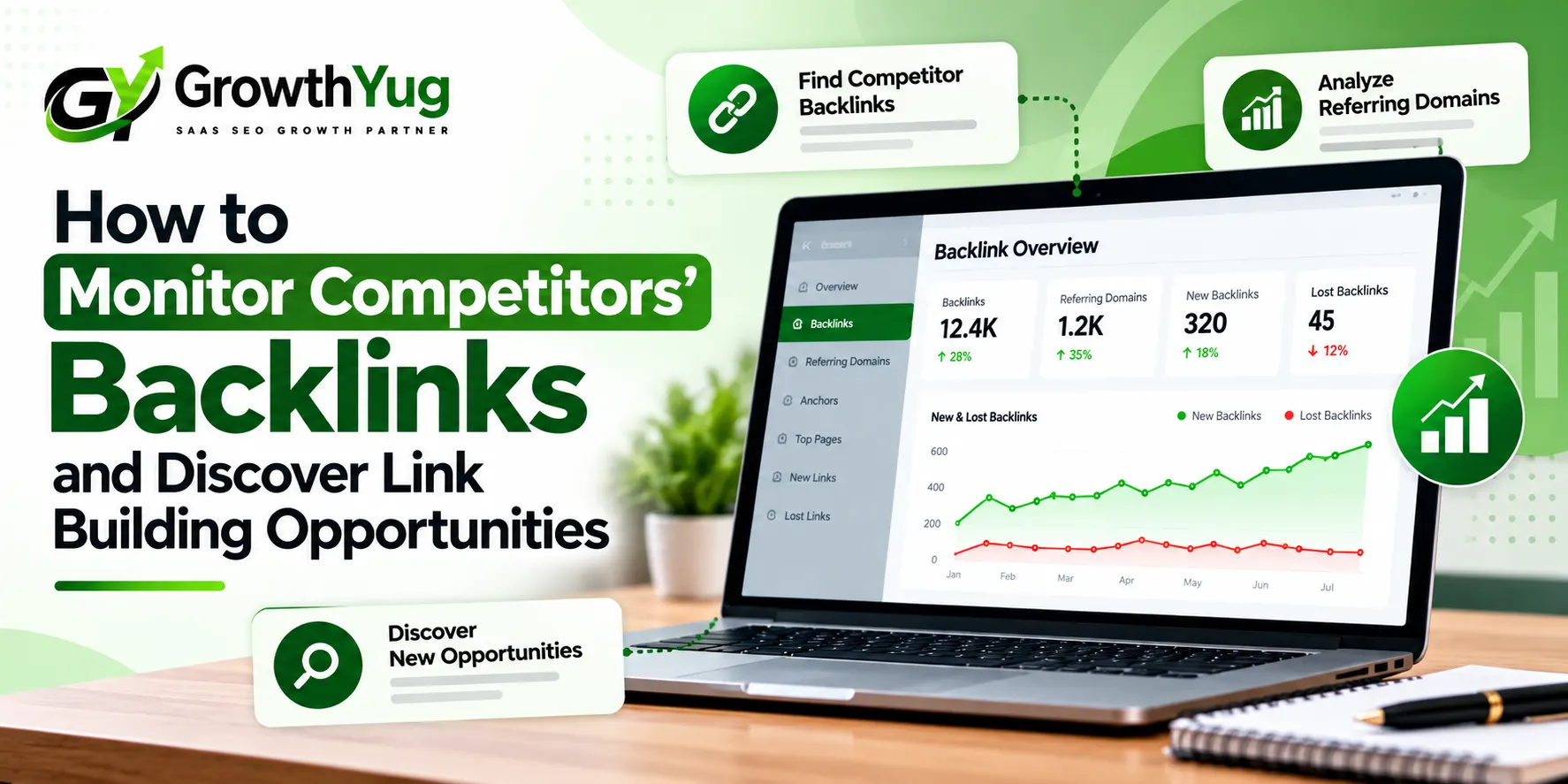
Competitor backlink monitoring is the process of tracking and analyzing the external websites that link to competing businesses. It involves identifying new and lost backlinks, reviewing referring domains, examining linked pages, and discovering link-building strategies that you can adapt for your own website.
For example, suppose your SaaS company competes with three other software providers. You discover that two competitors receive backlinks from SaaS industry blogs, technology publications, and software comparison websites.
These findings can help you identify relevant publishers, understand the content they prefer to reference, and develop a plan to earn similar links.
The goal is not to copy every backlink your competitors have. It is to understand why those links exist and find realistic ways to earn links that support your SEO and business objectives.
Why Is Monitoring Competitors’ Backlinks Important?
Regular backlink monitoring gives you a clearer picture of your competitors’ off-page SEO strategies and helps you prioritize link-building activities.
1. Discover Proven Link-Building Opportunities
Competitors’ backlinks provide a starting point for finding websites that already reference businesses in your industry. These websites may be relevant prospects for your own research, expert commentary, original data, or useful resources.
For example, if a SaaS publication links to a competitor’s detailed guide on product analytics, you could pitch a more comprehensive guide, a unique dataset, or an expert-led article on a related topic.
2. Identify Backlink Gaps
A backlink gap exists when competing websites have referring domains that do not currently link to your website.
Finding these gaps helps you prioritize prospects with demonstrated interest in your industry. Tools such as Ahrefs and Semrush offer competitor comparison features that help uncover these opportunities.
3. Track Competitors’ New Backlinks
New backlinks can reveal recent partnerships, successful content campaigns, digital PR coverage, and guest-contribution opportunities.
Monitoring newly acquired links can help you understand which strategies competitors are actively using and whether similar approaches make sense for your business.
4. Find Lost Backlinks Worth Recovering
Competitors sometimes lose backlinks because pages are removed, websites are redesigned, or links are replaced. Your own website may also lose valuable links.
Monitoring lost backlinks allows you to investigate the reason and contact publishers when a link can reasonably be restored or replaced with a relevant resource.
5. Improve Your Content Strategy
The pages attracting the most referring domains can reveal topics that publishers consider useful, original, or authoritative.
Use these insights to develop stronger content assets, such as original research, SaaS industry statistics, practical templates, in-depth guides, and expert commentary.
How to Monitor Competitors’ Backlinks: A Step-by-Step Process
A structured workflow makes competitor backlink analysis easier to repeat and more useful for long-term SEO growth.
Step 1: Identify Your True SEO Competitors
Start by identifying three to five competitors that target the same audience, keywords, or search intent as your business.
Your business competitors and SEO competitors may be different. A company that offers a similar product might not rank for your target keywords, while an industry publication or comparison website may compete with you for valuable organic traffic.
Use keyword research and competitor discovery tools to identify websites that consistently rank for the searches you want to target.
For example, a SaaS company selling project management software might analyze:
- Other project management software providers
- SaaS comparison and review websites
- Industry publications covering productivity software
- Blogs publishing project management guides
- Websites ranking for software-related informational keywords
Pro tip: Choose competitors based on relevant search results and audience overlap, not just brand size. Smaller competitors can reveal backlink opportunities that are easier to replicate.
Step 2: Analyze Each Competitor’s Backlink Profile
Once you have your competitor list, enter each domain into a backlink analysis tool.
Review the following metrics:
- Referring domains: The number of unique websites linking to the competitor.
- Total backlinks: The total number of discovered links, including multiple links from the same website.
- New backlinks: Recently discovered links that may reveal current marketing activity.
- Lost backlinks: Links that have disappeared or stopped being detected.
- Linked pages: Pages on the competitor’s website attracting backlinks.
- Anchor text: The clickable text used in backlinks.
- Link attributes: Whether links are marked as follow, nofollow, sponsored, or user-generated.
Do not judge a backlink profile by its total link count alone. One hundred links from a single domain do not represent the same diversity as links from one hundred independent domains.
Instead, evaluate referring-domain diversity, topical relevance, editorial context, and the quality of the pages linking to the competitor.
Step 3: Monitor New and Lost Backlinks Regularly
Competitor backlink monitoring should be an ongoing activity rather than a one-time audit.
Use backlink tools to review newly discovered links over the last 30 days, then investigate the most relevant findings.
For each new backlink, ask:
- Is the link from an industry-relevant website?
- Does it point to a blog post, product page, research report, or homepage?
- Is the link part of a guest article, editorial mention, partnership, or resource listing?
- Could we earn a link through a genuinely useful contribution?
- Does the linking page attract a relevant audience?
For lost backlinks, check whether the referring page still exists, whether the link was intentionally removed, and whether your content remains a suitable destination.
You can use a weekly review for active campaigns and a monthly review for broader competitive trends.
Step 4: Find Backlink Gaps With Link Intersect Analysis
One of the most effective ways to discover link-building opportunities is through backlink gap analysis, also known as link intersect analysis.
This process identifies websites that link to one or more competitors but do not link to your domain.
To perform a link intersect analysis:
- Enter your website as the target domain.
- Add three to five relevant competitors.
- Select referring-domain comparison if you want to find linking websites, or referring-page comparison if you want to investigate specific pages.
- Review domains that link to multiple competitors but not to you.
- Export the results and prioritize prospects based on relevance, quality, and realistic outreach potential.
If a technology publication links to three competitors in your niche, it is a stronger prospect for investigation than a random website with no connection to your industry.
However, a backlink gap is only a lead, not a guarantee that a publisher will link to you. Review each website manually before outreach.
Step 5: Find Competitors’ Most Linked-to Pages
A competitor’s most linked-to pages can show you which content formats attract external references.
Look for pages with strong referring-domain profiles, such as:
- Original research and industry surveys
- SaaS statistics and market reports
- Detailed educational guides
- Free tools and calculators
- Templates and downloadable resources
- Expert interviews and case studies
- Data-driven comparisons
Next, analyze why these pages earn links. Are they providing original data, solving a specific problem, offering a useful reference, or presenting expert insights?
Use that understanding to create something that offers distinct value rather than simply rewriting the competitor’s article.
For example, if a competitor’s SaaS SEO statistics page attracts links, you could develop an updated industry benchmark report using clearly sourced data and original analysis.
The objective is to give publishers a compelling reason to reference your resource.
Step 6: Investigate the Source of Each Valuable Backlink
Not every backlink opportunity can be replicated in the same way. You need to understand how each link was acquired.
Common backlink types include:
Editorial backlinks: Earned when a publisher references your research, expert insights, or useful content in an article.
Guest post backlinks: Earned through a relevant contribution to an external publication, where links are editorially appropriate and comply with applicable search-engine policies.
Resource page backlinks: Potential opportunities when a website maintains a curated list of useful tools, guides, or industry resources.
Digital PR backlinks: Earned through newsworthy research, original data, expert commentary, and stories that interest journalists or publishers.
Partnership backlinks: Links that may arise from legitimate industry partnerships, integrations, associations, or co-marketing activities.
Broken link opportunities: Situations where a relevant page contains a broken external link and you have a genuinely suitable replacement resource.
Understanding the acquisition method helps you select the right outreach strategy instead of sending the same generic pitch to every website.
Step 7: Qualify Opportunities Before Outreach
Once you have collected backlink prospects, evaluate their potential value before investing time in outreach.
Use the following criteria:
| Evaluation factor | What to check |
|---|---|
| Topical relevance | Does the website cover your industry or audience? |
| Editorial quality | Does it publish useful, original content? |
| Organic visibility | Does it appear to attract relevant search traffic? |
| Linking context | Would a link to your page genuinely help readers? |
| Audience fit | Could the website reach potential customers or partners? |
| Link placement | Is the link naturally included in meaningful content? |
| Outreach feasibility | Is there a clear reason and appropriate contact for your pitch? |
Metrics such as Domain Rating (DR), Domain Authority (DA), and Authority Score can help with preliminary comparisons, but they are third-party measurements rather than direct Google ranking factors.
A relevant, trustworthy publication with a real audience may be more valuable than a website with a higher authority score but little connection to your business.
Step 8: Build a Prioritized Link-Building Outreach List
Organize qualified opportunities in a spreadsheet or CRM so your research translates into action.
Recommended columns include:
- Referring domain
- Competitor receiving the backlink
- Source page URL
- Target page URL
- Backlink type
- Date discovered
- Relevance score
- Quality assessment
- Contact person or editorial email
- Proposed outreach angle
- Outreach status
- Follow-up date
- Final result
Group prospects by strategy, such as editorial outreach, guest contributions, resource pages, digital PR, or broken link replacement.
This makes it easier to personalize your outreach and measure which approaches produce meaningful results.
Best Tools for Competitor Backlink Monitoring
Several SEO tools can help you analyze competitors’ backlinks, compare referring domains, and identify link-building opportunities. The Best Backlink Monitoring Tools make it easier to track new and lost backlinks, evaluate link quality, monitor competitor strategies, and discover valuable link-building opportunities for long-term SEO growth.
1. Ahrefs
Ahrefs offers backlink analysis, referring-domain reports, new and lost backlink tracking, and Link Intersect functionality.
It is useful for examining competitor backlink profiles, identifying pages that attract links, and discovering domains that link to competitors but not to your website.
Learn more: Ahrefs Backlinks Guide
2. Semrush
Semrush provides backlink analytics, competitor discovery, backlink gap analysis, and backlink auditing features.
Its competitive analysis tools can help you identify websites that share referring domains with your competitors and investigate potential link-building prospects.
Learn more: Semrush Backlinks Overview
3. Google Search Console
Google Search Console is a useful free starting point for monitoring backlinks to your own verified website.
Its Links report provides information about linking websites, top linked pages, and common link text. It is not a competitor backlink research tool, and its report is not a complete inventory of every link.
Learn more: Google Search Console Links Report
4. Moz Link Explorer
Moz Link Explorer can help you review backlink profiles, linking domains, anchor text, and link-related metrics. It is another option for cross-checking backlink prospects and comparing competing websites.
Learn more: Moz Link Explorer
Which Tool Should You Choose?
Your choice depends on your budget, campaign size, and research needs. Ahrefs and Semrush are useful for comprehensive competitor analysis, while Google Search Console helps you monitor links to your own site without purchasing a dedicated backlink database.
For the most reliable picture, compare results from more than one source when possible. Different tools crawl and index the web differently, so backlink counts will not always match.
How to Turn Competitor Backlink Data Into Real Opportunities
Finding potential linking websites is only the first part of the process. The next step is to develop a convincing reason for those websites to reference your content.
Strategy 1: Create Better Resources Than Competitors
If a competitor earns backlinks from an outdated guide, look for opportunities to publish a more useful resource with current information, clearer explanations, original examples, or additional research.
Then contact relevant publishers who might benefit from the improved resource.
Your content must offer genuine additional value. A longer article alone is not necessarily a better resource.
Strategy 2: Pitch Relevant Industry Publications
Review the publications linking to competitors and identify the topics they cover.
Develop a pitch that includes a specific article idea, original expertise, or research that suits their readers. Where appropriate, offer a useful expert contribution instead of asking for a link without providing value.
Strategy 3: Use Original Research to Earn Editorial Links
Original data can make your website a useful reference for writers, analysts, and journalists.
SaaS businesses can publish surveys, customer benchmarks, industry reports, or carefully analyzed datasets. Make the methodology transparent and provide clear citations for external information.
Strategy 4: Reclaim Unlinked Brand Mentions
Monitor websites that mention your brand but do not link to your website.
When a mention is accurate and a link would help readers find the relevant resource, contact the publisher with a brief, polite request to add one.
This strategy works best when the brand mention already exists and the requested link improves the article’s usefulness.
Strategy 5: Find Relevant Resource Pages
Search for industry resource pages, curated tool lists, educational directories, and collections of recommended resources.
If a page lists competing tools or similar resources, assess whether your product or content meets its inclusion criteria. Explain why it would benefit the audience.
Avoid mass submissions to low-quality directories that exist primarily to sell links.
How to Monitor Competitor Backlinks Without Wasting Time
A repeatable process helps you concentrate on the opportunities most likely to be relevant to your business.
Follow these practices:
- Focus on quality over quantity: Prioritize relevant referring domains and useful editorial placements.
- Track changes over time: Record new and lost backlinks so you can identify patterns.
- Analyze multiple competitors: Compare several competing websites to separate common industry opportunities from isolated wins.
- Inspect source pages manually: Do not rely entirely on automated authority or toxicity scores.
- Personalize outreach: Reference the actual content and explain why your resource fits.
- Measure meaningful outcomes: Track qualified referring domains, successful placements, referral traffic, and relevant conversions.
- Avoid manipulative tactics: Do not pursue automated link schemes, private blog networks, or paid links intended to manipulate rankings.
Google’s spam policies address link spam, including buying or selling links for ranking purposes and other manipulative link practices. Paid placements should be appropriately qualified, such as with rel="sponsored" where applicable.
Read more: Google Search Essentials: Spam Policies
A Practical Monthly Competitor Backlink Monitoring Workflow
You can use the following workflow to keep your competitor research organized.
Week 1: Competitor discovery and audit
Identify your main SEO competitors and review their referring domains, backlink profiles, and top linked pages.
Week 2: Backlink gap analysis
Use link intersect reports to discover relevant websites that link to competitors but not to your website. Remove irrelevant prospects and prioritize the strongest opportunities.
Week 3: Content and outreach
Develop useful content assets, prepare personalized pitches, and contact qualified publishers, editors, or resource-page owners.
Week 4: Performance review
Review newly acquired and lost backlinks, outreach responses, successful placements, referral traffic, and opportunities to improve your next campaign.
This is a flexible framework, not a guaranteed link acquisition schedule. Adjust the workload based on your resources, publishing cycle, and campaign objectives.
Common Mistakes to Avoid During Competitor Backlink Analysis
Even a detailed backlink report can lead to poor decisions if you interpret the data incorrectly.
Chasing every competitor backlink: Some links may be irrelevant, low quality, or impossible to replicate. Focus on opportunities that fit your business and content.
Relying only on authority metrics: High DR or DA does not automatically mean a website is trustworthy or relevant.
Ignoring the linked page: A competitor may earn links because of a specific research report or tool, not simply because of its domain strength.
Sending generic outreach emails: Publishers are more likely to consider a relevant, well-researched proposal than a mass-produced request.
Building links without useful content: Outreach becomes harder when you have nothing distinctive to offer. Invest in resources that deserve to be referenced.
Treating every lost backlink as a problem: Some links disappear naturally or are removed for legitimate reasons. Investigate before attempting recovery.
Ignoring search-engine guidelines: Link-building strategies should focus on earning legitimate editorial references rather than manipulating search rankings.
How GrowthYug Can Help You Discover Better Link-Building Opportunities
A successful backlink strategy requires more than collecting lists of referring domains. It involves identifying the right competitors, understanding how their strongest links were earned, evaluating publisher quality, and developing outreach campaigns around useful content.
At GrowthYug, businesses can explore link-building support designed to strengthen their SEO strategy through relevant backlink opportunities.
Whether you are growing a SaaS company, improving organic visibility for a B2B website, or developing a long-term authority-building strategy, competitor backlink research can help you make more informed decisions about where to focus your efforts.
A structured process can help your team:
- Discover relevant websites that already link to competitors.
- Identify gaps in your referring-domain profile.
- Find content topics with strong link-earning potential.
- Prioritize editorial and industry-relevant opportunities.
- Organize outreach and track campaign performance.
The right approach combines competitive research, useful content, careful prospect qualification, and consistent outreach. Instead of pursuing backlinks simply to increase a metric, focus on earning links that make sense for your audience and support your wider marketing goals.
Visit GrowthYug to explore link-building services and develop a strategy aligned with your SEO objectives.
Final Thoughts
Monitoring competitors’ backlinks is a practical way to discover new link-building opportunities, understand successful content strategies, and identify gaps in your website’s backlink profile.
Start by analyzing a few relevant competitors, tracking new and lost backlinks, and using link intersect analysis to uncover promising prospects. Then evaluate each opportunity based on relevance, editorial quality, audience fit, and the value your content can provide.
The most effective link-building strategies do not simply replicate competitors’ backlinks. They use competitor research to identify opportunities and earn valuable links through original content, genuine expertise, and relevant relationships.
Ready to strengthen your backlink strategy?
Start analyzing your competitors, prioritize your best prospects, and turn your research into a sustainable link-building process with GrowthYug.
Frequently Asked Questions
1. What Is Competitor Backlink Analysis?
Competitor backlink analysis is the process of examining websites that link to your competitors. It helps you identify referring domains, evaluate link quality, discover content that attracts backlinks, and find new link-building opportunities for your website.
2. What Are the Best Backlink Monitoring Tools?
The Best Backlink Monitoring Tools include Ahrefs, Semrush, Moz Link Explorer, and Google Search Console. Ahrefs and Semrush are useful for competitor backlink research, while Google Search Console helps monitor backlinks pointing to your own website.
3. How Can I Find My Competitors’ Backlinks?
You can find competitors’ backlinks using SEO tools such as Ahrefs and Semrush. Enter a competitor’s domain, review its referring domains and linked pages, and analyze new and lost backlinks to identify potential link-building prospects.
4. What Is Backlink Gap Analysis?
Backlink gap analysis identifies websites that link to your competitors but not to your website. This process helps you discover relevant publishers, industry blogs, resource pages, and editorial websites that may offer opportunities to earn backlinks.
5. How Often Should I Monitor Competitors’ Backlinks?
For most active SEO campaigns, reviewing competitor backlinks weekly or monthly is a practical approach. Weekly monitoring helps identify recent link acquisitions, while monthly reviews provide a broader view of competitor strategies and backlink trends.
6. How Do I Identify High-Quality Backlink Opportunities?
Evaluate backlinks based on topical relevance, editorial quality, audience fit, organic visibility, and the context of the link. Domain authority metrics can support your initial assessment, but they should not be the only factors used to judge a website’s quality.
7. Can I Monitor Competitors’ Backlinks for Free?
Yes. You can use free SEO resources and limited free tool features to begin researching backlinks. Google Search Console provides backlink data for your verified website, but competitor backlink analysis generally requires a dedicated SEO tool or an alternative data source.
8. How Can Competitor Backlink Monitoring Improve SEO?
Competitor backlink monitoring helps you discover potential linking websites, identify backlink gaps, understand which content attracts links, and refine your outreach strategy. Earning relevant, editorially appropriate backlinks can support your website’s authority and organic search visibility.
9. What Is the Difference Between New and Lost Backlinks?
New backlinks are links that an SEO tool has recently discovered pointing to a website. Lost backlinks are links that the tool no longer detects. Monitoring both helps you identify competitor link-building activity and investigate opportunities to recover valuable links to your own website.
10. How Can SaaS Companies Discover Link-Building Opportunities?
SaaS companies can analyze competitor backlinks, identify relevant industry publications, create original research, publish useful resources, and pursue editorial outreach. A focused strategy prioritizes relevant websites and valuable content rather than simply increasing backlink counts.
11. Are Competitor Backlinks Safe to Replicate?
Not every competitor backlink is worth replicating. Review each linking website for relevance, editorial standards, and potential spam risks. Avoid manipulative link schemes and paid links intended to influence rankings. Focus on earning links that provide genuine value to readers.
12. How Can GrowthYug Help With Link Building?
GrowthYug helps businesses explore link-building opportunities that align with their SEO goals. Competitor backlink research, relevant publisher prospecting, and a focus on quality link placements can help businesses develop a more structured approach to building online authority.
Related Posts :
Does Guest Posting Still Work for SEO? (The Truth About Link Building Today)
How to Evaluate Backlinks That Drive SaaS SEO Growth: GrowthYug Guide
Google Search Console vs. Dedicated Backlink Monitoring Tools: Which Is Better?
SaaS SEO Guide 2026: Complete Strategy for SaaS Growth
AI and Link Building: What SaaS Marketers Need to Know in 2026
Guest Posting for SEO: Does It Still Work in 2026
SaaS Outreach Email Templates That Get Replies
Zero-Budget SaaS Link Building: How to Get Your First 100 Backlinks
AI in SaaS Link Building: What Works and What’s Hype