
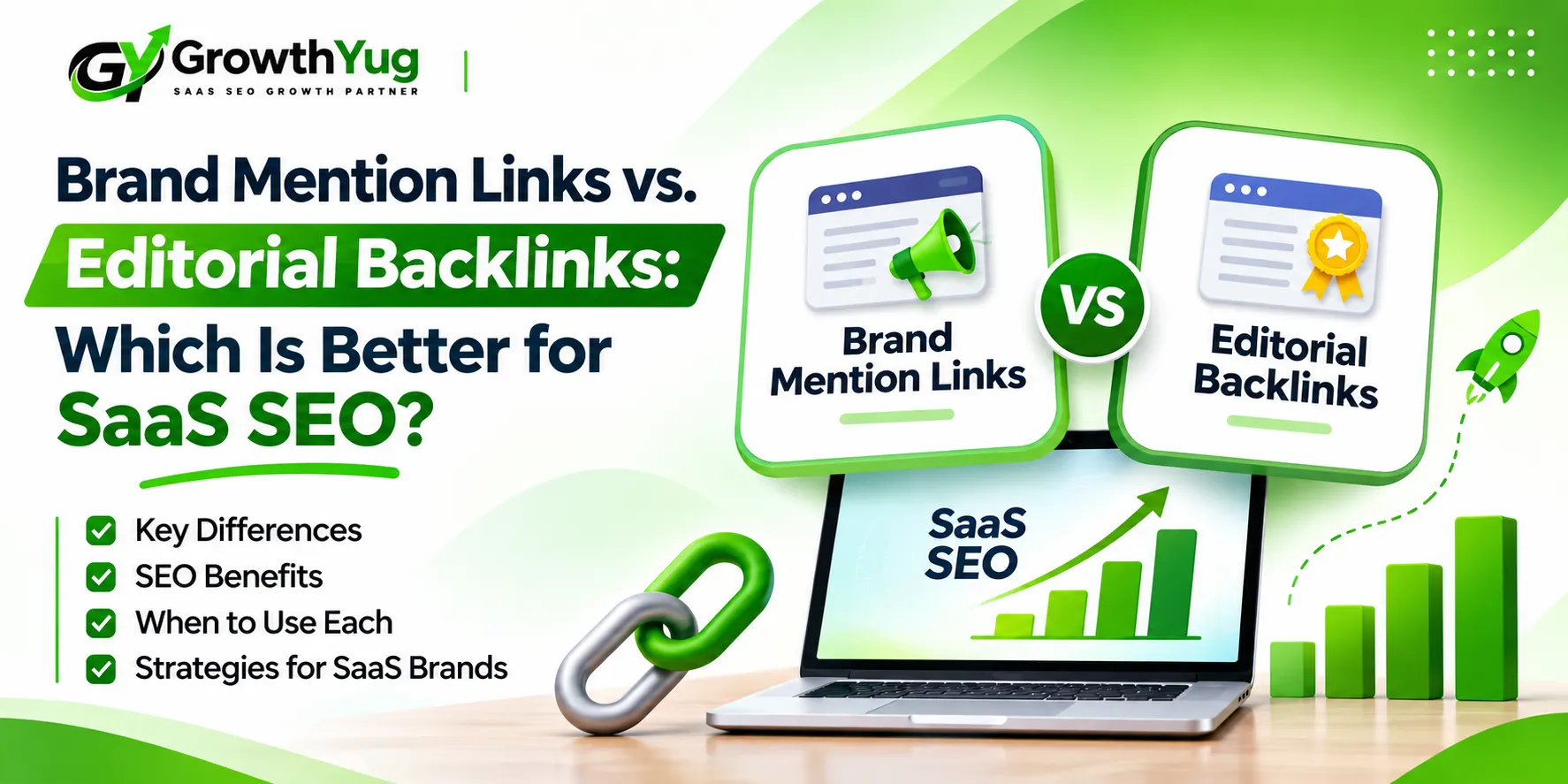
Brand Mention Links vs. Editorial Backlinks: Which Is Better for SaaS SEO?
SaaS SEO is no longer just about publishing content and building as many backlinks as possible. Search engines increasingly evaluate brand credibility, topical relevance, content quality, and the authority of websites referencing your business.
Two strategies that play an important role in building online authority are brand mention links and editorial backlinks.
Both help SaaS companies strengthen their online presence, but they serve different purposes. Brand mention links help establish brand recognition across relevant websites, while editorial backlinks provide contextual references within valuable content.
So, which strategy should SaaS businesses prioritize? Are editorial backlinks more valuable than brand mentions, or should both be part of a successful SaaS link-building strategy?
In this guide, we compare brand mention links vs. editorial backlinks, explain their SEO benefits, explore their differences, and show how SaaS companies can use both to build stronger search visibility and brand authority.
What Are Brand Mention Links?
Brand mention links are hyperlinks that use a company’s brand name as the clickable anchor text.
For example, if a SaaS company called CloudFlow is mentioned in an industry article with a hyperlink pointing to its website, that is a brand mention link.
Example:
“CloudFlow offers an effective project management solution for growing businesses.”
Here, the brand name CloudFlow links directly to the company’s website.
Brand mention links can appear across several types of websites, including:
- SaaS industry blogs
- Technology publications
- Business and startup websites
- Software comparison articles
- Industry directories
- Product review websites
- Partner and customer websites
- Digital marketing publications
What Are Unlinked Brand Mentions?
Not every brand mention includes a hyperlink.
An unlinked brand mention occurs when another website references your company without linking to your website.
For example:
“CloudFlow is becoming a popular choice among project management software providers.”
Although there is no clickable link, the brand still receives online exposure.
Unlinked mentions can support brand awareness and help businesses identify potential link reclamation opportunities. However, they should not be treated as equivalent to backlinks because they do not pass conventional hyperlink-based link equity.
What Are Editorial Backlinks?
Editorial backlinks are links that a website’s editor, journalist, or content publisher naturally includes within an article because the referenced resource adds value to the discussion.
Unlike links placed primarily for promotional purposes, genuine editorial backlinks are included because the content provides useful information, original research, expert insights, or supporting evidence.
Example:
“According to GrowthYug’s SaaS link-building guide, relevant editorial placements can help companies strengthen their backlink profiles.”
Here, the link to GrowthYug is included naturally within the article’s context.
Editorial backlinks commonly appear in:
- Industry research articles
- Expert interviews
- SaaS comparison guides
- Technology publications
- Industry reports
- Original research studies
- Resource pages
- Thought leadership articles
Why Are Editorial Backlinks Valuable?
Editorial backlinks can provide several SEO benefits:
- Contextual relevance: Links appear within content related to your industry, product, or expertise.
- Authority signals: Links from reputable websites can contribute to your site’s backlink authority.
- Referral traffic: Readers may click the link and visit your website.
- Brand exposure: Your company gets introduced to a relevant audience.
- Content credibility: Being referenced as a useful resource can strengthen your brand’s reputation.
The actual value of an editorial backlink depends on its relevance, placement, editorial quality, link attributes, and the credibility of the referring website.
Brand Mention Links vs. Editorial Backlinks: Key Differences
Both strategies help SaaS companies build online visibility, but their approach and potential benefits are different.
| Comparison Factor | Brand Mention Links | Editorial Backlinks |
|---|---|---|
| Main purpose | Brand recognition and visibility | Authority and contextual references |
| Anchor text | Usually the company name | Brand, descriptive, or contextual text |
| Link placement | Brand references and citations | Naturally within editorial content |
| Context | Brand-related discussions | Relevant topics and supporting information |
| Referral traffic | Depends on placement and audience | Can attract highly relevant readers |
| SEO value | Depends on link quality and attributes | Depends on relevance, quality, and attributes |
| Brand awareness | Strong potential | Strong potential |
| Editorial control | Varies by placement | Typically determined by the publisher |
| Best suited for | Brand visibility and recognition | Contextual authority and relevant referrals |
The key difference: Brand mention links focus on making your brand visible across relevant websites, while editorial backlinks focus on earning contextual references within valuable content.
A high-quality link can achieve both objectives at the same time.
Which Is Better for SaaS SEO?
There is no universal winner between brand mention links and editorial backlinks.
For most SaaS businesses, editorial backlinks can be particularly valuable because they provide contextual references from relevant publications. Brand mention links, meanwhile, help expand brand recognition and create additional opportunities for discovery.
The right choice depends on your current SEO position and business objectives.
When Brand Mention Links Are Better
Brand mention links can be useful when your SaaS company wants to:
- Increase brand recognition within its industry.
- Build a consistent online presence.
- Get featured in relevant SaaS publications.
- Improve visibility across product comparison websites.
- Turn existing unlinked mentions into backlinks.
- Strengthen brand discovery beyond traditional search results.
For example, a newly launched SaaS product can benefit from relevant mentions across startup blogs, software directories, and technology publications.
When Editorial Backlinks Are Better
Editorial backlinks can be particularly useful when your business wants to:
- Strengthen the authority of important landing pages.
- Improve the backlink profile of commercial pages.
- Earn contextual links from industry-relevant publications.
- Support competitive SaaS keywords.
- Attract qualified referral traffic.
- Build credibility through expert contributions and original research.
For example, a SaaS company competing for keywords such as “best CRM software for small businesses” may benefit from relevant editorial references within CRM industry publications.
Why SaaS Companies Should Use Both
A balanced link-building strategy is generally more sustainable than relying entirely on one type of link.
Brand mention links help people discover your business, while editorial backlinks provide meaningful contextual references that can support your SEO objectives.
Instead of choosing one, SaaS companies should develop a strategy that combines relevant brand mentions, genuine editorial placements, and valuable content assets.
7 Major Benefits of Brand Mention Links for SaaS Companies
Brand mentions can contribute to a stronger online presence, particularly when they come from relevant and trusted industry sources.
1. Improve Brand Recognition
Consistent references across reputable SaaS blogs, technology publications, and industry websites can help more people become familiar with your brand.
When potential customers repeatedly encounter your company in relevant discussions, they may become more comfortable exploring your product.
2. Create Link Reclamation Opportunities
Many companies receive online mentions without receiving a backlink.
Monitoring these mentions helps identify websites that have already referenced your brand.
You can contact the publisher and politely request that the existing mention be linked to your website when appropriate.
3. Increase Referral Opportunities
A relevant brand mention link can introduce your SaaS product to readers who are already interested in your industry.
For example, a mention in a project management software comparison article may bring visitors who are actively evaluating different tools.
4. Strengthen Your Online Reputation
Being referenced by relevant industry publications, SaaS communities, and business websites can help establish your company’s presence within its market.
However, the credibility of the mentioning website matters more than the number of mentions alone.
5. Support Brand Discovery in AI Search
AI-powered search experiences increasingly present users with brand recommendations, summaries, and references from multiple sources.
Relevant brand mentions across credible publications may contribute to a broader digital presence and help users discover your business.
However, there is no guarantee that brand mentions will result in AI citations or recommendations. Quality, source credibility, content relevance, and other factors also matter.
6. Build Relationships With Industry Publishers
Brand mention opportunities can create relationships with bloggers, editors, journalists, and SaaS industry publishers.
These relationships may lead to future interviews, expert contributions, research collaborations, and editorial coverage.
7. Support Long-Term Brand Visibility
A consistent presence across relevant websites can help your SaaS brand become more recognizable over time.
The objective should be to earn meaningful coverage rather than simply increase the number of mentions.
7 Major Benefits of Editorial Backlinks for SaaS Companies
Editorial backlinks are an important part of a quality-focused SaaS link-building strategy.
Here are seven reasons why SaaS companies invest in them.
1. Strengthen Website Authority
Relevant backlinks from established publications can contribute to your website’s authority.
Search engines use links as one of many signals when discovering and evaluating web pages.
However, a high-authority website link does not automatically guarantee higher rankings.
2. Improve Topical Relevance
Context matters when building backlinks.
A link from a SaaS publication discussing software development, CRM platforms, or business automation may be more relevant than a link from an unrelated website.
Relevant editorial references help create a stronger connection between your website and its subject area.
3. Support Important Landing Pages
Editorial backlinks can point to different pages depending on the article’s topic.
For example:
- Homepage: Build overall brand authority.
- Product pages: Support product discovery.
- Service pages: Strengthen service relevance.
- Blog posts: Attract relevant research traffic.
- Research pages: Earn citations for original information.
A natural backlink profile should not point exclusively to the homepage or commercial pages.
4. Attract Relevant Referral Traffic
A well-placed editorial backlink can bring visitors who are genuinely interested in your solution.
For example, a link within an article about SaaS automation tools can attract business owners, marketers, or software professionals looking for automation solutions.
This traffic may create opportunities for product trials, subscriptions, and leads.
5. Build Industry Credibility
When respected publications reference your research, insights, or expertise, your business gains an opportunity to establish credibility.
This can be especially valuable for SaaS companies competing in crowded markets.
6. Support Competitive Keyword Strategies
Editorial backlinks can help strengthen the pages you want to rank for competitive search terms.
For example, a SaaS company targeting keywords such as:
- SaaS project management software
- CRM software for startups
- Marketing automation platform
- Cloud accounting software
- SaaS customer support tools
Can benefit from relevant editorial references pointing to useful pages on its website.
Backlinks are only one ranking factor; content quality, search intent, technical SEO, and user experience also matter.
7. Create Long-Term SEO Value
A genuinely useful editorial article may continue attracting readers and referral traffic long after publication.
Unlike short-lived promotional placements, strong editorial coverage can become a lasting part of your company’s digital footprint.
Types of Brand Mention Links and Editorial Backlinks
Understanding the different formats can help SaaS businesses choose suitable link-building opportunities.
Common Types of Brand Mention Links
1. Brand Name Links
The company name is used as the anchor text.
Example: GrowthYug helps SaaS businesses develop strategic link-building campaigns.
2. Product Mention Links
A specific SaaS product or software name is linked to its product page.
Example: CloudFlow project management software.
3. Company Profile Links
Your company is mentioned in business profiles, startup directories, and relevant industry listings.
4. Review and Comparison Links
Your brand is referenced in software review articles, product comparisons, and industry roundups.
5. Partner and Customer Mentions
Business partners, customers, and collaborators reference your company in relevant content.
Common Types of Editorial Backlinks
1. Editorial Guest Contributions
Industry experts contribute valuable articles to relevant publications, with contextual references where appropriate.
2. Expert Interviews
A SaaS founder, product manager, or industry specialist is interviewed by a publication and receives relevant brand or website references.
3. Original Research Links
A publisher references your original survey, research report, industry data, or benchmark study.
4. Resource Page Links
A website includes your genuinely useful resource in a relevant collection of guides, tools, or references.
5. Industry News Coverage
A publication references your company when covering product launches, funding announcements, business developments, or industry trends.
6. Data and Statistics Citations
A writer uses your original data or research as supporting evidence in an article.
7. Expert Commentary Links
Journalists and editors reference your company’s expertise through quotes, insights, and professional contributions.
How to Build Brand Mention Links for SaaS Websites
Building brand mention links requires consistent monitoring, relevant outreach, and useful brand resources.
Here is a practical approach.
Step 1: Find Existing Brand Mentions
Start by identifying websites that already mention your SaaS company.
You can use:
- Google Search
- Google Alerts
- Ahrefs Content Explorer
- Semrush Brand Monitoring
- Mention
- Brand24
Search for your brand name, product name, and common variations.
Step 2: Identify Unlinked Mentions
Review the results and identify pages where your company is mentioned without a hyperlink.
Prioritize mentions on relevant websites with useful content and genuine audiences.
Step 3: Evaluate Website Quality
Before contacting a publisher, review:
- Website relevance.
- Content quality.
- Organic visibility.
- Audience engagement.
- Editorial standards.
- Existing outbound links.
Avoid websites that publish unrelated content primarily to sell backlinks.
Step 4: Contact the Publisher
Send a short, professional email explaining where your brand is mentioned and why linking to your official website would help readers.
Example outreach email:
Subject: Quick Link Request for Our Brand Mention
Hi [Name],
I came across your article mentioning [Brand Name]. Thank you for including our company in your content.
Would you consider linking the brand mention to our official website? This would make it easier for readers to explore our product and learn more about what we offer.
Thanks for your time and consideration.
Best regards,
[Your Name]
Step 5: Track Your Results
Maintain a record of:
- Website URL.
- Mentioned brand name.
- Link status.
- Contact information.
- Outreach date.
- Response status.
- Final backlink URL.
This makes it easier to identify successful opportunities and manage future outreach.
How to Earn High-Quality Editorial Backlinks for SaaS
Editorial backlinks are earned by creating content and expertise that publishers genuinely want to reference.
Here are some practical approaches.
1. Publish Original SaaS Research
Original research gives publishers something valuable to cite.
Consider creating:
- SaaS industry reports.
- Customer behaviour surveys.
- Software adoption statistics.
- Industry benchmarks.
- Marketing performance studies.
- Technology trend reports.
For example, a report on SaaS customer acquisition costs could attract references from marketing blogs and business publications.
2. Create Link-Worthy Resources
Develop resources that solve specific problems for your target audience.
Examples include:
- SaaS SEO checklists.
- Software comparison guides.
- Industry statistics pages.
- Free calculators.
- Technical templates.
- Practical marketing guides.
Useful resources give editors a reason to reference your website.
3. Contribute Expert Insights
SaaS founders, developers, product managers, and marketing professionals can share their knowledge through expert contributions.
Focus on publications that cover your industry and target audience.
Avoid generic guest posts created only to insert backlinks.
4. Build Relationships With Relevant Publishers
Identify websites that regularly publish high-quality SaaS and technology content.
Develop relationships by:
- Sharing useful research.
- Offering expert commentary.
- Providing original statistics.
- Participating in relevant discussions.
- Suggesting genuinely useful resources.
Long-term relationships can create better editorial opportunities than mass outreach.
5. Use Digital PR Campaigns
Digital PR combines content, research, storytelling, and media outreach.
For SaaS businesses, suitable campaigns include:
- Product innovation announcements.
- Original industry research.
- Founder interviews.
- Expert opinions.
- Unique market insights.
- Technology trend analysis.
A strong digital PR campaign can generate brand mentions, editorial backlinks, and referral traffic together.
Brand Mention Links vs. Editorial Backlinks for AI Search and GEO
Search behaviour is evolving as users increasingly discover businesses through AI-powered tools and generative search experiences.
For SaaS brands, this creates another reason to invest in a credible digital presence.
How Brand Mentions Can Support GEO
Generative Engine Optimization (GEO) focuses on improving a brand’s visibility in AI-generated answers and recommendations.
Consistent brand references across relevant industry websites can help establish a broader online footprint.
Useful activities include:
- Earning mentions from respected SaaS publications.
- Maintaining consistent company information.
- Publishing original research.
- Participating in industry discussions.
- Building a recognizable brand presence.
How Editorial Backlinks Can Support GEO
Editorial backlinks often appear within detailed, topic-specific content.
These placements can expose your brand to audiences and provide contextual references to your website.
For example, a SaaS company mentioned in a detailed comparison of marketing automation platforms may gain both referral visibility and an opportunity to be discovered by AI-powered search systems.
Do Brand Mentions or Editorial Backlinks Matter More for AI Search?
Neither guarantees an AI citation.
AI platforms use different systems and sources to generate answers. Their selection processes can change, and there is no universally established formula for earning citations.
A sensible approach is to build both:
- Brand mentions for broader brand recognition.
- Editorial backlinks for contextual references and link authority.
- Original research for unique, citable information.
- Consistent brand information for better entity clarity.
The goal is to make your SaaS company a credible and recognizable source within its industry.
Common Mistakes to Avoid When Building SaaS Backlinks
A successful link-building strategy focuses on quality, relevance, and editorial integrity.
Avoid these common mistakes.
1. Prioritizing Quantity Over Quality
Building hundreds of low-quality backlinks does not guarantee better SEO performance.
Focus on relevant websites with genuine audiences and useful editorial content.
2. Buying Links Without Evaluating Quality
Not every paid placement is valuable.
Google’s spam policies address links intended to manipulate search rankings. Paid placements should be handled with appropriate link attributes, such as rel="sponsored" or nofollow, where applicable.
3. Using Exact-Match Anchor Text Repeatedly
Overusing commercial anchor text can create an unnatural backlink profile.
Use relevant and natural anchor variations, including brand names, URLs, descriptive phrases, and contextual references.
4. Ignoring Website Relevance
A link from an unrelated website may offer limited value.
Prioritize publishers whose content and audiences align with your SaaS product or industry.
5. Publishing Generic Guest Posts
Content created only to place a backlink rarely provides meaningful value.
Contribute original insights, practical examples, research, and useful information.
6. Ignoring Unlinked Brand Mentions
Existing brand mentions can be valuable outreach opportunities.
Monitor your company name and product names regularly to identify relevant unlinked references.
7. Measuring Success Only Through Domain Authority
Third-party metrics such as Domain Rating (DR) and Domain Authority (DA) are useful for comparing websites, but they are not Google ranking factors.
Evaluate the complete picture, including relevance, organic visibility, referral traffic, link quality, and business outcomes.
How to Measure the Success of Brand Mention Links and Editorial Backlinks
Tracking the right metrics helps SaaS companies understand which link-building activities are contributing to their marketing objectives.
| Metric | What to Measure | Why It Matters |
|---|---|---|
| Referring domains | Number of unique websites linking to you | Shows backlink profile growth |
| Brand mentions | Linked and unlinked brand references | Tracks brand visibility |
| Link relevance | Topical connection between websites | Evaluates contextual quality |
| Referral traffic | Visitors coming from external links | Measures audience discovery |
| Organic traffic | Traffic to linked pages | Helps evaluate SEO performance |
| Keyword rankings | Visibility for target keywords | Tracks search performance |
| Conversions | Leads, demos, trials, and signups | Connects SEO with business results |
| Link attributes | Follow, nofollow, sponsored, and UGC | Helps assess link characteristics |
Useful Tools for Tracking Results
Google Search Console: Monitor referring links and the performance of your website in Google Search.
Ahrefs: Analyse referring domains, backlinks, anchor text, and competitor backlink profiles.
Semrush: Track backlink opportunities, brand mentions, and keyword visibility.
Google Analytics 4: Measure referral traffic, engagement, and conversions.
Google Alerts: Monitor new online mentions of your company and products.
Use multiple tools because no single platform provides a complete picture of your backlink and brand visibility.
A Practical SaaS Link-Building Strategy: Combining Both Approaches
Instead of treating brand mention links and editorial backlinks as separate activities, SaaS businesses can integrate them into one structured strategy.
Here is an example of how to approach it.
| Activity | Primary Objective | Expected Opportunity |
|---|---|---|
| Brand mention monitoring | Discover existing references | Link reclamation |
| SaaS industry outreach | Increase brand exposure | Relevant brand mentions |
| Expert contributions | Share industry expertise | Editorial references |
| Original research | Create citable content | Research citations |
| Digital PR | Build publisher relationships | Brand coverage and links |
| Product comparisons | Improve product discovery | Contextual brand references |
| Resource development | Publish useful assets | Natural editorial links |
Recommended Monthly Workflow
Week 1: Research and Audit
- Review existing backlinks.
- Identify unlinked brand mentions.
- Analyse competitor referring domains.
- Identify relevant SaaS publications.
Week 2: Content and Outreach Preparation
- Develop original research or useful resources.
- Prepare expert insights.
- Build a list of relevant publishers.
- Create personalized outreach messages.
Week 3: Outreach and Relationship Building
- Contact publishers.
- Request relevant brand mention links.
- Pitch original research and expert commentary.
- Follow up on previous conversations.
Week 4: Review and Optimization
- Track new referring domains.
- Monitor brand mentions.
- Review referral traffic.
- Evaluate link relevance and quality.
- Identify opportunities for the next month.
This approach creates a repeatable process without relying on bulk, low-quality link placements.
Build a Stronger SaaS Backlink Profile with GrowthYug
Brand mention links and editorial backlinks both play important roles in building a recognizable and authoritative SaaS brand.
However, successful link building requires more than simply collecting backlinks. It requires relevant placements, quality content, strategic outreach, and a clear understanding of your business goals.
GrowthYug helps SaaS companies strengthen their online presence through strategic link-building solutions designed around relevance, authority, and sustainable SEO growth.
Our link-building services include:
- Guest Posting: Relevant content placements on industry-related websites.
- Editorial Backlinks: Contextual backlinks within valuable editorial content.
- Brand Mention Links: Relevant brand references that help improve online visibility.
- Listicle Link Building: Strategic placements in relevant software lists, comparison articles, and industry roundups.
Whether you’re launching a new SaaS product or improving an established website’s backlink profile, GrowthYug can help you develop a link-building strategy aligned with your SEO objectives.
Ready to strengthen your SaaS SEO strategy?
Explore our Link Building Packages and Pricing and discover how GrowthYug can help your brand build authority, improve online visibility, and grow its organic presence.
Frequently Asked Questions (FAQs)
1. What is the difference between brand mention links and editorial backlinks?
Brand mention links use a company’s name as clickable anchor text. Editorial backlinks are links naturally included within an article because the referenced website or resource adds value to the content. A link can be both a brand mention and an editorial backlink.
2. Are brand mention links good for SEO?
Relevant brand mention links can contribute to a website’s backlink profile, referral traffic, and brand visibility. Their SEO value depends on the linking website, relevance, placement, and link attributes.
3. Are editorial backlinks better than brand mention links?
Editorial backlinks can be particularly valuable for contextual relevance and link authority. Brand mention links can support brand recognition and discovery. Neither is universally better; both can serve different SEO objectives.
4. Do unlinked brand mentions help SEO?
Unlinked mentions do not pass conventional hyperlink-based link equity. However, they can support brand awareness and create opportunities to request a relevant backlink.
5. Can brand mentions improve AI search visibility?
Relevant brand mentions may contribute to broader online recognition and help users discover your business. However, they do not guarantee that AI search platforms will cite or recommend your brand.
6. How many editorial backlinks does a SaaS website need?
There is no fixed number. The right approach depends on your competition, website authority, target keywords, content quality, and existing backlink profile. Focus on earning relevant, trustworthy links rather than meeting an arbitrary monthly target.
7. What makes a high-quality editorial backlink?
A high-quality editorial backlink typically comes from a relevant, credible website and appears naturally within useful content. The publisher should have genuine editorial standards and an audience that aligns with your business.
8. Are paid editorial backlinks safe?
Paid links intended to manipulate search rankings can violate Google’s spam policies. Advertising and sponsorship links should use appropriate attributes, such as rel="sponsored" or nofollow, where applicable.
9. How can I find unlinked brand mentions?
You can use Google Search, Google Alerts, Ahrefs Content Explorer, Semrush Brand Monitoring, and other monitoring tools to discover websites mentioning your company without linking to it.
10. Should SaaS startups invest in link building?
Link building can help SaaS startups develop industry visibility, earn relevant references, attract referral traffic, and strengthen their backlink profiles. It should be combined with quality content, technical SEO, and a clear product positioning strategy.
11. Which anchor text is best for SaaS backlinks?
Natural anchor text is generally the best approach. Brand names, website URLs, descriptive phrases, and relevant contextual text can all be appropriate. Avoid excessive use of exact-match commercial keywords.
12. How long does it take to see results from SaaS link building?
Results vary depending on the website’s existing authority, competition, content quality, link relevance, and search engine crawling and indexing. Link building should be viewed as a long-term SEO activity rather than an immediate ranking solution.
Related Posts :
Editorial Backlinks vs. Guest Posts: Which Is Better for SaaS SEO?
Zero-Budget SaaS Link Building: How to Get Your First 100 Backlinks
Guest Posting for SEO: Does It Still Work in 2026
Backlink Audit: How to Find the Links Helping or Hurting Your SEO
What Is a Backlink Database and How Does It Work?
Why Are Your Backlinks Not Getting Indexed? Causes, Checks, and Fixes